Tuesday, June 12, 2012

Ferns and Fungi


When you hike through an "old growth" forest, you expect to see lots of trees, but the smaller plants are easier to see since they are closer to eye-level. If you gaze up at the large trees, you are guaranteed to trip on the roots, causing great damage to your hands and knees, let alone your camera when it hits the ground! So this post will focus on the ferns and fungi we found in the forest.

Stinkhorn Fungus
The Kingdom Fungi includes some of the most important organisms, both in terms of their ecological and economic roles. By breaking down dead organic material, they continue the cycle of nutrients through ecosystems. In addition, most vascular plants could not grow without the symbiotic fungi, or mycorrhizae, that inhabit their roots and supply essential nutrients. Other fungi provide numerous drugs (such as penicillin and other antibiotics), foods like mushrooms, truffles and morels, and the bubbles in bread, champagne, and beer.

Varnish Shelf Fungus and Pleasing Fungus Beetle
Most fungi are saprophytes, feeding on dead or decaying material. This helps to remove leaf litter and other debris that would otherwise accumulate on the ground. Nutrients absorbed by the fungus then become available for other organisms which may eat fungi. Many fungi are parasitic, feeding on living organisms without killing them. Ergot, corn smut, Dutch elm disease, and ringworm are all diseases caused by parasitic fungi.

Magnolia Cone Fungus
This magnolia cone fungi will only grow in dead fruits of magnolia trees. See the small filaments? If you dig under the leaves on the forest floor, these filaments look like little strings in every shovelful. Certain orchids cannot reproduce unless their seeds fall into ground containing specific fungi. We tend to think of fungi as undesirable in our homes or gardens, and between our toes, but nature depends on these lifeforms.

Coral Stemmed Fungus
Although we usually picture the standard mushroom shape when we think of fungi, we only see the fruiting part of the organism above ground. They don't produce their own food, but can display bright colors or just dead looking white tissue. I'd love to know more about them, but I'd have to learn an entirely new language just to discuss their parts!

Indian Pipes
You would think these white Indian Pipes were fungi as well, but they aren't. They lack chlorophyll, thus the white color, but has a mutual relationship with small, wood-rotting fungi that free nutrients for this plant's use.

Climbing Fern
Walking in the old growth forest makes me think about the great swamps of the Pennsylvanian and Mississippian ages - the source of coal in Eastern Kentucky, which is our blessing and our curse.


In spots, we saw ferns growing waist-high along the trail....

Spleenwort in Rockface
...while other small ferns grew only in the cracks of a vertical rockface.


Once we found a boggy spot with spaghnum moss and netted chain fern so thick you left a footprint if you stepped in it, so we didn't.


Ferns reproduce by spores found on the bottom of the fronds, and they can be used to help identify the species. Little bugs will curl up in a frond to lay their eggs. It's wonderful to see the inter-relationships in the forest.


Biodiversity is the key word to scientists and ecologists studying the Eastern Kentucky forests. The biodiversity of this region is greater than that of most of the other temperate areas in the world! If mountaintop removal continues, many of these species will be lost forever when their habitats are destroyed. They survived the ice ages, but may not survive the age of man.

Sunday, June 10, 2012

From the Mountaintop

Cumberland Plateau from High Rock on Pine Mountain
Last week, if you had asked if I could hike ten miles in a day, I would have laughed in your face! But now I am a new woman who CAN hike ten miles one day, followed by five to eight miles each of the following three days! Of course, my feet hurt so much I have trouble sleeping at night, but that's a small price to pay for this wonderful experience at the Pine Mountain Settlement School's Lucy Braun Forest Study workshop. We talked for years about going to see the remaining old forests in Eastern Kentucky, and this was just the way to do it. Pine Mountain is an overthrust fault running approximately 120 miles from northeast to southwest. This means that the sedimentary rocks which normally lie in horizontal layers tilted up as they pushed over existing rock to create the mountain. Lucy Braun was a geologist and botanist who devoted her life to the study of plants and conservation campaigns to save wilderness areas and other natural sites in the 1920's and 1930's - something that women just did not do then. We explored nature preserves such as Bad Branch, Lilley Cornett Woods, Blanton Forest and Black Mountain, finding an incredible variety of rocks, plants and animals.

White Oak
First, my definitions had to change. I'd always thought Lilley Cornett Woods was "virgin" forest that had never been timbered. The correct terminology is "old growth" forest, which has many large trees over 200 years old, along with seedlings, saplings and young trees. My image of large trees with little or no undergrowth was completely wrong. The canopy of trees is broken by gaps formed when large trees fall, allowing sunlight to reach the forest floor. The rotting logs provide vital nutrients to the entire community. Biodiversity is the key word for old growth forests, and this area in Eastern Kentucky has one of the highest levels of diversity in the country.

Rhoddy-Hell
As I concentrated on my footsteps, trying not to trip on rocks and roots in the trail, I thought about the early pioneers. They had to get lost. They must have been discouraged, struggling up one steep hill, only to find another on the other side, while they slashed their way through rhododendron thickets in the creek beds, commonly known as "rhoddy-hell." I'll never understand how they settled this territory.


 The idea of "virgin" implies that it is the same as it was before Europeans arrived, which it is not of course, even though it has not been commercially timbered. Natural disasters such as storm and fire change the forest. Before the 1930's the dominant tree in the forest was the American Chestnut - until the chestnut blight arrived. All the mature trees died, but small ones still grow from those old roots, until they reach the size to bear fruit. Then the chestnut blight kills them off again. So logging is not the only thing to change an old growth forest.

Hemlock Wooly Adelgid
Now the hemlock wooly adelgid is a great risk to all these forests. It is a small insect that lays its eggs on the hemlock tree, and the larva suck the juices out until the tree dies. I want to cry when I see this damage and wonder how the forest will adapt. Some trees are being chemically treated, a process which must be repeated every four years or so. There is great hope for a beetle which eats only wooly adelgids (we all hope!) Yes, I know, what eats the beetle?

Mountaintop removal
Exotic plants, animals and diseases, brought from other parts of the world by man, are bad enough. But then humans decided deliberately to kill the mountains with a process called mountaintop removal. It wasn't bad enough to dig holes inside the mountains for coal, or to strip off the sides of a mountain. Now the coal companies just take the entire mountain down. Every plant and every animal is dead. No matter how hard environmentalists work, the coal companies and the politicians always seem to win.  This is the view from atop Pine Mountain looking into Virginia. I saw a similar landscape in Washington state, but they called it Mt. St. Helens, and the destruction was caused by a volcano, not human beings.


Jobs and electricity and supposed to be the reasons justifying such destruction, yet I understand that much of the mining is mechanized and large numbers of jobs are not being created. When the coal seams are depleted, what happens to the jobs? They plan to just tear down another mountain. Our group was joined by Hugh Archer of Kentucky Natural Lands Trust, which fights the greedy and short-sighted companies by purchasing land at risk, particularly in the Pine Mountain corridor. It's a challenge though, to raise the money and negotiate with property owners who expect a premium over market value for their land. Much of our hike was on property saved by KNLT.


The next few posts will explore some of the diverse life forms we found on our hikes, including these bright red little newts. So come back for more...

Tuesday, June 05, 2012

Not Just Another Vulture Photo...


Anyone who has followed this blog for long knows that I like vultures. I love watching them fly so effortlessly in the sky. I like watching them eat dead fish at the Falls of the Ohio, then rise all at once to circle on the thermals. I am so disappointed that Eo, our Turkey Vulture at Raptor Rehabilitation of Kentucky, does not seem to like me, but knowing he can send you to the hospital for stitches when he bites, I have wisely chosen not to press the issue with him. Any time I see vultures overhead, I pull out my camera for another photo. Well, today it paid off. I saw a small bird mobbing a Turkey Vulture at Creasey Mahan Nature Preserve this afternoon, and quickly aimed, since the action was almost overhead. And look at this shot! A Red-winged Blackbird is chasing the vulture! Click to make it larger and you can see all the details. WhooHoo!

Saturday, May 26, 2012

Night of the Nighthawk


Pursuing flying insects at dusk and dawn, the Common Nighthawk can be seen flying its floppy flight in rural or urban areas. Its white wing patches and erratic flight make it look like a big bat with headlights. I've wanted to see this bird for years, and finally found it above La Quinta Inn at Columbia, MO, where we attended a family wedding.


Now, remember, Nighthawks are not hawks at all, but members of the nightjar family. They fly at dusk and dawn catching bugs on the wing, and especially like building with lights that attract bugs. Although they are incredibly agile, and their wings resemble a falcon's, they have a very small beak, not in the least like a raptor's. Actually, someone brought a Nighthawk to the Raptor Rehab Center recently. Well, it has hawk in its name, right?


When we returned to the hotel after a family dinner last night, we heard the distinctive peent of this bird and looked up to see its white wing bars swooping over our heads. The call was surprisingly familiar, and I must have heard them before, not realizing what they were. My sister-in-law said she always thought they were bats. (Sorry, I didn't take this photo - wish I could claim it.)


They swoop and dive so fast, it's hard to get a focus at all in the failing light, let alone a closeup. After a few minutes, they fold their wings and dive down over the edge of the roof - zoom - with a distinctive, but mostly indescribable sound. Like a Woodcock, they compress air under their wings, and their feathers make it sound like a zooming airplane! I had several people ask what I was looking at as they unloaded their luggage after a long day on the road, but alas, they weren't intrigued enough to come back out to the parking lot for the fun. You have to be careful though. Trying to follow these birds as they circle overhead can make you dizzy!


The wedding itself was delightful - tears and laughs during the ceremony, as it should be. Mostly, we enjoyed the chance to visit with family we hadn't see for years (or in my case as an in law, had never seen before at all). Three boys were born in the family within a few months of each other, and every time I turned around the Three Musketeers had their heads together solving the problems of the world, and loving every minute of it. Our 92-year-old aunt is the last of that generation in the family, and regaled all of us with stories of her siblings and all the cousins. I don't know how she remembers all those names and dates! I certainly have enough trouble knowing the birth dates of my own children! After several falling episodes, she is moving to an assisted living facility, and has her furniture all arranged on a chart of the new apartment. She looks forward to having someone else cook three meals a day for her!


To counteract all the goodies we've been eating, we found a nearby park this morning to hike for several hours before the wedding. Just down I-70 is a winery overlooking the river, so we watched the sunset over the wide, wide Missouri. I imagined Lewis and Clark traveling upstream at this point, and wondered how they would react to the big trucks crossing overhead on the bridge for the Interstate! Can you hear Rod Serling in the background?

Thursday, May 10, 2012

Snake Hollow


Pulling into the parking lot at Bernheim Forest's visitor center last night, we spied a long black snake hurrying across the warm pavement towards the safety of the nearby trees. By the time we reached it, it had disappeared entirely just a foot away from where we had last seen it. Maybe he was heading for Snake Hollow.


Last month, artist Patrick Dougherty created a most unusual kind of sculpture entirely from willow sticks, and Dick was very excited to help in its construction.


Huh? Art from willow sticks? I wouldn't have thought of it either, but this is very attractive, and kid friendly. It resembles a house after a severe storm - the roof and siding are both gone, revealing all the structural beams - and it tilts quite a bit in the direction of the wind.


Most sculpture is something you just stand there and look at, but the twists and turns invite you to enter and explore. In fact, some of the doors are designed for children only, and lead to little hidey-holes where a child can giggle softly while parents call his name just on the other side of the wall.


Patrick said he didn't want to make a maze, because kids can get lost and scared when they can't find their way out. This is more like a labyrinth where each turn leads you someplace else.


A fascinating little green and white spider has taken up residence in the Hollow. I don't know what kind it is, and hope someone will recognize it. As the sun sinks down, shadows play on the walls and the floor of each corridor.


The fish pond at the Visitor Center reflected the sky and wisteria trellis above, until one of the fish jumped for an insect, setting the image in motion.


Dick spoke to the Bernheim volunteers last night about our trip to the Galapgos Islands last summer, and I went along as his personl IT techie. I don't know how the horticulture department managed to change their DNA to grow little name tags!


Of course, the Barn Swallows are nesting in the rafters under the porch at the Garden Pavilion, as they do every year, while the Purple Martins swoop around their white gourds just across the lake. Don't worry, there are plenty of insects for all the birds who eat them.


By the time we left, the guards counted our cars going out the half-closed gate, making sure no one was left inside the property after hours. Are there purple mountains at Bernheim? No, just some tall clouds from a storm system passing north of us. You can see why we love this place!

Sunday, May 06, 2012

Birding by Ear


I confess that I started blogging to show off my bird photos when I got some good ones. I am a birder who is binocular challenged. That is, I have trouble actually finding a bird to watch, and have been reluctant to lead bird walks when asked. To compensate, I listen faithfully to the CD's of birdsong, reviewing even familiar songs every spring. If I hear the bird, I want to know what I'm looking for. Frankly, the song may be all I can find most of the time. So when a bird that usually eludes me comes out of the leaves, I get really excited.


The bright orange Baltimore Oriole is one of my favorites, and a challenge for the ear birder. The Peterson Birding by Ear CD's give 4 examples of its song, which sound nothing like one another! The narrator doesn't come out and say so, but I've concluded that each Oriole sings a completely different song than all other Orioles. I've learned not to pay attention to the "tune", but listen to the "tone" - a rich whistle - of this bird. And just when you have followed it, circled around under the right tree, peering up into the leaves, it silently flies to a nearby tree and starts singing there. Sometimes I think they do it on purpose! If you whistle part of the song back, they get curious and sneak a peak. That's the time to have your camera ready!


I watched an Oriole at the Falls of the Ohio jumping around in the leaves, then followed it to the next tree where it climbed into its down hanging nest. It was silent since the females don't sing.


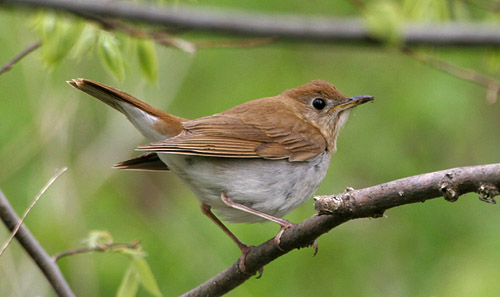
As I checked the nest boxes at Creasey Mahan on Friday, I heard a very unexpected song - that of the Veery. A tawny thrush of damp deciduous forests, the Veery is the least spotted of all the American spotted thrushes and one of the easiest to identify, mostly because of its song. It breeds along the Canadian border, and winters in South America, so you have to catch it in migration around here.


Due to the unique breathing capabilities of birds, the Veery sings a duet with himself! In this video, you won't see the bird (not unusual), and the sound of a squeaky swing is in fact a squeaky swing. But keep listening till the end for the eerie duet of the Veery.
         

Indigo Buntings were abundant at the Falls of the Ohio yesterday. Two of them defended territories next to the deck, and would gang up to chase a third male who dared come too close!


This guy just sang louder to be heard over the wind and the noise of big waves on the Ohio River below him.


Of course, not all birds have melodic songs. Cedar Waxwings travel in flocks, and love mulberries when they turn ripe. However, they sound more like high pitched buzzing insects than birds, so watch closely for movement in the branches.


Meadowlarks are usually seen before they are heard. Even if you see them, their backs are brown and well camouflaged. Only when it turns around will you see the bright yellow breast with a black ascot.


I monitor the nest boxes at Creasey Mahan Nature Preserve twice every week. In other years, the Tree Swallows claimed a box next to the Field House, but this year the House Sparrows got there first. Not to be discouraged, they moved to another box by the maintenance building, but this box was destroyed by predators. House Sparrows again, I suspect. Finally, they chose a box on the driveway. Last week, she refused to leave the nest when I opened the door. This time, she gave me the evil eye, warning me away, before she finally flew off. I counted 5 little white eggs, nestled in the feathers lining the nest. She's a good mom who doesn't give up!

Sunday, April 29, 2012

Natural Bridge, Natural Wildflowers

The last two weeks of April are Derby Festival in Louisville, but Dick and I decided to head for the hills instead. Natural Bridge State Park and the Kentucky Native Plant Society hosted their 31st annual Wildflower Weekend, and since we had not been to Natural Bridge and the Red River Gorge for several years, we decided to go. Of course, our friend Tavia Cathcart, Executive Director at Creasey Mahan Nature Preserve, was the keynote speaker for Saturday evening, which encouraged us to come here rather than the Smokies. All the spring wildflowers are blooming about three weeks earlier than in most years, so we weren't sure how many flowers would be seen during the weekend, but boy, were we surprised! I don't keep an official life list of wildflowers (although I should probably start one), but I would have added at least 23 new species this weekend! I was amazed that things like trillium and ginger were still blooming, though not in great abundance.

The orchids were the most exciting to find. Just like some of the best birds are found while standing in the parking lot, some of the nicest orchids were growing right next to the main trail going up to the bridge itself. We saw large orchids, such as this beautiful yellow Lady's Slipper...


 and showy orchis within 3-4 feet of the pathway.


The pink Lady's slipper was much more elusive though, and we risked tripping on roots and rocks in the path to scan both sides of the hill for them.


Typically, I envision orchids as large and elaborate, the big flower you wear at the prom. But many orchids are small and inconspicuous, if not downright invisible! This spring coralroot is an orchid, and the closer I stood to get a photo of the minute blossoms, the harder it was to focus.


The birds sang all day, from Carolina Wrens who sounded like they were using amplifiers, to three little Ruby-throated Hummingbirds dive bombing each other at the feeder. I often thought the same Hooded Warbler was following us around, since we heard one no matter where we hiked, along with many other unseen warblers. If I hadn't studied bird song for many years, I could only have claimed 5 or 6 species actually seen. But then a larger bird flew through the trees and sat where I could find it in the binoculars. The most wonderful Wood Thrush just sat and posed for at least 5 minutes! All his relatives or rivals had serenaded us, but this one came out to take a bow!


He showed each profile, then turned so we could see his warm cinnamon brown back and pink legs. This bird certainly made up for all my disappointment with the other birds that stayed in hiding!


Each of the Kentucky State Parks has a dining room with a view, and they hang bird feeders by the windows for the entertainment of the diners. As always, the gray squirrels show off their acrobatics chasing each other up and down the trees, jumping on the feeders, and hogging all the seed. We met a couple who have attended 30 of these wildflower weekends at Natural Bridge and they gave us a tip. "Come back this evening, when the dining room is closed and darkened," they said. "The flying squirrels come then to get their share of the sunflower seeds." We gingerly shined a flashlight to be sure they were present, and the small noctural squirrels weren't disturbed at all.  I got brave and turned on my camera flash, and that didn't bother them either, so I got some marvelous photos of  their shining eyes and sleek skin folds they use to fly! Every few minutes, you would see a faint glimpse of something in the air - another flying squirrel. I've never seen them in the wild before, so it was truly exciting, and I passed the tip along to a little girl in the lobby the next day. Hope she was able to see some.

If you have never been to/heard of Natural Bridge before, look into it. The Red River shaped the Red River Gorge much as the Colorado River shaped the Grand Canyon. Over millions of years, the river cut and left quite impressive rock formations, also known as arches. In the Red River Gorge there are an estimated one-hundred fifty (150) arches, a number surpassed only by Arches National Park in Utah.To reach them, you hike through deep thickets of rhododendron and hemlocks which may be lost to the wooly adelgid in my lifetime. It's like the glaciers - you should try to see them while you can. The rhodies aren't in bloom yet, but on top of the ridges, the mountain laurel are ready to put on a show. They often grow in a crack of the rock out into nothingness. But look at the delicate landing pads they provide for pollinators. Actually, Tavia's presentation was about the tricky ways flowers attract pollinators, so I now appreciate these more than ever.