Saturday, June 22, 2019

Acadia by Land and by Sea

Percheron Team

The Carriage Roads and stone bridges in Acadia National Park were financed and directed by philanthropist John D. Rockefeller, Jr., between 1913 and 1940, for hikers, bikers, horseback riders and carriages. The network includes 57 miles of woodland roads free of motor vehicles, of which 45 miles are within Acadia National Park .
A team of Percheron draft horses pulled us through the park. One trip even goes to the top of the mountain on strictly horsepower. They stand 16 hands or over, and weight about 1,900 pounds each.  If the two horses that are pulling together have trained with one another and have worked together before, they can’t just pull three times as much working together as they can by themselves.  The two trained horses in tandem can actually pull 32,000 pounds, which is a load four times as heavy as either of the horses could pull by themselves. Teamwork counts!
Percherons can be black, gray, chestnut, bay, roan, and sorrel. French-bred Percherons are born black and then turn gray as they mature; no other color is allowed in the registry. They were originally bred to carry knights into battle in that heavy armor. Our driver said these horses were 8 years old (I think) and would not change to a lighter color, although they had some grey ones back at the barn.
Carriage Road Foundation
You may notice that many of the roads are built on a steep slope, yet the road surface is flat. A “hands on” type of project manager, John D. Rockefeller, Jr., paid close attention to the smallest of details in the road’s construction as well as the landscaping. Granite from Hall Quarry on Mount Desert Island was quarried and transported by the construction crews for road material and bridge facing. Native vegetation such as fern and wild blueberries was tastefully used throughout to landscape the roadside, and shade trees were planted at good places to rest the horses. During this whole process, he even knew, and kept track of, the names of the laborers, running his own private CCC in the 1930s. By the time the project was finished, he not only had financed and supervised the roads, but 16 of the 17 stone faced bridges on the island that can be seen crossing streams, roads, waterfalls, and even a cliff side. The foundation is built without any mortar between the stones, so water can percolate through them and run safely down the hill when it rains.
Thunder Hole
While making the round trip on the Park Road, we didn't stop often for any serious hiking, but there were attractions along the road itself that caught our eyes, especially one called Thunder Hole. I took lots and lots of photos trying to catch the biggest amount of spray and the waves broke over the rocks on the shoreline.
Thunder Hole is a small inlet, naturally carved out of the rocks, where the waves roll into. At the end of this inlet, down low, is a small cavern where, when the rush of the wave arrives, air and water is forced out like a clap of distant thunder. Water may spout as high as 40 feet with a thunderous roar! Hence the name: Thunder Hole.  There are guard rails to keep people from being swept away (which has happened) during rough weather. And everyone squeals when they get wet. Watch out for the algae and other slippery things growing on the sidewalks and steps.
Friendship Schooner Alice E
After flying in an old airplane, we wanted to going sailing. The Alice E was built in 1899 and is the oldest Friendship Sloop sailing today, carrying up to six passengers. Her builder and exact location are a mystery but they know that she was built somewhere near Friendship, Maine. Alice E. was first used as a working lobster boat. It does have a motor now, for maneuvering around the harbor...
...but as soon as we left the harbor, we raised sail and Dick got some lessons on steering a sailboat. People still live on Great Cranberry Island, and the kids have to be ferried to bigger MDI to catch a school bus each day.
Bear Island Lighthouse
All the lighthouses we saw on MDI were short. I always think of them as tall, like those in North Carolina. The difference, I heard, is that these lighthouses are built on cliffs to begin with, so they are naturally elevated. Even though they are still operative, it's all automatic.
Bald Eagle
We saw plenty of birds on our trip, and some porpoises...
Osprey Nest Southwest Harbor
...and even an Osprey nest on the navigation sign, the best place to build according to Ospreys. However, the voyage was three hours long, and all the islands looked the same, so I would have been happy with a somewhat shorter trip.

Friday, June 21, 2019

Into the Park

Acadia was first established as Sieur de Monts National Monument in July 1916 by President Woodrow Wilson but then was changed to Lafayette National Park in February 1919 when it became the first national park east of the Mississippi. It was not until January 1929 that it officially was named Acadia National Park. The story we heard was that some ladies were going to donate more land, but didn't want to give anything to the French, and that's why it was changed to Acadia National Park. Apparently they did not know that Arcadia was a French colony to begin with. I couldn't resist putting in the map of MDI to give some perspective. The green is the park, and the dark black is the park loop road. The road is one-way along the southeast side of the island, but two way through the interior.
Sand Beach
Maine is noted for its rocky coast, and this is the only sand beach to be found anywhere. Even though the water is really cold, tourists couldn't resist going to the beach. I bet they only got their toes wet then came right back out.
Here's where the one way roads prove to be a good idea. There are incredible views all along this coast, so you are allowed to park in the right lane of the road and walk along the crest. Occasionally there are smaller paths like the one we took to eat lunch with a view. In the height of the tourist season, they have to close the park road to traffic. What a way to spoil your vacation! They have shuttles then to take you around the park, but I'm sure the buses get caught in traffic jams too. My advice - if you go to Acadia, make it in early June!
Birch trail
The first place we stopped was Sieur de Monts Spring. It has a springhouse and the Abbe Museum, which we didn't see, because we headed for the Nature Center immediately. The Wild Garden has more than 300 native species which are labeled to make identification easy. They are grouped in nine separate habitat areas, and we were enthralled! We learned that there are several different species of birch, and it was hard to distinguish them from the alder, and occasionally the aspen. I never did get a handle on the difference between the spruce and fir trees.
Yellow Lady's Slipper
Maine's spring season is 6-8 weeks behind us in Kentucky, so many early wildflowers were still blooming. I gasped aloud when we walked past this enormous cluster of Yellow Lady's Slippers.
Bunchberry
Bog Laurel
Star Flower

Columbine
Wildflowers are like birds, only easier to photograph since they don't fly away. We were delighted to find familiar plants, but just as happy to identify something new. The Bunchberrys look like dogwood trees growing low to the ground, and blueberries come in three sizes of bushes - short, medium and tall. The little Star Flower grows everywhere, and the garden keepers don't even bother to label it. I've never seen a flower with seven petals on the blossom before! Hmm, the internet says that Star Flowers can be found in Kentucky. The blossoms resembling Mountain Laurel were in fact Bog Laurel.
Interrupted Fern
Maine ferns are everywhere, and I always wished I could take a class about them. We recognized many of the larger ferns - Cinamon, Royal, Ostrich- but the Interrupted Fern was really unusual. It grew green fronds on the botton, but they turned brown with spores in the middle, then green again at the top. The smaller ferns were harder to distinguish.

Wednesday, June 19, 2019

Bar Harbor

Glacial Eratic Rock on Beach
Acadia National Park has always been on my bucket list for national parks, and I am so glad we got to spend a few days exploring the area. First, I did not realize that it is a 47,000-acre Atlantic coast recreation area primarily on Maine's Mount Desert Island, and everyone pronounces the name of the island differently. The island itself is quite large, and the park takes up roughly half of it. As a rock nerd, the first think I noticed was all the glacial formations and the beautiful Maine granite. This is going to be great! But let's talk about Bar Harbor first.
Bar Harbor Harbor
As we came down the eastern side of the island on Route 3 to our hotel, the road was under construction and only the lane going in to town was open. Everyone who checked in (including me) panicked. How will we reach the hotel again if the road doesn't go back north!! The hotel clerk said it had been like that for over a year. And the ENTIRE Visitor's Center for the park was closed. Any other park would have brought in a trailer and set up someplace to answer visitor's questions, so strike one against this park. :(  The road situation was taken care of by a detour from downtown Bar Harbor through the park, where we could re-enter Route 3 southbound towards our hotel, much like using the bypass around Gatlinburg in the Smokies. 
Bar Harbor Mansion now a hotel
Bar Harbor reminded me of Newport, RI in many ways. By the 1880's, the rich and famous tried to outdo each other with entertaining and estates, often hiring landscape gardener and landscape architect Beatrix Farrand, a resident at local Reef Point Estate, to design their gardens. A glimpse of their lifestyles was available from the Shore Path, a walkway skirting waterfront lawns.
Walking across sand bar in Bar Harbor
There actually is a sand bar at low tide from the harbor to Bar Harbor Island which you can walk across, but be careful to check the tides first and give yourself enough time to get back before the tide comes back in, or you may have a long stay on the island.
Cruise Ships
The downtown area of Bar Harbor isn't very large, and parking is very limited. The parking meters on the street take credit cards, so I guess they would just charge you if you were late in getting back- $2.00 per hour. Everything is expensive - restaurants, hotels, you name it. I couldn't believe it when we saw two huge passenger cruise ships in the harbor, accompanied by two smaller cruisers on one day. The town, cognizant of the street congestion that the passengers cause, has capped the daily number of visitors who can come ashore — 3,500 in summer, 5,500 in spring and fall. YIKES! Thank goodness we arrived before the "season" actually began and didn't get caught in any traffic jams. During the season, there is a shuttle service to take you through the park, since the traffic is so bad, but it wasn't operating yet, and we had no trouble.
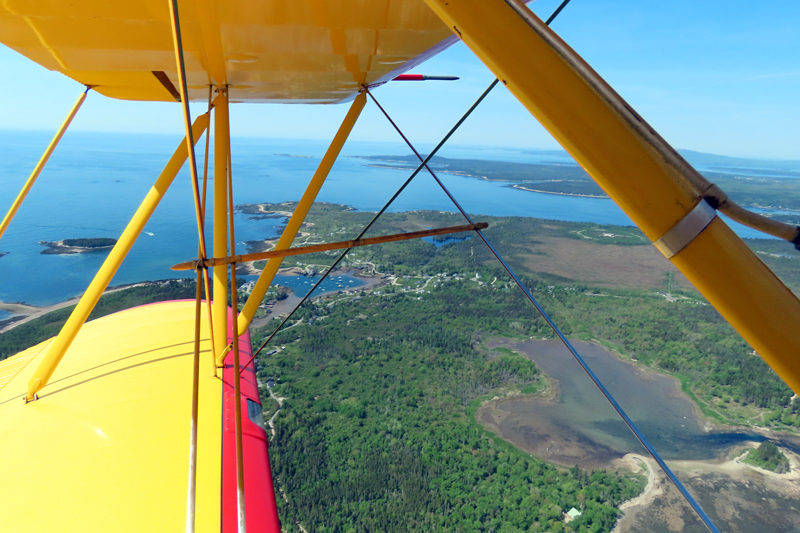
Waco biplane
We enjoyed our airplane tour around Kauai in Hawaii last year, that we decided to try it again. Only this time we found a bright yellow biplane to ride in. 
View from above
At a speed of only 80 mph, the trip was leisurely with plenty of photo opportunities on the side of the plane where you sat. They asked if either of us were over 300 pounds in weight. Ha! The two of us had a hard time getting both legs inside the front cockpit! I think it was designed for younger more agile people. Next post...Acadia National Park.

Sunday, June 16, 2019

Coastal Maine Botanical Garden

Apple Blossoms
Bird Camp closed right after breakfast on Friday morning, so we loaded up the car and headed down the coast to Boothbay, ME, home of the Coastal Maine Botanical Gardens. Our friends, Tavia and Matt Brown, visit Maine each fall, and this garden was first on their list of "must see" places for our trip.
Map of Gardens
Several things impressed us on arrival. First, all the buildings were top notch new buildings. The visitor center itself only opened in 2018. We couldn't find our Bernheim Forest membership cards, but they looked in the book and admitted us on reciprocity. Very nice of them.
Lenten Rose
 In 1991 a small group of MidCoast residents dreamed of building a world-class public garden on 148 acres of rocky coastal forest that would one day be both an economic engine and cultural anchor for the region. They mortgaged their own homes as collateral, and approached other people with money to fund their dream, so after 16 years of planning, the Gardens opened officially in the summer of 2007. The Gardens comprises 295 acres, 17 of which are gardens and forests featuring native plants of Maine and other plants suited to northern coastal conditions. Over 200,000 guests from throughout the United States and 63 foreign countries visited CMBG in 2018.
Rhododendron Garden Waterfall
 While waiting for the next docent tour, we visited the rhododendron garden, which was in full bloom. They run big golf carts around the grounds to help visitors move from place to place (while avoiding mosquitoes).
I took far more photos of these beautiful plants than I can post here.

Sensory Garden Labyrinth
One section of the garden was designed for a friend of the founders who was blind, I believe. The sensory garden can be enjoyed by touch, sound, and scent. There is even a stone labyrinth- walk barefoot and you can always keep on the path.
Children's Garden


Library and playhouse
My favorite garden was the Children's Garden, modeled after classic children's stories, which, I regret to say, I did not recognize for the most part. I kept thinking that Tavia would love to set up something like this at Creasey Mahan Nature Preserve, if she could come up with the funding and more staff to keep it up.


Magnolia Warbler
The Maine sections of the garden were a little more on the wild side, but still cultivated, and not always labeled with the names of the flowers. Very enjoyable though.
They were in the process of digging up tulips, which were mostly done blooming, and replacing them with perennials. We wondered what they would do with the tulip bulbs and the docent said they give or throw them away.
Artwork of all sorts graced the garden as well. Many pieces were made of Maine granite, of course, but my favorite was this kinetic piece which acted like a windmill.  When the wind blew, the shiny metal pieces began to twirl, and the whole thing rotated to catch the wind.

Saturday, June 15, 2019

More Maine Birds

Black Capped Chickadee
At Bird Camp, you not only look for birds, you learn HOW to find them! Pete Dunne's best advice - watch for movement. Your eyes are hard wired to notice movement, and you will never find a bird in a tree by sweeping your binoculars back and forth. Pete also gave us the short course on pishing, after all he wrote the book on it, litteraly- https://www.amazon.com/Art-Pishing-Attract-Birds-Mimicking/dp/0811732959.  But of course, little birds such as warblers and chickadees in particular, are experts a avoiding being seen, so I feel pretty proud of photographing this little Black Capped Chickadee at all! We also learned a lot about bird songs and calls, and the difference between them.
Downy Woodpecker

Hairy Woodpecker
When the other half of our group of campers headed to Egg Rock Island for Puffins, we boarded two vans to go for land birds in a nearby neighborhood. We found both Hairy and Downy Woodpeckers tending to their chicks. Although we saw rectangular Pileated Woodpecker holes in many trees, we did not see or hear the bird.
Gray Catbird
Common Yellowthroat
Yellow Warbler
Red-winged Blackbird
 A pond hosted a muskrat den and hundred of birds, with the Red-winged Blackbirds making the most noise of course.
Tree Swallow
Tree Swallows zipped overhead catching insects, and occasionally landed for a while to look around.
Cedar Waxwings
I always think of Cedar Waxwings as berry eaters, which they are, but in early spring there aren't many berries around to eat. We watched Waxwings eating the blossoms on apple trees! They must have been going for the nectar in them, and they were quite numerous.
Boblink
Bobolink in flight
For lunch we headed to the Great Salt Bay Farm, near Damariscotta, to look for grasslands birds, including BOBOLINKS! This was only the second time I've ever seen them, and it was a real thrill. The male mates with several females, who build their nests in the grass. The males perch on the tops of grass and sing loudly to defend their territories!
Eastern Bluebird
We looked around the pond for a rumored Virginia Rail and Sora. I heard the Sora, but did not find it when we reached the pond itself. We also heard Marsh Wrens, with only a quick glance as they flew from one clump of reeds to another. The Bluebird, however, was dazzling as he brought bugs to his next box.
Fish Ladder
Our final stop of the afternoon was at the fish ladder. Yes, it's designed to let the alewives (Yep, the name of the fish) climb upstream into fresh water to spawn, but it also catches them at certain times of day. Apparently this is a Maine tradition.
Black-crowned Night Herons
Two Black-crowned Night Herons perched hopefully in the trees above the fish ladder. I'm sure they eventually got their share too.
Baltimore Oriole
A Baltimore Oriole and his mate built a woven nest that was practically invisible in the leaves, but he sang on a nearby branch to protect it, and to guide birders to the right tree to find it.
Bald Eagle calling
As we approached the boat dock to return to Hog Island, we heard a pair of Bald Eagles in the tree overlooking the water. We have seen many eagles, and their numbers are no longer threatened. In fact, many local people say they are beginning to be a nuisance, often preferring to grab chicks from their nests rather than hunting for fish.
Listen to Pete Dunne pishing to call in some birds...