I understand that it's a sign of old age when you start conversations with "I remember when..." although I suppose that's better than "I don't exactly remember..." I volunteered at the Falls of the Ohio State Park from 2003-2009, and enjoyed every minute. I learned the history of this area, the geology, the river, the birds and flowers, and much more. It's always a pleasure to go back down there and see what's going on. Some of the trees on the river bank have washed away, no surprise there.
Great Blue Heron at boat ramp
The river has been high for many months, and it shoots out from the McAlpin Dam with great strength. Thus, none of the wading birds can fish there on the fossil beds. We found herons and egrets circling around looking for a safe place to land.
Black Vultures on power tower
Black Vulture
Turkey Vulture
I learned to appreciate vultures while standing on the deck at the Falls of the Ohio. Dead fish would wash ashore, and the vultures took care of the mess. The Blacks found a beach ball one day and played soccer with it. They always waited until the sun was up long enough to create thermals before leaving their roosts in the morning. Smart birds.
Brown -tailed UPS bird
Of course, the biggest bird there is the UPS bird. They were on a strange landing path coming upstream from the west before turning to land in Kentucky. Very noisy birds.
Goose Family
Apparently Canada Geese will adopt other goslings. This family had about 9, but they were two different ages and sizes. Didn't seem to matter as they paraded around at the cabin.
Osprey nest
Ever since 2003, or before maybe, there have been Ospreys nesting on the river. One of the power towers on Shippingport Island hosts cell phone transmission antennas, and the Ospreys always build their nest on it. Since the birds are protected, they stay there, but each fall the phone company tears it down. Doesn't discourage the birds though. I don't know if this is the same pair from so long ago. And I've always wondered why we don't see more of them on the river, since they are supposed to return to the area where they grew up when it's time to breed.
Groundhog
We noticed one groundhog in someone's yard as we walked down the levy (risking our lives from the bikers speeding along). One the way back the whole family was enjoying the sun and clover, with four of them visible!
Yellow-billed Cuckoo
I went for years and years without seeing a cuckoo, and now I've found them three times in about two weeks!
Cedar Waxwing
We heard that the serviceberry bushes at the Falls were full of berries, and drove over to look for Cedar Waxwings, which are berry eaters. They must have eaten all the ripe serviceberries yesterday, and we only saw red (unripe) berries and no birds. However, as we neared the cabin, there is a great big mulberry tree and it was full of both berries and birds, making our day! Somehow, Cedar Waxwings always look they they have been painted with water colors, their different colors blend so smoothly into each other. Then they must dip the end of their tails into a bucket of bright yellow paint.
Spring has been so indecisive this year. One day the sun shines and temps are in the 60s or 70s, and the next day a cold front sweeps through, leaving heavy rain and/or snow, with temps back in the 30s. Events scheduled for Saturdays have been hit hard, having been changed twice because of predicted rain all day on Saturdays. This week, we have had a couple days of warm, but very windy weather, so I decided to go out. Local birders are reporting some rare species coming through our area, and I wanted to see if I could find any of them.
Song Sparrow
Beckley Creek Park is a favorite birding spot along Floyd's Fork river, and birders have found several Virginia Rails in the wetlands. I joined a group of people already there, and although I didn't see the Rail yesterday, I did find a Wilson's Snipe all by myself. Yeah! Mostly I found Song Sparrows and Red-winged Blackbirds.
American Kestrel
The raptors enjoyed the clear skies, and I saw many Turkey Vultures, a Red-tailed Hawk, and a fast little American Kestrel. Maybe I'll try for the Rail again tomorrow.
Sora
The Sora is a member of the rail family too, passing through Kentucky on its way to Canada where it breeds after spending the winter along the Gulf Coast. This one is using the bird observation area at the Falls of the Ohio State Park, just across the river, as a resting spot. It is sheltered from observation, except for people inside the building. There is a little pond and rocks to shelter in. So far, it seems pretty happy there.
Nesting Bald Eagle
4 or 5 years ago, when they started building a bridge across the Ohio River at the eastern edge of the county, an existing Eagle nest was found right by the construction area. Will all the activity affect it? They couldn't really move the planned bridge, so they just started building. Now the bridge is complete, and the birds seem unaffected. She seems to be counting the cars as they zoom beneath her tree.
The river has flooded again in the last week, after the huge floods in March, so people are trying to ge things cleared up. The gates on the McAlpin Dam are still lifted allowing the water to flow through as fast as possible. Debris clogs the sidewalks leading down to the fossil beds at the Falls of the Ohio, but that's not too much of an issue yet, since the fossil beds themselves are still under water. Management at the state park don't hurry to clear away debris in the spring since it can reappear so quickly.
The river is still high and so muddy that it looks like milk chocolate rather than water!
The Kentucky Derby is the first Saturday in May, and the party starts two weeks before the race itself. This year it's starting even earlier since someone erected this giant ferris wheel within the ramp of the Big Four Bridge. The Bridge attracts huge numbers of people wanting to walk across the river. The ferris wheel will be here until after Derby. As soon as there is a nice evening with a good sunset, we plan to go down and ride it too!
Here is the little Sora enjoying an algae snack from the pond.
A few weeks ago, I noticed I wasn't receiving notices from the KY Bird List. Inquiries revealed that it's dropping people randomly, and I should just re-subscribe. Good thing, or I would have missed the notice about Willets and American Avocets at the Falls of the Ohio. A cold front moved through the night before, and all sorts of birds were showing up. The Avocets breed in the northern plains area and winter in the Southwest. Every few years, however, some show up in the shallow water below the dam at the Falls of the Ohio. My friend was there with his good scope and had already located them (which I would have had trouble doing on my own) and we saw about eight of them yesterday afternoon. By evening, another birder said she also found a flotilla of 58 more birds swimming in the deeper water behind the dam! You just never know what's going to turn up at the Falls! But it takes time and persistence to find something good, because there's no predicting what will show up while you stand there.
Willets - digiscoped
I'm used to seeing Willets when we go to the beach, but I think it's the first time they have shown up here. They too breed in the northern plain-southern Canada area, wintering along the Gulf and Atlantic shores. Again, they were all perched on the same rock, at least half a mile away from our observation point. If Tom hadn't found them first, I might have missed them altogether. Would you have know what they were without someone telling you? Granted, the scope alone gives a better view.
Blue-Gray Gnatcatcher
Then I wandered down the Woodland Trail, since Tom's wife was down there with the warblers coming through on migration. The Falls of the Ohio State Park does not have a lot of acres, but it is the only patch of woods and shallow water for far around. I call it a green oasis in a jungle of asphalt. As I joined her, we were surrounded by more birds calling than I have ever heard there! Hooded Warblers, Yellow Warblers, Yellow Throated Warblers, Northern Parulas, Gnatcatchers, Baltimore and Orchard Orioles, and may I didn't recognize at all. We played the call for the Yellow Warbler who was certainly perched just above our heads from the sound of him, but could not entice him to come down and play. Same for the Parula. The buzzy little Gnatcatchers were so busy hunting caterpillars, it was hard to focus on them before they jumped to the next branch.
Summer Tanager
I got lucky with an otherwise silent Summer Tanager. Cardinals are very common at the Falls, and I had to look two or three times to be sure this was my nemesis bird, and it was. Hooray!
Warbling Vireo
One other bird came briefly into view, a little larger than many of the others. Colleen confirmed this as a Warbling Vireo, a life bird for me. Hooray again! But no more than 10 minutes after entering migration heaven, the sun came out, the clouds blew off, and it got real quiet in the woods. The Yellow Warbler and Parula still called, but the large variety of song stopped.
Bald Eagle Nest - Shippingport Island - digiscoped
Well, since I'm here anyway, might as well run down to see if I can find the Eagle nest on Shippingport Island. The island is in the middle of the river, and the nest must be close to a mile away from shore. When I first looked, I got lucky, since the male was sitting on a branch nearby, and I spotted him and the nest. Another birder says he's seen two little fuzzy heads a couple times. but he has telescopic eyeballs as well as a good scope! By the time I got my phone lined up for a photo through the scope, the male had moved off. Can you see the nest? That dark blob in the middle? In a few more days, the leaves will cover it entirely. The first year or two that this pair tried to nest, they failed, but I never heard any guesses why. This must be the third successful nesting at least. Pretty cool to have them right in the urban area.
The last few days have been pretty birdy for me. Thursday evening the volunteers at the Falls of the Ohio met for a sunset get-together. As the temperatures dropped, it became very pleasant. Of course, I was busy trying convince everyone of the virtues of vultures! As they soared overhead, two Turkey Vultures gave a demonstration of precision formation flying vulture-style. Those great big wings never run into the next bird.
Kettle of Circling Vultures
Large groups of both Turkey and Black Vultures circled around. Maybe they were hunting for supper, and maybe they were just looking for a good roosting spot for the night. The trees lining the Ohio River at the Falls may host up to 25-30 vultures each for the night. Who needs Motel 6? The guys with good spotting scopes also found a Snowy Egret fishing in the shallow water, while both of our Bald Eagles perched on the dam. My eagle expert friends say you can't see the nest at all now for all the leaves, but earlier they found 2 eaglets, which should be ready to fledge any day now. We'll have to keep an eye out for all dark eagles who don't quite have the knack of flying yet.
Kentucky Warbler
Today we joined the Beckham Bird Club for a trip to Jefferson Memorial Forest. Dick volunteers there all the time, but seldom has an opportunity to go birding. Barbara is especially good at knowing her bird calls, which is important under the forest canopy. We were delighted with the warblers we saw/heard today, including this little Kentucky Warbler, who finally came out of hiding. The Hooded Warbler was shy and did not leave the bushes to greet us.
Common Yellowthroat
A Common Yellowthroat (another warbler) hopped out to give us the eye when we played his call. Who's that in MY territory? he seemed to be saying. A yellow Pine Warbler lived up to his name, warbling from the pine trees, but too far away for a photo.
Worm-eating Warbler
Most exciting though, was finding two birds to add to my life list. At first I thought this Worm-eating Warbler was a Carolina Wren, since I just got a glimpse of him among the dead leaves where he hunted for, you guessed it, worms. Lots of warblers eat worms and caterpillars. I wonder how this one got stuck with the name? I didn't get a photo myself, and borrowed this one from the Internet. Closer examination (a challenging task given the unceasing activity of this bird) shows that he has lots of stripes on his head. He jumped around our position, calling and searching in the dead leaves for about 5-10 minutes -- a terrific performance for our morning.
Summer Tanager
The triumph for me was actually seeing this Summer Tanager. I've often heard this distinctive picky-tucky-tuck call in the forest, but never could track it down. This one sat in the relative open of a nearby tree, waiting patiently for me to take as many photos as I could. The Birding By Ear CD says this bird sounds like a robin that has taken voice lessons. It's cousin the Scarlet Tanager has black wings, and sings like a robin with a sore throat. The field guide says the Summer Tanager is a more southern bird. Anyway, I've been trying to find one for years, and was delighted to increase my life list today! Keep seeking, and eventually ye shall find!
I confess that I started blogging to show off my bird photos when I got some good ones. I am a birder who is binocular challenged. That is, I have trouble actually finding a bird to watch, and have been reluctant to lead bird walks when asked. To compensate, I listen faithfully to the CD's of birdsong, reviewing even familiar songs every spring. If I hear the bird, I want to know what I'm looking for. Frankly, the song may be all I can find most of the time. So when a bird that usually eludes me comes out of the leaves, I get really excited.
The bright orange Baltimore Oriole is one of my favorites, and a challenge for the ear birder. The Peterson Birding by Ear CD's give 4 examples of its song, which sound nothing like one another! The narrator doesn't come out and say so, but I've concluded that each Oriole sings a completely different song than all other Orioles. I've learned not to pay attention to the "tune", but listen to the "tone" - a rich whistle - of this bird. And just when you have followed it, circled around under the right tree, peering up into the leaves, it silently flies to a nearby tree and starts singing there. Sometimes I think they do it on purpose! If you whistle part of the song back, they get curious and sneak a peak. That's the time to have your camera ready!
I watched an Oriole at the Falls of the Ohio jumping around in the leaves, then followed it to the next tree where it climbed into its down hanging nest. It was silent since the females don't sing.
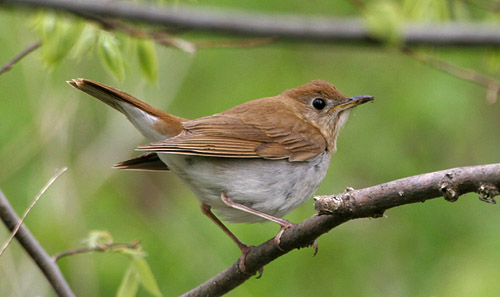
As I checked the nest boxes at Creasey Mahan on Friday, I heard a very unexpected song - that of the Veery. A tawny thrush of damp deciduous forests, the Veery is the least spotted of all the American spotted thrushes and one of the easiest to identify, mostly because of its song. It breeds along the Canadian border, and winters in South America, so you have to catch it in migration around here.
Due to the unique breathing capabilities of birds, the Veery sings a duet with himself! In this video, you won't see the bird (not unusual), and the sound of a squeaky swing is in fact a squeaky swing. But keep listening till the end for the eerie duet of the Veery.
Indigo Buntings were abundant at the Falls of the Ohio yesterday. Two of them defended territories next to the deck, and would gang up to chase a third male who dared come too close!
This guy just sang louder to be heard over the wind and the noise of big waves on the Ohio River below him.
Of course, not all birds have melodic songs. Cedar Waxwings travel in flocks, and love mulberries when they turn ripe. However, they sound more like high pitched buzzing insects than birds, so watch closely for movement in the branches.
Meadowlarks are usually seen before they are heard. Even if you see them, their backs are brown and well camouflaged. Only when it turns around will you see the bright yellow breast with a black ascot.
I monitor the nest boxes at Creasey Mahan Nature Preserve twice every week. In other years, the Tree Swallows claimed a box next to the Field House, but this year the House Sparrows got there first. Not to be discouraged, they moved to another box by the maintenance building, but this box was destroyed by predators. House Sparrows again, I suspect. Finally, they chose a box on the driveway. Last week, she refused to leave the nest when I opened the door. This time, she gave me the evil eye, warning me away, before she finally flew off. I counted 5 little white eggs, nestled in the feathers lining the nest. She's a good mom who doesn't give up!
I haven't posted anything for a while, and can't really remember what I've been doing to inhibit posting. This week we went to an evening program at the Falls and I didn't take my camera, which is always a mistake, even if you plan to go immediately into the building.
Saturday was a beautiful afternoon though, so I got a second chance to record the sunset. I love watching the changing colors. The river is very high since it rained several day last week all though the Ohio Valley. The weather service thinks we could set a new record for annual rainfall in 2011. When the sun goes down though, the river turns from muddy brown to silver.
The first part of the renovation at the Interpretive Center is complete, and visible through the window as you drive into the park.
In addition to being beautiful, the glass sculptures all have meaning as well, but I haven't learned all those details yet. Someday....
You can enjoy the sunset directly or indirectly reflected in the large observation windows.
Geese circled overhead, honking as they searched for a quiet spot to spend the night...
...while Lewis and Clark commemorate their beginnings in the Louisville area with a handshake...
...and the city skyline sparkles as night falls. All this and I still made it home by 6:30!