Tuesday, August 17, 2010

Butterflies Galore

Variegated Fritillary
This Saturday will be the second annual Butterfly Open House at Creasey Mahan Nature Preserve, and what a difference a year makes! Last year, Tavia and I chased through a field, trying unsuccessfully to catch some butterflies for the event. The children had better luck, but we still only had a small number. This year, we won't really need to catch butterflies to put in the netted pavilion at all. We can just walk out to two different butterfly gardens, and see dozens of them at once!

Red Spotted Purple

In the cool morning (the first "cool" anything we've had for weeks), I walked down Mahan Lane, the main trail, startled when clouds of butterflies rose around my feet. In delight, I noticed that they were feeding on the wild cherries lying on the ground rotting. Wild cherry is the host plant for the Red Spotted Purple butterfly, and I understand why so many were around.

Viceroy

After taking pictures, I decided to put them into a Flash file for the Creasey Mahan website. Enjoy!

Tawny Emperor
The field guide I used described the Emperors, both Tawny and Hackberry, as "pugnacious," an odd adjective for butterflies, I thought. They aren't afraid of people, and don't hesitate to land on us looking for minerals on our skin. I think they laugh when they tickle us while walking around.

Red Admiral - top

Many butterflies close their wings when they land, so it can be difficult to identify them from the bottoms only, let alone get a good photo. The wing bottoms usually bear little or no resemblance to the tops, and not all field guides give pictures of both.

Red Admiral - bottom Eastern Comma - top Eastern Comma - bottom
Common Buckeye - top
Common Buckeye - bottom
I wonder why there seem to be so many more butterflies this year than previous years. Something about the hot weather? More butterfly gardens? Simply being more aware of them, now that I'm in the nature business? Whatever the reason, they are absolutely gorgeous!

Friday, August 13, 2010

Peregrine Falcon Release

I've volunteered at Raptor Rehab of Kentucky, Inc. for a little over a year now. This is the first time I've attended a release, and it was a real thrill. This is Pe Fa 113 (Pe Fa is short for Peregrine Falcon, of course.) She was found near a restaurant on the Ohio River in June, and brought to us for rehabilitation. The same pair of Falcons have nested on the Big Four Bridge across the river for quite a few years. If a bird falls out of the nest, there is nothing beneath but water. We treated her, and put her in a flight cage to build up her wing strength. She even got live pigeons for food sometime so we were sure she knew how to catch her prey. Now she is on the way to the Kenneth Coleman Station - a Big Rivers Electric power station near Hawesville, KY, about an hour and a half downstream from Louisville. Kate Heyden, Avian Biologist for the Ky. Dept. of Fish and Wildlife, will be there to band the bird, and complete the release. Fish and Wildlife is placing nesting boxes in various locations around the state to either attract wild birds, or place Falcons from rehabilitation. Since this is a juvenile Falcon, she doesn't have a territory of her own to return to, making her a prime candidate for this new box.
I was pleased to see the interest shown by the plant employees. Many of them joined us for the banding, and then followed us out into the blistering heat to watch what she did when released. She is a high energy bird, and wanted to fly off as soon as John Wicker (RROKI co-director) removed her from the travel crate.
Kate explained the banding process. This Falcon's information will be entered in a database, accessible should she be caught in the future.
John held the bird firmly while Kate applied loose bands on both legs....
...but she let us know in no uncertain terms what she thought about it.
John took her around for all the plant personnel to see up close. Believe me, I was not the only person clicking away in that room! This will be "their" falcon, and everyone wanted to take a good look.
In order to keep her calm while she was transferred to the box, Kate put a falconer's hood on her....
...but she wiggled out of it in no time at all, then turned to glare up and bite Kate's Visitor's tag to express her displeasure.
When you look at some of the Falcon cams, you find nesting boxes installed on the roof of a tall building. This time, the nest box is installed in the side of a tall building, to re-produce the cliff ambiance, safe from both above and below, accessible only by wing. Of course, there is a door inside the building to the box, so future banders don't have to ride up in a crane to band chicks born there. Luckily, we did not have to climb up several stories with Kate, and moved around to the other side for a better view.
Here is the building from where we stood...not close at all, but at least we found a spot in some shade! Look at the top of the blue building, on the right side and you can see a small something sticking out of the wall. That is the entrance to the box, with perches for convenience. We waited, and sweated, and tried to keep focused on that small box, waay up there. Be ready, we said. When that door opens, she'll shoot out of there so fast, there will only be one chance for a photo.
Well, the door opened, and she came out to sit on the perch, looking around to see what's going on. Anything above? She seemed very interested in the sky, but did not see the Kestrel flying on the other side of the same building.
OK, the wings are stretching. Get ready now!
Here it comes! She's going to fly! Click on the photo to enlarge it, and you can see the bands on her legs. But after a good stretch, she remembered that Kate left a nice fat quail in the box, and decided to go back in for lunch. We stood there for a while, and finally decided it was time for our lunch too. While we were a little disappointed not to see her flying, it was a good sign that she felt comfortable enough to eat. I'm sure she took an aerial tour of the plant after a little after lunch nap! Good Luck to you, Pe Fa 113.

Tuesday, August 03, 2010

Life in the Raw

Saturday afternoon we visited some friends who own 140+ acres in nearby Shelby County, KY. Portia is a natural plant landscaper, and President of the local chapter of Wild Ones, while her husband is part of the Louisville Metro Parks system- both real nature professionals. Although they reside in a house in town, they live at this property, and I can certainly see why. They have planted much of it in native grasses and wildflowers, along with frog ponds and wetlands. The rest is moist forest, perfect habitat for Barred Owls and Red Shouldered Hawks. We walked and drove around for hours having a wonderful time. Portia blithely rattled off the Latin names for every plant we passed, and I couldn't remember even half of the English versions I pressed her for, but she was patient with me nonetheless.
Insects, of course, play a vital part in this ecology, with bees, dragonflies and butterflies of many varieties flitting about. The bees are particularly hard workers, as evidenced by the gigantic pollen saddlebags on this guy, err girl.
Jerry mentioned something about giant bee killing insects, when we came upon this dramatic scene. Since this predator was concentrating on dinner, it paid us no attention. The meal wiggled her legs a bit, but had no chance of escape. I'm glad I couldn't hear her screaming.
I looked for this insect under wasps or hornets with no luck. Tavia thought it might be a fly instead, and we found the ID there -- a Robber Fly (efferia). It's about 2" long, and definitely a killer. I don't know what robbery might have been going on here, but it changed into felony murder, if not premeditated murder pretty quickly. Today Portia emailed me, "Sunday morning we discovered a mating pair right where we had set up to work on the roof; still attached they flew away just long enough for Jerry to ascend their special rung on the ladder. Later in the day we discovered a single bee killer/robber fly on the sidewalk a few feet away. A group of ants were devouring the fly for dinner. So I guess what goes around comes around again."
Even when the sun set peacefully, we knew that Nature would proceed during the night as it had all day long, with each creature finding and consuming the food it needed. Life in the raw...
It's Tuesday, and I spent the day at Creasey Mahan Nature Preserve, as usual. We needed some new photos, so I hiked around for about and hour and a half. I saw a bird atop one of the Bluebird boxes, and from a distance thought it was a fledgling Bluebird. As I approached, it turned out to be an adult male Bluebird that was BALD! I've seen this condition in other wild birds, and heard that it was feather mites. Poor guy! I hope he can make it till winter and the mites will die then. I am concerned though, since there are newly hatched babies in this box. Katdoc sent this link http://www.hiltonpond.org/ThisWeek030701.html to an article by Bill Hilton about bird mites like this.
Tavia replanted a big meadow with native flowers and grasses last year, but evil Johnson Grass has taken over much of the area. She mowed it all down again, and may have to reseed. One flower variety is new to me though, and I hope it survives. This is a Passion Flower. Not like True Love, but as in religious Passion. To the priests traveling with Spanish Conquistadors, the 3 styles and stigmas in the center represented nails, the 5 stamens beneath them were Christ's wounds, the fringe was the crown of thorns, and the 10 petals and sepals behind the fringe were the apostles, except for Judas and Peter.** Whew! That's a lot to read into one flower!
It is a vine, and host plant for the Gulf and Variegated Fritillary butterflies. Medicinal use of this herb began in the late 19th century in the United States, especially for treatment of anxiety resulting from mental worry or overwork. I'd say many people need to grow this one in their gardens! The fruit is edible, Tavia says, but this one isn't ripe yet. It's not what you know, it's who you know!

**Wildflowers of Tennessee the Ohio Valley and the Southern Appalachians, co-authored by Tavia Cathcart. It's so fun know a real author!

Sunday, August 01, 2010

Women Imaging Women

Our friend Debra Lott, the Artist, opened her new exhibit this weekend at Pyro Gallery on historic West Market Street, in Louisville, Kentucky. We always enjoy her work, which provokes feelings on my part, as well as thought. The first exhibit we saw is shared in my Viewpoint posting. Her canvases are 72 inches tall (that's 6 feet) and you gain a different perspective by moving closer and farther away.
In this exhibit called "Women Imaging Women," Debbie focuses on mothers and daughters, including a series of paintings called "Dreams of My Daughter," a visual interpretation of her daughter's graphic descriptions of lucid dreams. I don't remember ever discussing my dreams with my mother, but Debbie does a wonderful job understanding her daughter. In this one, her daughter has the common dream about falling or flying, which everyone has from time to time.
In "Deep Sea Dreams," exotic fish swim in and out of reality, forming the pillow and sheets of the dreamer. Click on the picture to enlarge it a bit. Can you see the fish?
My favorite is one called "Blue Heron Dreams," where once again Great Blue Herons can be found surrounding the dreamer if you look just right. Here is the full image...
...followed by a focus on the girl's head...
...with a closeup of the Heron in the sheets. In this piece, Debbie says, the Herons indicate disappointment, worry and nagging problems. These creatures point to situations that the dreamer refuses to confront, and those that are causing fear and insecurity. Movie makers commonly make dream scenes, all blurry and moving, but Debbie worked harder, I think, to capture a moving dream on canvas. Wow, sounds like she studied more than art in school! http://www.debralott.com/ explains her views on her art in a terrific video. Check it out!
Another artist at the exhibit is Betty Levy, who works with fabric. She followed the genealogy of 100 women in her family back to 1840, free stitching their names on antique linen handkerchiefs, then arranging them on the wall as a family tree. Her family came from Poland and Lithuania, so she sometimes had trouble finding the names, and embroidered those handkerchiefs as "Unknown Glazer" for one branch of the tree.
Betty shared her thoughts about this work with us, and I was truly moved. Thanks to Debbie and Betty for sharing themselves with all of us through this exhibit. It would be a frightening thing to put your feelings out for everyone to look at in a gallery.

I sometimes think about how little I know about my own family and background. My father was involved with his family genealogy, and we teased him that he had 200 years of dead relatives in his computer. But I was never really interested in too many of the details, which disappointed him. One set of my grandparents came from Vanceburg, KY, but I couldn't tell you anything more than that about them, even though I spent a week or two with them every summer as a child. James Michener is one of my favorite authors, and the continuity he draws for a family or region always strikes me. What will my grandchildren learn about us, when they are born? I've done nothing famous, or even particularly interesting. This area of the Ohio River Valley was so pivotal to the development of the entire country, yet the personal details are mostly hidden or forgotten. I would like to work with a historian on the Creasey Mahan Nature Preserve property. Even though I'm not related to any of the people, I would like to have some connection to their stories. Is this a sign that I'm getting old?

Sunday, July 25, 2010

Good Old Summer Dragonflies

Widow Skimmer
It's a typical summer day in the Ohio Valley. One of those 90-90 days, where the temperature and the humidity levels are both at 90. What sounds like the most fun thing you could do on a day like this? Swimming? Sailing at the lake? Sit in the shade with an icy glass of tea? Or, best yet, just stay inside with the air conditioning?
Common Whitetail Female
We chose option E: None of the Above, and went hunting for dragonflies at Blackacre Nature Preserve instead. A biologist from the Kentucky Nature Preserves Commission led about 10 sweating enthusiasts down to the sunny pond to hunt for dragonflies and damselflies. The Nature Preserves Commission works to preserve areas of biodiversity in the state, and Blackacre is one of their partners. The dragonflies love bright sunshine, so let's hurry before it clouds over, he urged.
Green Darter
Although I listened to his discussion, I was so busy trying to photograph these insect raptors, I didn't always catch his identifications. Or, I couldn't see the insect at all in the first place. So if anyone sees any errors here, let me know. This Green Darter is in the "obelisk" position. By raising its tail into a vertical position, it reduces the amount of heat being absorbed from the sunlight. Pretty smart, isn't it?
Slaty Skimmer
Some dragonflies are perch potatoes, while others zoom around so fast I can hardly see them, let alone identify them. These Slaty Skimmers stayed perched on one branch for many minutes. We saw a Wandering Glider, which can sometimes be found hundreds of miles at sea. They migrate north to breed, then the young migrate back south again.
Halloween Pennant
The Halloween Pennant likes to "tee up" on the tips of grasses or cattails. It has really cool little red spots called "stigma" on its wings.
Green Darner Female
As in birds, the female may bear very little resemblance to the male of the species. In fact, the males are so determined to mate with every female they can as often as possible, we learned that the females sometimes have to go hide in the bushes to get away from them. In some species the male can remove the sperm of the previous male to breed with the female, so he has to guard her carefully while she lays her eggs to be assured of fatherhood.
Ebony Neon Damselfly
Damselflies are quite a bit smaller and less active than the dragonflies we saw. The male Ebony Neon is just that - ebony wings and a blue/green iridescent body. The female has white tips on her black wings, and her body isn't as shiny. I knew the damselfly folds its wings when it lands, but I always thought they only had two wings to begin with. Now I know they have four wings of the same size that overlap when folded.
Ebony Neon Damselfly Female
Blue Dasher
The dragonfly scientists only started giving common names recently, but the descriptions are so accurate most of the time. Dashers, Dancers, Skimmers, Gliders, Cruisers, Darners - lots of names with verbs in them. Or else they wanted to compete with Santa's reindeer!
We found one empty shell called an "exuviae" left behind when the larvae emerges as an adult. Unlike butterflies, these dragonflies will molt and shed their exoskeletons 8 to 17 times before reaching adulthood.
At least the dragonflies were large enough to see easily. This little damselfly was only about an inch long, and just about invisible with its wings folded.
We enjoyed the mid-summer flowers as we hiked back to the pond. Queen Anne's Lace attracted this ant too.
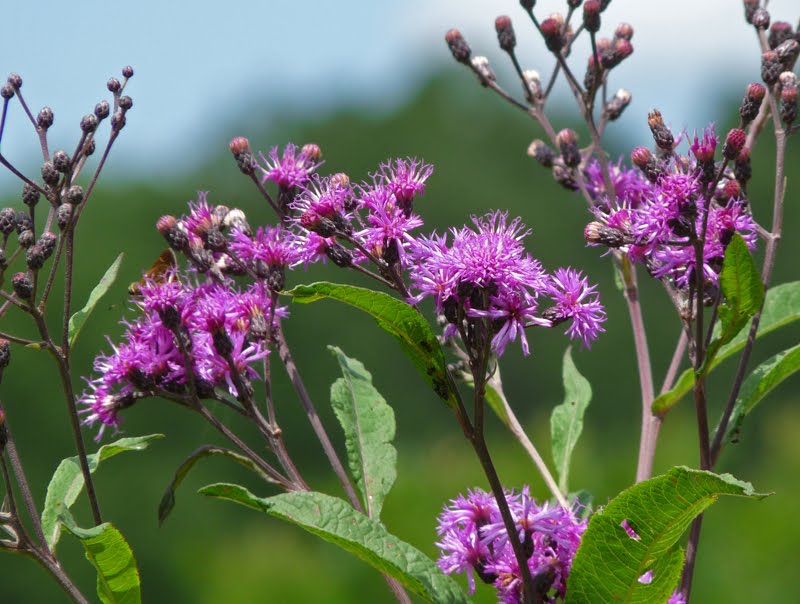
And the iron weed is starting to bloom, while the Bob Whites called from the meadow. When we finished with dragonflies, we started to go for them, but when they didn't respond to my whistles, we decided we were too hot and thirsty to hunt for them this afternoon. Maybe another time....

By the way, have any of you bloggers out there started using the new templates, etc offered by Blogger? I looked at some of it and didn't see an option to upload pictures from my hard drive, only from Picasa or a URL. The template designs looked pretty nice though.