Saturday, October 22, 2016

Back in Destin Again

How surprised I was when Dick said were in Destin as recently as 2013. We have traveled to so many places since then, it seems like a much longer time. As we drove around today, many places looked familiar.


Monarch butterflies are still on their way to Mexico, but most of the bright orange butterflies are Gulf fritillaries and some of my favorites. Starting in late summer and continuing through fall, huge numbers of adults migrate southward into peninsular Florida. Adults overwinter in frost-free portions of their range. The Gulf fritillary produces multiple generations each year. Adults may be found in all months of the year throughout much of Florida. Females lay the small yellow eggs singly on or near leaves, stems or tendrils of purple passionflower which the larvae devour upon hatching.

Forster's Tern
Laughing Gull Winter Plumage

Royal Tern
Ruddy Turnstone
Sandwich Tern
 
The sun was blindingly bright, making it hard to adjust to squinting in the light to looking through a small view scope on the camera, even when shaded by my hat. We saw the gulls and terns I normally expect this time of year in Florida, but no Willets and no Ring-billed Gulls. Hmmm. The Sandwich Terns have obviously been eating mustard with their sandwiches again!

Several Great Blue Herons waded in the clear shallow water below the Ft. Walton Pier. One caught several fish, but moved too quickly for me to catch at it with the camera. Raptors have 14 neck bones, and I wondered how many neck vertebra herons have to stretch and coil their necks. Hidden by skin and neck feathers, the extra bones double back on themselves, giving the resting neck its characteristic “S” shape. They are also the force behind the lethal bill. As expected, the neck bones begin at the back of the great blue’s skull. A short way down the neck, a remarkable thing happens. The neck vertebrae switch places with the trachea and esophagus. The neck bones are now in the front and the vulnerable food and wind pipes are behind them. As the neck gets closer to the body, its internal arrangement returns to a normal configuration with the bones in the back. Couldn't find anything confirming how many bones they have though.


For $2.00 you can walk out on the pier. Only the Yankees, I told Dick, would sit in swim suits on a windy chilly day such as this morning. The local fisher people on the pier were dressed in warm jackets and hats. The local birds know to hang around and someone will throw a fish on the deck eventually. Of course, the pigeons don't care much for fish.

From the pier we saw shapes in the water, and tried to determine what they were. Fish? Jelly fish? Trash? One round dark spot appeared to be swimming, and eventually stuck its head into the air - a turtle! Several other long dark spots swimming along surfaced and we got our first view of dolphins, without paying someone to go out in a boat to look for them!
Pyramid of Giza on the beach
 One beach goer was either a good artist or an Egyptian architect. We found him working on the great pyramid of Giza right here in Ft. Walton Beach.

 
I'm sure some wave theory in physics explains the water wave and the waves in the sand as well. A website from Scientific American says, "The most accepted explanation is that the flow of the overlying fluid (water or air) interacts with the moving sediment grains in a manner that results in a stable shape, or bedform. The specific shape therefore depends on the density and viscosity of the fluid, its speed above the sand and the nature of the sediment (that is, its characteristic size, shape and density)." I'm just as happy to appreciate them without having to explain how they are formed. Of course, they didn't mention footprints of people walking back to the boardwalk.!

Thursday, October 06, 2016

Back at Beckley Creek Park

After a day of slaving over a hot laptop to catch up on many emails and other computer tasks I've put off for many weeks, my Fitbit showed only 1,700 steps for the day. Oh my, that will not do! This morning a report came through the KY Birdlist that a Sora had been sighted at Beckley Creek Park, so that became our destination for our daily walk. The sun is setting much earlier now, but the temperature was perfect.
At the Grand Allee wetlands, we searched the edge of the lake which was filled with lily pads and duck weed. The mutt ducks swam around laughing at their own jokes. A single Pie Billed Grebe dove down into the weeds. But we saw no Sora.
The fall offers many sightings not found in the other months. This small entirely black wooly worm scurried across the gravel path. It must feel like I would when hiking over a pile of boulders. Ouch! What do they say about wooly worms and the weather? Folklore says that thin brown bands on the woolly worms means a harsh winter is coming, wider brown banded woolly worms mean a mild winter,  nearly black woolly worms means a severe winter is coming, and finally the very light brown or white woolly worms mean a snowy winter according to the folklore. I just saw a projection on the Weather Channel today that we may have heavy snowfall this winter. Brr.
Jimson Weed
Datura stramonium, known by the common names Jimson weed or Devil's snare, is a plant in the nightshade family. It is believed to have originated in Mexico, but has now become naturalized in many other regions. In America it is called the 'Devil's Apple,' from its dangerous qualities and the remarkable effects that follow its administration. When the first settlers arrived in Virginia, some ate the leaves of this plant and experienced such strange and unpleasant effects that the colonists (so we are told) gave it this name by which it is still known in the United States. It is also known very commonly there by the name of 'Jamestown (or Jimson) Weed,' derived probably from its having been first observed in the neighborhood of that old settlement in Virginia.  Also known as Thornapple, in early times, it was considered an aid to the incantation of witches, and during the time of the witch and wizard mania in England, it was unlucky for anyone to grow it in his garden. 
aka Thornapple
It is considered highly poisonous, but parts are used for medicinal purposes. Browsing animals as a rule refuse to eat Thornapple, being repelled by its disagreeable odour and nauseous taste, so that its presence is not really dangerous to any of our domestic cattle. Among human beings the greater number of accidents have occurred among children, who have eaten the halfripe seeds which have a sweetish taste.

Red Sumac is a joy in the autumn, both the leaves and the tiny red berries. Sumacs look edible and toxic at the same time, and with good reason: They’re in a family that has plants we eat and plants that can make you ill. The seeds of the sumac have tannic acid in them. Putting the berries in boiling water will release the tannic acid. It can make a tea but it can quickly become too bitter to drink. To make an ade, use one to two cup of berries per quart of water. I prefer two cups and less water.  The “bobs” of berries can be cut off and dried for later use.
Jewelweed
When you are out in the field and find you have been exposed to poison ivy, oak, or stinging nettle you can reach for the jewelweed plant and slice the stem, then rub its juicy inside on exposed parts. This will promptly ease irritation and usually prevents breakout for most people. Hummingbirds love to drink from the small orange or yellow flowers.
aka Touch Me Not
When the seed pods are ripe, the slightest touch will make them explode. The pod itself curls up providing an the power to spread the seeds for next year.
When we walked at Beckley last time, we saw large "flocks" of Monarch butterflies on migration to Mexico. The majority of Monarchs have passed through, but one or two fluttered tiredly across the fields. This guy landed in the grass, then moved a few feet away to feast on a pile of dog poo. Ah, all those good minerals! This may give it the strength to continue his journey south. Good luck your majesty!

Wednesday, September 14, 2016

Beckley Butterflies


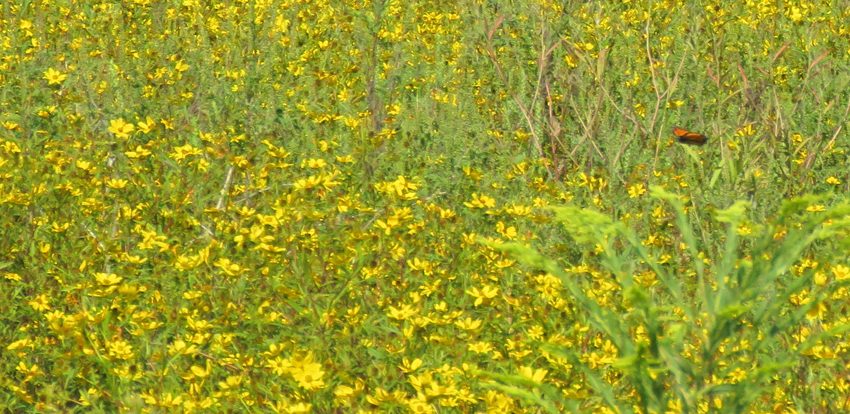
Golden Meadow
 It was a beautiful morning, not too hot, so we decided to walk at Beckley Creek Park. What a great decision that was! Everything was golden. All the gold wildflowers were blooming, under the clear blue sky.
Orange Jewelweed
 Along Floyd's Fork we saw both orange and yellow jewelweed blooming in the shade.
Lobelia
 Occasionally, a little spot of blue or purple poked its head up through the gold flowers.
Monarch Butterfly
But the most amazing thing we saw were the scores of Monarch butterflies, landing on golden flowers, or dancing in circles with each other. The Monarch numbers have been so small because of chemicals, then the big snow storm in Mexico at the wintering location. I haven't seen more than a few all summer, despite the milkweed we planted.
Monarch Caterpillar
We found one little Monarch Caterpillar painfully crawling across the gravel, in the hot sunshine. Following the box turtle rule, we gently picked him up and moved him to the grass in the direction he was crawling. 
Monarch in flight
When a Monarch lands on a flower, it instantly folds its wings, while it takes a sip of nectar. No matter how many burst shots I took, I could not get one with it's wings open. I was getting dizzy turning in circles as I tried to find and focus on flying Monarchs. Yep, getting a shot of one in flight would be serendipity. Look carefully. Do you see a Monarch in flight in this shot?

Monarch
Spotted Silver Skipper
Hackberry Emperor
Buckeye Butterfly
Actually, I saw more different kinds of butterflies today, than I have seen in many years. This Buckeye is the first in at least 4 years.


Saturday, September 10, 2016

10 Years Blogging

 
Sneezeweed
 I can't believe it! I have been blogging, off and on, for over TEN YEARS! Sometimes I get lucky and my photos are really good, and other times, they are a bit fuzzy, but they are a record of some cool bird I saw today. I always say that one of God's greatest gifts is the gift of forgetfulness.  Just imagine what your life would be like if you remembered every single thing you had ever seen or done. You wouldn't have time to see or do anything new! Photographs, and this blog, help me remember the good times, while the rest slips away.
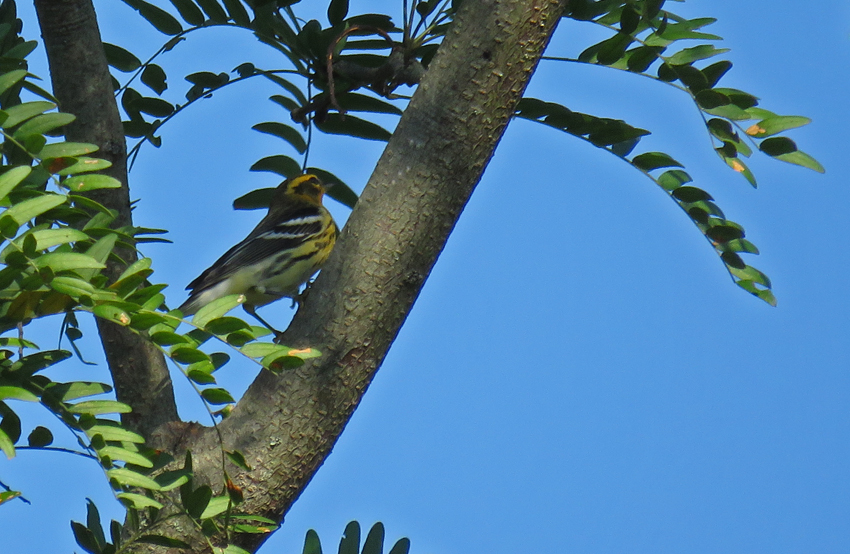
Blackburnian Warbler
I started birding about the same time. In fact, I wanted to use the blog to help prove which birds I had actually seen. This morning, I joined the Beckham Bird Club on our annual Breakfast with the Birds outing. We went to Turkey Run, one of the newly opened areas of the The Parklands. This year we started our Green Breakfast, with everyone bringing their own eating and drinking utensils so we didn't have to throw anything away. Going out with a group of experienced birders is always a benefit to me. On my own, I may hear birds, recognize the song but not be able to find the bird in the trees. Or I see it, do not recognize the song and am left in great frustration. This morning, I kept saying, "How in the world did he see that bird?"
Blackburnian Warbler
Warblers are my great nemesis. Today, Pat, Jane and Rob found Blackburnian, Hooded, Black and White Warblers, and maybe some others I don't remember. Sigh.
Scarlet Tanager Female
Then, of course, there are the juvenile and females that don't look like what I expect, since I always picture the male featured in the field guide. Yes, indeedy, you need to learn the females, juveniles, and males in winter plumage, along with the trees they might be perched in.
Do you see a bird?
We kept hearing White-eyed Vireos calling to each other as we walked down the trail, but they are skulkers and dart quickly from tree to tree to avoid being seen. Rob is our expert on bird calls. We finally found this one and I actually saw it in binoculars. Birders have to be patient, and my friends are always willing to work with any birder who hasn't seen the current attraction.
White-eyed Vireo
I always say that bird photography is an act of faith. You have to find the bird with binocs, then find it in your camera lens, then focus and click, all before it moves to the next branch. Well, 3 out of 4 isn't bad. This guy is a little out of focus, but it's the first photo I've ever taken of a White-eyed Vireo, so I'm content. I like to learn mnemonics to help me remember a call. Found Spit and see if I care. Spit! and Quick, give me a rain check! for this one.
Turkey Vulture
The Turkey Vulture is one of my favorite birds because it's large enough to be easily seen, and doesn't hide in the tree branches, but flies right out in the open for good photographs!
Ripe Persimmons
Of course, if the birds aren't cooperating, I always like to take photos of the plants. They, at least, aren't going to fly away!

Tuesday, August 02, 2016

Aspens on the Trail
On our last full day of exploration, we decided to head up to Summit Lake, having seen an article praising its beauty. The road turned to dirt quickly, and as we went higher and higher, the rocks and ruts got bigger an bigger. Even though we had a Jeep that could handle it, when we saw the sign saying "4 more miles to Summit Lake," we decided to turn around and head back down to Dry Lake. A passing Forest Service ranger told us where to find the trailhead, and we strolled between the aspens, into the soft loam under the conifer forest, then out into areas of exposed rocks. This trail had more variety of habitat than any we have seen this week. But it was not at all marked so you knew where to go.

Fire-fighting Helicopter
The views were wonderful, as always. A large helicopter made several trips overhead, and we later learned that it was fighting a forest fire in nearby Wyoming.
All week, we have seen hundreds of thousands of dead pine trees, victims of the pine bark beetle and it's deathly fungus. Sometimes the patterns drilled by the beetles are very beautiful. People in town are taking the holey wood and making furniture with it.
We crossed over several clear creeks, tumbling down to the Yampa River below. Under the spruce trees, the ground was so soft and loamy it felt like you were sinking into marshmallows.

Dusky Grouse
Finally found our one and only life bird for the trip - a Dusky Grouse. They look like big brown chickens, and are reputed to be the dumbest bird around. They stand still and think they are invisible!
Mountain Chickadee
Red-tailed Hawk Soaring Overhead
 Other birds were a little harder to find. Both Black-capped and Mountain Chickadees flicked around in the conifers, joined by little Red-breasted Nuthatches. All three chirp and cheep, but stay in the shadows and inner branches.
Bracken Jungle
We haven't seen many ferns in these mountains, but found ourselves pushing through 5 foot tall brackens today. They covered the trail, grabbing at our feet. We needed machetes, but only had hiking sticks to cut our way out.
Black and White Moth
Ah, here's a different little butterfly, I thought. When going through the photos in the evening, I found it had feathery little antennae - the sign of a moth, rather than a butterfly.
Colorado Summer
With the help of some experienced hikers, we finally returned to the car. Thank Goodness! Did you know that your cell phone can give your exact coordinates and elevation, as well as compass directions? I'll always remember the beautiful Colorado blue skies!