Vernal pools, also called vernal ponds or ephemeral pools, are temporary pools of water that provide habitat for distinctive plants and animals. They are considered to be a distinctive type of wetland usually without fish, thus allowing the safe development of young amphibian and insects unable to withstand competition or predation by fish. I was surprised not to hear any frogs.
Hays Kennedy Park in Prospect, KY, has a prime example of vernal pools. The long narrow pool is quite shallow. They are called vernal pools because they are often, but not necessarily, at their maximum depth in the spring ("vernal" meaning of, relating to, or occurring in the spring) and by summer, only a few frog puddles will remain.. Vernal pools may form in forests, but they are more typically associated with grasslands. While many vernal pools are only a few meters in width, playas and prairie potholes are usually much larger, but are still otherwise similar in many respects, with high water in wet periods, followed by dry conditions.
The pool usually hosts dabbling ducks such as Mallards, Northern Shovelers and Bluewinged Teal. Last year a pair of Red Necked Phalaropes found this pool, so you don't assume that nothing exciting ever happens here. In March, when we had a slight warm spell, you could hardly walk along the pool for all the goose poo on the banks. I never knew that teals make a peeping cheeping kind of sound. They sounded like baby chicks!
Meadow Larks sing on the other side of the water, but they usually hide down in the grass.
Between snow showers yesterday, the sun came out occasionally, highlighting all the crab apple trees in bloom. They grow so close together, you can tell they haven't been planted by anyone.
At least I think they are crab apples. Don't Bradford pears escape to the wild sometimes? I sank down into the squishy mud, hiding at the base of the trees. This is a very wet place in the spring.
But the only wild flowers would be considered weeds, such as this Dead Red Nettle...
...and the first Garlic Mustard of the season. Poison Hemlock is sprouting right behind the Garlic Mustard. Ah well, this is an easy stop on my way home from Creasey Mahan Nature Preserve, well worth the walk on the wet side.
I subscribe to the 4 F's of bird
photography; Find 'em and Focus
Fast before they Fly away!
Wednesday, April 16, 2014
Monday, April 14, 2014
More Spring Adventures at Bernheim Forest
![]() |
| Eastern Meadowlark |
![]() |
| Red-tailed Hawk |
![]() |
| Bloodroot |
![]() |
| Yellow Trout Lily with Green Pollinator |
On this sunny afternoon, all the flowers were completely open, and the pollinators were busy, busy, busy. I always enjoy seeing the variety of pollinators, including different bees, beetles and flies. The tiny Pussy-toes were full of eensy-weensy little flies.
![]() |
| White Violets |
Wren suggested I look around the Sun and Shade Trail, near the headwaters of Lake Nevin for more flowers. In the mowed areas, the ground was purple and white with Common Violets and White Violets.
![]() |
| Magnolia Blossom |
![]() |
| Twinleaf |
Only 30 minutes away from Louisville, Bernheim Forest is such a wonderful resource, both in their people, programs and natural resources. I am so glad to to be part of it!
Saturday, April 05, 2014
Early Wildflowers
After spending the morning at Bernheim Forest with my grandson and son-in-law, I got home and turned right around to head out again. They have white trout lily in one particular spot there, and if you delay going, you will miss them altogether.
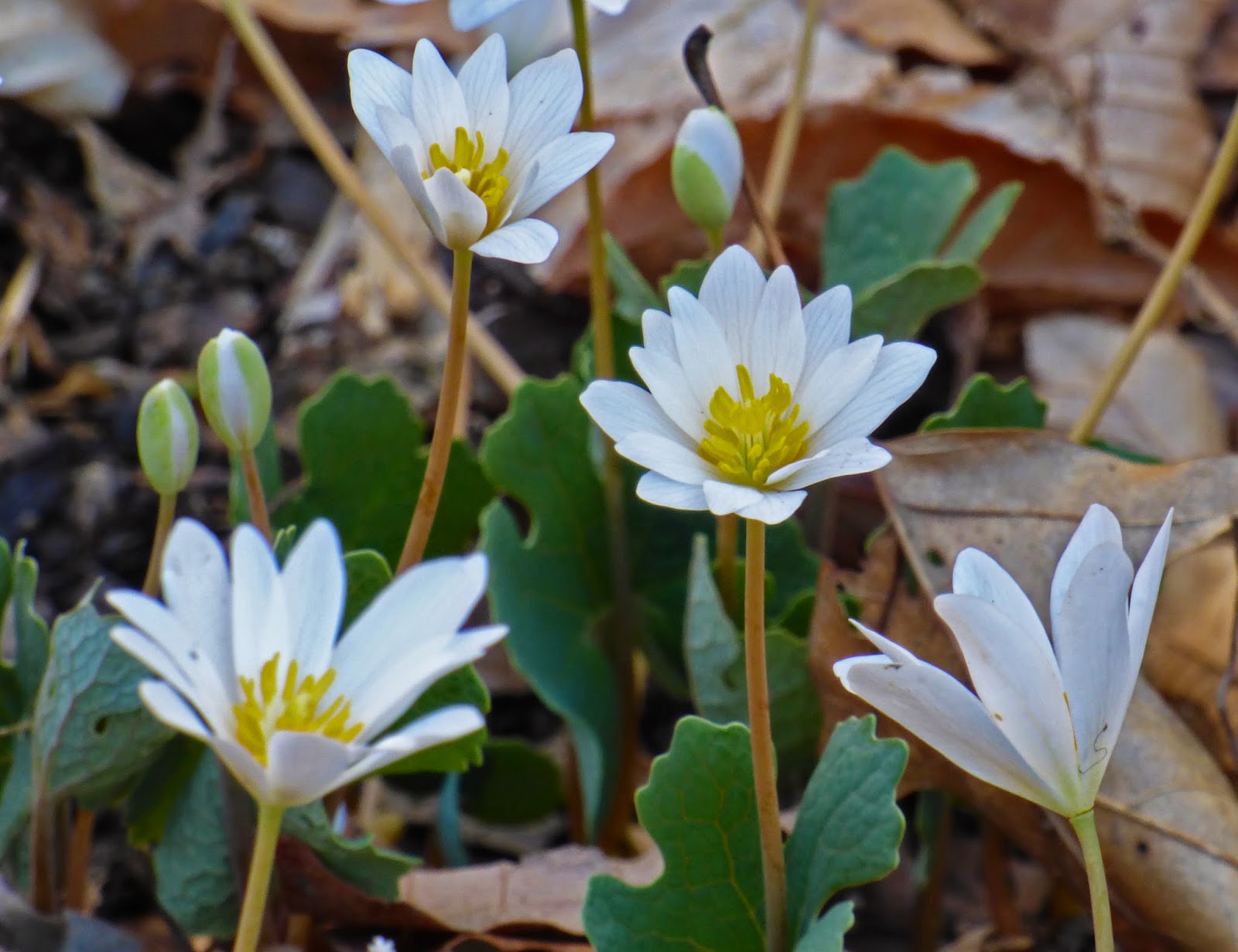
Then, of course, are the delicate white bloodroots. They pop up in the embrace of a leaf, and the delicate blossoms only last a day.
There will be more of most of these species in the next few weeks, plus many others, but the first I see in the season are always extra special
Then, of course, are the delicate white bloodroots. They pop up in the embrace of a leaf, and the delicate blossoms only last a day.
Rue anemone, swaying with each small breath of wind...
...and toothwort just starting to blossom.There will be more of most of these species in the next few weeks, plus many others, but the first I see in the season are always extra special
Saturday, March 22, 2014
Spring Serenade
![]() |
| Horned Grebe |
Louisville's newest park is called The Parklands of Floyds Fork, and will eventually connect five parks including hiking and biking trails, playgrounds, and restored wetlands, along many miles of Floyd's Fork. The Fork itself is 62 miles long, not quite enough to be classified as a river, but a wonderful place to canoe and explore. The eastern part of Jefferson County is quickly being overrun by development, and this park will help to save some of it at least.
Friday, March 21, 2014
Meadowlark Morning
I love the sound of Meadowlarks, and they were everywhere this morning. One flew across the road before us, so we got out and played their call on my phone app to see if we could get a good look at him. He dashed out of the grass, over our heads, and into a tall tree where he could get a good look around for competitors.
We casually walked his way, still playing the call from time to time. He eyed us from above, and eventually flew down, circled once, then dropped back into the grass. No fooling this guy! He knew exactly where that sound was coming from. Once he was sure we were no threat he got back down to whatever business was on hand for this morning. It was a real thrill for us to see him gleaming in the sun though!
Lots of other birds were enjoying the sunshine too. We saw more Blue Jays than any other bird I think, both calling "Jay Jay" and chasing each other around. I don't remember seeing so many of them at once, and thought they might be migrating, but the field guide said they are year-round residents in Kentucky. Someone had put a pile of dog food kibble on the ground and both Jays and Red-bellied Woodpeckers were taking advantage of the gift.
Cardinals chipped back and forth...
...while Grackles gave us the evil eye from overhead...
...and Red-winged Blackbirds called from almost every branch it seemed.
A pair of Red-shouldered Hawks circled each other, calling "Keer Keer", followed by a silent but majestic young Red-tailed Hawk up among the Turkey and Black Vultures.
Then a very unusual bird caught our attention. Instead of a "mottled" duck, this looked like a "model" duck - otherwise known as a model airplane with pontoons. The engine was quiet enough to not disturb the birds and we had fun watching it fly around. Tomorrow the temperatures should drop again, so I'm glad we got out there while the gettin' was good!
Sunday, March 16, 2014
March Lions and Lambs
![]() |
| Witchhazel |
![]() |
| Song Sparrow |
![]() |
| Eastern Bluebird |
![]() |
| Red Maple Blossoms |
The sky is blue and clear.
I run outdoors without a coat,
And spring is almost here.
Then before I know it,
Small clouds have blown together,
Till the sun just can't get through them,
And again, it's mitten weather.
Sunrise and sunset are close to twelves hours apart today, and the birds and plants seem to know that spring is here, and willing to take a chance on the weather. The early bloomers are out, and bees are looking for them. I, on the other hand, go out whenever the sun shines, and wrap up in my favorite blanket on days like today, when it is going to rain/sleet/snow once AGAIN! But I'm more than ready to have it be spring every day!
Sunday, March 09, 2014
Unusual Birds
![]() |
| Red-necked Grebe |
![]() |
| Red-necked Grebe and Canada Goose |
![]() |
| Grebe Diving |
![]() |
| Red Necked Phalarope |
![]() |
| Western Grebe |
Thursday, March 06, 2014
Happy Duck Dance!
![]() |
| Long-tailed Duck |
Are there birders out there who go it absolutely alone? If so, they must be very, very good, or very, very frustrated. If it weren't for my birder friends, and their postings of bird findings on the BirdKY email list, I would have a hard time finding many cool birds. Yesterday, one of them posted about birds at a location I've not been to before, which ends up being about an hour up the Ohio River from Louisville. So this morning, I stopped for coffee, and headed upstream.
![]() |
| Bald Eagle Nest |
I ran into him when I arrived, and he was amazed. "Where did all the gulls go?" We did find the Red-necked Grebes, but did not get a good picture of the female which was the only close bird. I stopped at the restaurant to use the Ladies' Room, still wearing my binoculars. A man at the bar asked if I'd seen the Bald Eagle that sometimes perches in a sycamore tree by the marina across the road. I thought that would be a good place for one too, but no, he hadn't shown up today. It's always interesting that binoculars or a spotting scope can prompt complete strangers to start conversations about birds. Even though they usually are not birders themselves, their interactions with birds seem to be important to them. However, as I started back towards Louisville, taking a scenic road along the river west of Carollton, KY, I did see a large blob of sticks in a bare tree. Fortunately, there was no traffic as I slowed to a crawl. OMG! There's a white blob in the dark blob! It's an Eagle nest, and she's sitting on it! I parked in the middle of the next small road, and carefully ran across to take some photos of her. A quick email to Kentucky's avian biologist in Frankfort confirmed that they know about this nest. It would have been cool though, to find a new one.
![]() |
| Common Merganser |
![]() |
| Common Goldeneye |
Eddie advised me to go upstream a bit to the Big Four Bridge. This bridge carried trains for many years, and has recently been converted to a pedestrian bridge, with great success to my surprise. Anyway, Eddie said he's seen some of these much sought after ducks close to the Indiana shore, just under the bridge. OK, I'll give it a try.
Indeed, how could anyone be a birder without the help of other birders? At last, with the help of my friends, I dance the Happy Duck Dance, and publish my photos of this rare (around here anyway) duck. When I got home, an email was waiting from another friend to go see the Woodcocks' mating display. Thank goodness it's tomorrow evening!
Thursday, February 27, 2014
Long-tail Ducks
With long-term ice all over the country, it seems, many sea ducks which would normally not come to the Ohio Valley have decided this isn't a bad place to spend the winter after all. At least the river hasn't frozen. It's been a birder's bonanza! The reports started weeks and weeks ago about Long-tail ducks being found on the Ohio River near downtown Louisville. When I realized this was not the brown and white duck I visualized (the Pintail), I started making trips to the river on a regular basis, whenever the sun came out. But, no luck for me. A friend went back in the late afternoon one day and said she saw it clearly.
On Monday morning, my friend Del called to say 8-9 of them had been sighted, so I hopped right in the car, morning toast in hand! Fortunately, I found Brainard when I arrived. He found the ducks as little specks with white heads in the middle of the river. With his assistance, I got some good looks with the spotting scope, but they were way too far away for any photos. I confess to borrowing these nice ones from the Internet.
Why would they be so hard to find? We've had a bit of a warm spell the last week or so, and all our snow has melted, along with quite a bit from upstream, apparently. The water levels are very high, and white caps form from wind and current. Most of the dark specks are logs and debris floating downstream. Do you see any ducks in this photo? Look very closely in the lower left, near the tree. You see what we are up against? From this point on the Indiana shore, it is about a mile across to the Kentucky side where the canal for barges comes out.The water is much calmer there, and it's a good place for birding.
The ducks swam along in a line, or rather they floated quickly down towards the dam. One by one, they dove down into the water looking for mussels. The Corps of Engineers only has to keep the navigation channel at nine feet deep, so it's not as deep as you would think here. These Long-tails can dive up to 30 feet. All four gates on the dam are completely out of the water, to keep the logs from jamming up. When the ducks got too close to the dam, they would take flight and go back upstream a bit, to start the process all over. I'll probably keep looking for them, just to see if I can get a photo of my own, but at least I've added them to my Life List!
Subscribe to:
Posts (Atom)