Showing posts with label Beckley Creek Park. Show all posts

Thursday, May 28, 2020

Back to Beckley Creek


Baltimore Oriole preening
Migration season appears to be winding down, if not over. Our birder friends are not posting about finding unusual birds anymore. We haven't been to Beckley Creek Park for a few weeks, and decided to head back that way. "Should we bird or walk?" my husband asked. If we see birds, we'll bird. If not we'll walk, I replied. A month ago, we saw lots of Baltimore Orioles, but this time only one called to us, and he was busy preening, squeezing out a drop of oil and spreading it on his feathers, and zipping them back together if needed. "No time for you birders to take nice pictures. You already have those," he said.
Blue Grosbeak
It's funny how I associate certain birds with certain locations. For example, the only place I recall ever seeing a Blue Grosbeak is here at Beckley Creek. But none this year, so far...
Blue Grosbeak - immature
 At first, we thought it was an Indigo Bunting. You can see how similar they can look. But look at the extra large beak on this one-thus the name "Gros" or large beak. An adult bird would be blue all over, except for the rust on the wings. This one isn't blue on his breast yet, and seems to be an immature bird.
Indigo Bunting
The Indigo Bunting is one of my favorite blue birds...

Eastern Bluebird

Is this a good pose?
But the Eastern Bluebird is the best at posing. He never tries to hide in the leaves and is glad to turn around so the sun shines on his brilliant blue back!
Yellow-breasted Chat
The Chat is a warbler, although you would hardly believe it to look at him. Much larger than most of them, and Chat must be short for "chatter." The sun had been ducking in and out of the clouds all morning, but this Chat must have ordered the sun just for me to take photos of him.

Lichens on tree

Lichens on tree
You might this this is the tropical jungles by all the different varieties of lichens growing on the trees. It looks like tree lettuce! I joked that a lichenologist (not knowing the scientific name) would have a great time studying just this one tree. Just looked it up, and they are called lichenologists! Ha!
Red-shouldered Hawk couple

Red-shouldered Hawk
Red-shouldered Hawks are always recognizable by their call - a loud keer, keeer, keeeer, that just goes on and on. The larger bird is the female, as with all raptors.
Turtles basking in the sun
There are other animals besides birds at the park, of course, and we spotted 10-12 turtles basking in the sun on the banks of Floyds Fork, which winds through the park. Can't tell which species these are, but the one on the right has a different smooth shell.
Willow Flycatcher
Flycatchers are some of the toughest birds to identify, because most of them look just alike. Even eBird has a category for generic flycatcher, and the field guide says you can't tell them apart unless you hear them. This little guy was perched out in the open in the wetlands, singing away "fitz-brew" instead of the burry "fee-bee-o" of the Alder Flycatcher. We played the "fitz-brew" song back and he answered us. Confirmation! Even if he's not in a willow tree.
Yellow-billed Cuckoo

Yellow-billed Cuckoo
Across the river, a large brown bird flew into a tree- a Yellow-billed Cuckoo! I go for years without seeing one, and now I found them twice in about a week. This one, however, started flipping its tail up and down. Was it giving me the bird? Was it trying to entice a mate to come in? Yep, it was the mate. Before I could get aimed and focused, another Cuckoo landed on top of her for a short while then flew off. Love on the river bank!

Now, Blogger says that the "legacy" version of the software will be going away in June, why don't I take a look at the new version. I did, and it will take a while to find the things I am looking for. Others have posted the same questions. Why do they think they have to change things, just to make them look different? Sigh. I'll try to keep calm.

Monday, April 27, 2020

Birding Galore!

American Goldfinch
Well, things have changed haven't they.  With the COVID quarantine, we no longer spend any hours every week volunteering. I am over my cancer, but am still at risk for COVID probably, so we keep our distance. My memory is not reliable, so my husband has to be very patient with me. The YMCA is closed, so we don't go to exercise, and if it rains, we can't walk at the Mall. But we try to get in steps on Fitbit every day. We were registered for the Verde Valley Birding Festival in Cottonwood, AZ last week, which got cancelled. But they used their imaginations and did virtual birding instead! I even became a virtual birding buddy with a student from the University of Vermont whose Environmental Studies class had gone online. Audubon asked the chapters to adopt one of these students and talk to them about birding. We looked at Cornell's feeder cam and I explained what we were seeing. Even talked about birding ethics! The neighborhood gets a little boring after 6 weeks, so we try to go to other parks and look for wildflowers or BIRDS! I've even taken the eBird tutorial on Cornell's website and been certified as an eBird user, which I never did before. And I've started posting on this blog more than ever in the last few years.
Solitary Sandpiper
 

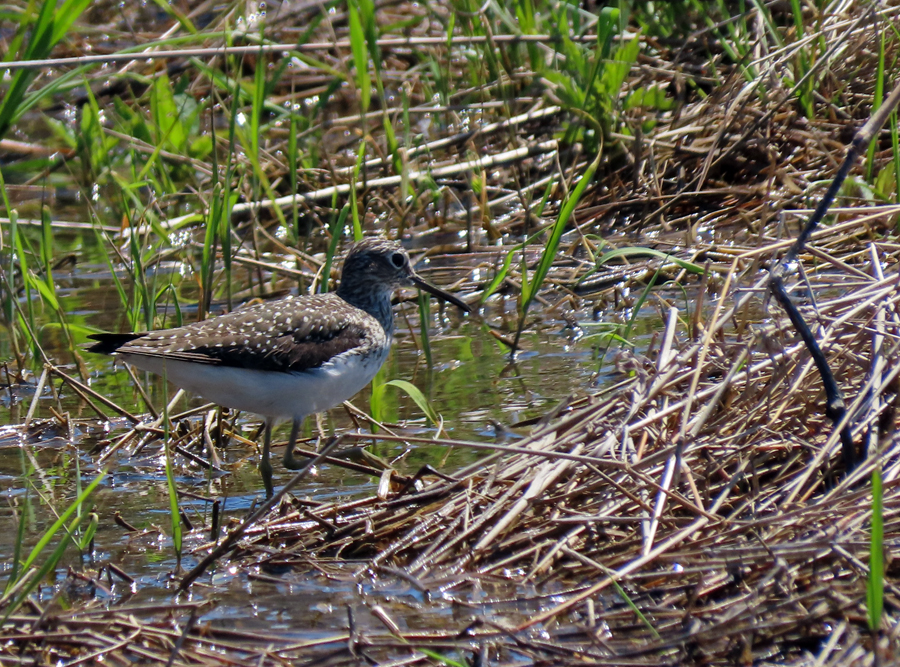
This morning one of our birding friends posted that he had spotted a Virginia Rail at Beckley Creek. A few years ago, one was sighted there, and flocks of birder came to look at it. Could it possibly be the same bird? Anyway, we were planning on going there this morning, so I grabbed my camera and we jumped in the car, but no luck with the Rail. It's probably there, but they are experts at hiding in the grass and reeds. While scanning the wetlands, I did spot something quietly moving around. It's a Solitary Sandpiper! I have a terrible time identifying Sandpipers, mostly because I see them so rarely I think. So I carefully compared this one to other Sandpipers on the Cornell website when we got home. How cool!
Baltimore Oriole
One of my favorite birds is the bright orange Baltimore Oriole. I have never heard two of them sing the same song, so the songs on my app don't do much good to call them in. But they like to tee up on the top of a tree and whistle their hearts out, so they aren't too hard to find. You can just whistle the song back to them, and they are very forgiving if you don't get it just right.
Red-winged Blackbird
Red Shoulders hidden - non-territorial

Juvenile
Female
This time of year, if there is any standing water around, you will hear the raucous call of the Red-winged Blackbirds. When you see the red epaulettes, you know he's on territory, saying "Get out! This is mine!" When you only see the yellow line, he's not being so aggressive, at a feeder, for example. The female looks like a huge sparrow, but hides well in the marshy area of her nest. This is the first time I've seen what is obviously a juvenile Red-winged Blackbird. He sang their "chuck" note, but isn't ready to challenge the big birds yet.
Warbling Vireo
This is the second time in a week we have heard and seen a Warbling Vireo. A birder friend once said their song sounds like "blurbieleialdlslakdlaioiieu" rather than some recognizable tune, and that advise has worked so far! Haven't seen/heard any Red-eyed Vireos yet this year. Either it's too early for them, or I haven't been in the woody habitat they like.
Green Heron- skulking

Punk feather-do
After the excitement of the Solitary Sandpiper, I was ready to head out for lunch and to rest my aching feet. But we were right next to the pond, so might as well check it out for anything to add to our list, and Dick saw a GREEN HERON! They are superb skulkers and we don't find them often, even in habitat where we would expect them. This guy walked about for several minutes, flashing his punk feathers, before finally fading into the cattails.
Common Yellowthroat
Here's the one that got away. They were singing everywhere, witchity witchity, but wouldn't come out in the open to visit. So here is one I found at Beckley Creek a few years ago. Total on eBird --30 species!

Thursday, October 06, 2016

Back at Beckley Creek Park

After a day of slaving over a hot laptop to catch up on many emails and other computer tasks I've put off for many weeks, my Fitbit showed only 1,700 steps for the day. Oh my, that will not do! This morning a report came through the KY Birdlist that a Sora had been sighted at Beckley Creek Park, so that became our destination for our daily walk. The sun is setting much earlier now, but the temperature was perfect.
At the Grand Allee wetlands, we searched the edge of the lake which was filled with lily pads and duck weed. The mutt ducks swam around laughing at their own jokes. A single Pie Billed Grebe dove down into the weeds. But we saw no Sora.
The fall offers many sightings not found in the other months. This small entirely black wooly worm scurried across the gravel path. It must feel like I would when hiking over a pile of boulders. Ouch! What do they say about wooly worms and the weather? Folklore says that thin brown bands on the woolly worms means a harsh winter is coming, wider brown banded woolly worms mean a mild winter,  nearly black woolly worms means a severe winter is coming, and finally the very light brown or white woolly worms mean a snowy winter according to the folklore. I just saw a projection on the Weather Channel today that we may have heavy snowfall this winter. Brr.
Jimson Weed
Datura stramonium, known by the common names Jimson weed or Devil's snare, is a plant in the nightshade family. It is believed to have originated in Mexico, but has now become naturalized in many other regions. In America it is called the 'Devil's Apple,' from its dangerous qualities and the remarkable effects that follow its administration. When the first settlers arrived in Virginia, some ate the leaves of this plant and experienced such strange and unpleasant effects that the colonists (so we are told) gave it this name by which it is still known in the United States. It is also known very commonly there by the name of 'Jamestown (or Jimson) Weed,' derived probably from its having been first observed in the neighborhood of that old settlement in Virginia.  Also known as Thornapple, in early times, it was considered an aid to the incantation of witches, and during the time of the witch and wizard mania in England, it was unlucky for anyone to grow it in his garden. 
aka Thornapple
It is considered highly poisonous, but parts are used for medicinal purposes. Browsing animals as a rule refuse to eat Thornapple, being repelled by its disagreeable odour and nauseous taste, so that its presence is not really dangerous to any of our domestic cattle. Among human beings the greater number of accidents have occurred among children, who have eaten the halfripe seeds which have a sweetish taste.

Red Sumac is a joy in the autumn, both the leaves and the tiny red berries. Sumacs look edible and toxic at the same time, and with good reason: They’re in a family that has plants we eat and plants that can make you ill. The seeds of the sumac have tannic acid in them. Putting the berries in boiling water will release the tannic acid. It can make a tea but it can quickly become too bitter to drink. To make an ade, use one to two cup of berries per quart of water. I prefer two cups and less water.  The “bobs” of berries can be cut off and dried for later use.
Jewelweed
When you are out in the field and find you have been exposed to poison ivy, oak, or stinging nettle you can reach for the jewelweed plant and slice the stem, then rub its juicy inside on exposed parts. This will promptly ease irritation and usually prevents breakout for most people. Hummingbirds love to drink from the small orange or yellow flowers.
aka Touch Me Not
When the seed pods are ripe, the slightest touch will make them explode. The pod itself curls up providing an the power to spread the seeds for next year.
When we walked at Beckley last time, we saw large "flocks" of Monarch butterflies on migration to Mexico. The majority of Monarchs have passed through, but one or two fluttered tiredly across the fields. This guy landed in the grass, then moved a few feet away to feast on a pile of dog poo. Ah, all those good minerals! This may give it the strength to continue his journey south. Good luck your majesty!

Wednesday, September 14, 2016

Beckley Butterflies


Golden Meadow
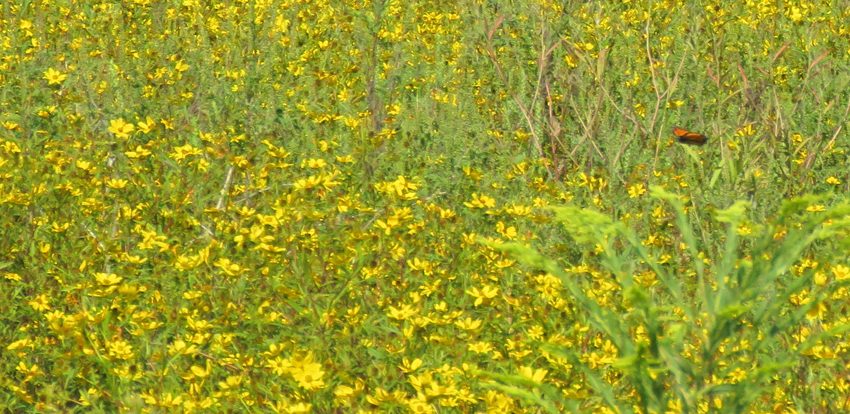
 It was a beautiful morning, not too hot, so we decided to walk at Beckley Creek Park. What a great decision that was! Everything was golden. All the gold wildflowers were blooming, under the clear blue sky.
Orange Jewelweed
 Along Floyd's Fork we saw both orange and yellow jewelweed blooming in the shade.
Lobelia
 Occasionally, a little spot of blue or purple poked its head up through the gold flowers.
Monarch Butterfly
But the most amazing thing we saw were the scores of Monarch butterflies, landing on golden flowers, or dancing in circles with each other. The Monarch numbers have been so small because of chemicals, then the big snow storm in Mexico at the wintering location. I haven't seen more than a few all summer, despite the milkweed we planted.
Monarch Caterpillar
We found one little Monarch Caterpillar painfully crawling across the gravel, in the hot sunshine. Following the box turtle rule, we gently picked him up and moved him to the grass in the direction he was crawling. 
Monarch in flight
When a Monarch lands on a flower, it instantly folds its wings, while it takes a sip of nectar. No matter how many burst shots I took, I could not get one with it's wings open. I was getting dizzy turning in circles as I tried to find and focus on flying Monarchs. Yep, getting a shot of one in flight would be serendipity. Look carefully. Do you see a Monarch in flight in this shot?

Monarch
Spotted Silver Skipper
Hackberry Emperor
Buckeye Butterfly
Actually, I saw more different kinds of butterflies today, than I have seen in many years. This Buckeye is the first in at least 4 years.