Showing posts with label wildflowers. Show all posts

Saturday, April 24, 2021

Mammoth Cave National Park for All

Mammoth Cave Formations
When I think of National Parks, I normally imagine driving to another state, such as Wyoming or Montana. That's where you find National Parks - far, far, away. But Mammoth Cave is right here in Kentucky, less than a 2 hour drive from Louisville, and we tend to overlook it. And caves, right? You go in the hot weather to enjoy the cool cave tours.

Foamflower, Delphinium and Phlox

Even without the world's longest cave system, the above-ground land encompassing Mammoth Cave National Park would merit its National Park status due simply to its extraordinary density – and diversity – of plant life. While the acknowledged "showcase of vegetation" within the Park Service, Great Smoky Mountains National Park, has approximately 1,500 flowering species in its more than 500,000 acres, Mammoth Cave National Park supports more than 1,300 species in only one-tenth of that acreage.

Accessible overlook ramp- Echo Spring

Caves and sinkholes are really only accessible to healthy people, able to climb. Folks in wheelchairs, crutches, or just with balance issues, don't dare go to many places at Mammoth Cave. Now, however, the parks people have been working to improve the Handicapped Accessible trails. Echo Spring Trail, for example, has been paved and large size porta-potties installed. Overlooks on the trail have been re-constructed to add clear panels, so people in wheelchairs can take pictures without trying to peer between parts of the fence. The trail has been completed to make a full loop, but the signs are a bit in arrears, so don't pay much attention to them. If you visit at the right times, you can find wild flowers and migrating birds in this valley as well. Since I have lost my balance somewhere, we walked the Heritrage Trail, near the Visitor Center, and down the steep hill to the Green River Ferry and Echo Spring Trail. So far so good for a couple of older folks.

Golden Seal

Then we got ambitious and drove to the Cedar Sink Trail, where we heard the wild flowers were terrific. Well, they were right, and the flowers were terrific, but so were the stairs. We managed to hike down the gravel and wood steps, but when we arrived at the metal stars going to the actual sink hole, I said NO, quite  firmly. If we walked down there without falling (doubtful) we still have to make it back to the car again. Since it was late April instead of earlier in the season, we saw a variety of different flowers along the trail. With no construction along the trail, Garlic Mustard was not found!

Bellewort

Foam Flower, May Apple, Delphinium

Fire Pink, Stonecrop and Ragwort

Foam Flower

Phlox and Jacob's Ladder

Bluegray Gnatcatcher
The day was gray, cloudy and windy. Another birder reported large numbers of birds found earlier, so we were hopeful. Although we heard lots of birds, we actually sighted very few of them. In a later email, this birder also reported finding few birds on the same day, which made us feel better. Thanks to Steve Kistler who knows all the birds and flowers in the park! http://hartcountyflora.org/index.html
Northern Parula
When you are out on the trail, you soon find that there is no internet signal to be had. All the birders who rely on their electronic equipment as usually out of luck. Dick got his phone going though, and managed, after several attempts, to lure this Parula close enough for photos. Thanks Dick!
Hooded Warbler
A Hooded Warbler guarded his territory while we caught our breath on Cave Sink Trail. "I think I'll rent a video!" he called loudly from the lot of the trees. Unfortunately, this guy did NOT come down for a photo no matter how much we we called, or pished or pleaded. Since we know he was up there, I borrowed a photo of his cousin from another trip. Hey, it's acceptable!

Sunday, April 26, 2015

Birds and Blooms II

Zebra Swallowtail on Dogwood Blossoms
If you are having trouble locating the flitting, darting little warblers in the spring, you can always take photos of wildflowers. At least they only move when the wind blows.
Dwarf Crested Iris
Many spring wildflowers are white, but sometimes you find bright blues, reds and yellows. The colors look different to pollinators who can often see in ultraviolet light.
Canada Violets
Roses are red, Violets are blue, or white or yellow...Usually violets grow close to the ground, but the Canada Violet has a long stem and a yellow center in each blossom.
Halberd Violet
Other violets leaves of elongated shape or varied shades of green.
Yellow Lady's Slippers
It's always the thrill of the season to find any kind of orchid, so when a friend asked if we'd seen the Yellow Lady's Slippers growing on the roadside, we hopped in the car immediately. You would expect a bright yellow like this to flash like neon, but it's so easy to drive right by them if you don't know exactly where they are. Two professional photographers with tripods were our clue. We saw single blossoms, or pairs, then found a cluster of four and another of SIX blossoms! What a thrill!
Pink Lady's Slipper
We found a single Pink Lady's Slipper almost by accident, growing all by itself on the top of a large boulder down by the Visitor's Center just below the Falls. People walked right by it all day without seeing it.
Sweet White Trillium, Jewel Wakerobin - t simile
Trilliums have three of everything - three leaves, sepals, petals - so they are easy to recognize. Natural Bridge State Park has similar geography, and there are loads of Trillium there, but we found very few plants at Cumberland Falls State Park, and a few different species at Yahoo Falls in McCreary County. How disappointing.
Sweet Betsy - t cuneatum
Telling them apart can be a real challenge. Be sure to use a field guide that puts all of them together for comparison. Since most of them have dark red or white blossoms, you can't rely on color or leaf shape to make an ID. The trick is to look closely at the colors of the reproductive parts - the stamens and ovary.
Red Trillium, Stinking Benjamin, Red Wakerobin, Stinking Willie - t erectum
There are sooo many common names for trillii (trilliums?) so even I try to pay attention to the latin names for them. Many of them refer to the unpleasant odor. Less common names for the t erectum include American Tru-Love, Bumblee Root, Indian Shamrock and Threeleaf Nightshade!
Solomon's Plume fka False Solomon's Seal
Every year I seem to take photos of the same kinds of flowers, but that's OK. They are always beautiful!
Fire Pink

Foam Flower

Squaw Root

Star Chickweed

Wednesday, April 16, 2014

Raven Run Wildflowers - Too Early, Too Late

Blue-eyed Mary
Raven Run Nature Sanctuary is a county park on the bluffs of the Kentucky River in Fayette County, not far from Lexington.  Part of the property was acquired with funds from the Kentucky Heritage Land Conservation Fund. Much of the 734 acres is old farm land, full of invasive plants such as bush honeysuckle, multi-flora rose, garlic mustard, and poison hemlock, just like everywhere else. In the last few years, they had a project to get rid of bush honeysuckle, which appears to be successful in  part, but it's coming right back into the cleared areas. As I drove down the Interstate, I was saddened to see the fringe of green under all the trees - honeysuckle leafing out before anything else. 
Bumblebee on Dwarf Larkspur
But as you head down the trail, past old stone fences, the flowers began to appear. Dwarf larkspur comes in both purple and white, plus a few shades in between. This is the only place I have ever seen blue-eyed Mary. In the creek valley I've heard wild turkey every time I visit the park. Today, I could swear I heard a Broadwing Hawk, although I couldn't call it out of hiding. Might have been a Blue Jay trying to fool me (if so, it worked!), but I didn't hear any other Jay calls all day. 
Dwark Larkspur
Spring Beauty

Dainty spring beauty was abundant, with little pink stripes and anthers. Twice, several teenagers passed me on the trail, talking and walking fast, not looking at any of the flowers. How could they come to such a park and not look at this flowers this time of year? Makes no sense to me.
Early Saxifrage
Good old Kentucky limestone underlies everything, of course. In fact, you risk breaking limbs and cameras both, tripping over the stones in the trail! Where the trail cuts between two big boulders, those limestone loving plants like stonecrop and this early saxifrage grow right out of the rocks.
Squirrel Corn
And just beyond those rocks I finally found both squirrel corn and Dutchman's breeches. the leaves are similar, but you can tell the difference by the blossoms. The Dutchman hangs his breeches on a line with the pants legs pointing up, while squirrel corn (how did it get that name!) has rounded tops.
Sharp-lobed Hepatica and Sessile Trillium
The trail to the overlook on the Kentucky River Palisades hosts hepatica and columbine that I found nowhere else. Of course, the hepatica flower grows on a stalk before the leaves ever come up, so I never get to see them. Columbine also likes to grow right out of cracks in the rocks, but today it was only in bud. However, the twinleaf and cutleaf toothwort had finished blooming all together. Looks like I was both too early and too late at the same time!
Wild Ginger Blossom
One of my spring favorites is the little heart-shaped wild ginger. Under the hairy leaves, one solitary dark maroon blossom may grow down on the ground itself. The flower evolved to attract small pollinating flies that emerge from the ground early in the spring looking for a thawing carcass of an animal that did not survive the winter. By lying next to the ground the flower is readily found by the emerging flies. The color (and smell) of the flower is similar to that of decomposing flesh. Whether these flies pollinate the flower or not is in some dispute.You have to get way down on the ground to get a photo of them at all.
Flower Bowl Hillside 4-16-14
I was disappointed, but not too surprised, at the lack of flowers in the Flower Bowl (as I call it). This valley has always been too steep to farm, and has never been disturbed, as far as I know, so there are an minimum of invasives, and the ground beneath the trees is open, hosting huge numbers of native wild flowers. However, the cold winter, or just the cold snap this week, has affected it, since there were not the wide wide variety of flowers growing on top of each other up and down the hillside.
Flower Bowl 4-16-2010
The first year we went to Raven Run, I was absolutely breathless when we started into the valley. As far as you could see, up hill and down, the forest floor was covered with larkspur, wood poppy, phlox, and blue-eyed Mary. All those flowers were blooming, yes, but not in the outstanding numbers of previous years. The false rue anemone seemed to be most abundant this year. Maybe it would all catch up if I had time to return in a week. In May, we are returning to Natural Bridge State Park for more wildflowers!

Monday, April 14, 2014

More Spring Adventures at Bernheim Forest

Eastern Meadowlark
Saturday morning, I taught a Birding 101 class for about 15 of the Naturalists in Training at Bernheim Forest and Arboretum, for my good friend and mentor, Wren Smith. After the classroom presentation, we went outside to see what we could find with our new birding skills, and to practice using binoculars, which I admit to be one of the hardest parts of birding. By the time I find the bird and focus on it, it's often gone. I'm good at hearing the birds, and identifying the more common ones by ear, but I've never felt comfortable leading a walk and being able to direct people to the actual bird in the tree. However, we heard some good candidates to be called in from the Meadow, including this outstanding Meadow Lark. As soon as I played his call, he sped over to us, circling the group, eyeing us for the rival Lark. He moved from perch to perch for the next 20 minutes, still on the alert, so we got some great chances to view him.
Red-tailed Hawk
Overhead in the clear blue sky a large Red-tailed Hawk showed off her identifying marks for my new birders. A Turkey Vulture and Black Vulture soared close together so they could see the easy difference between those species. Purple Martins chittered around their gourd nest boxes. All in all, it was a terrific morning.
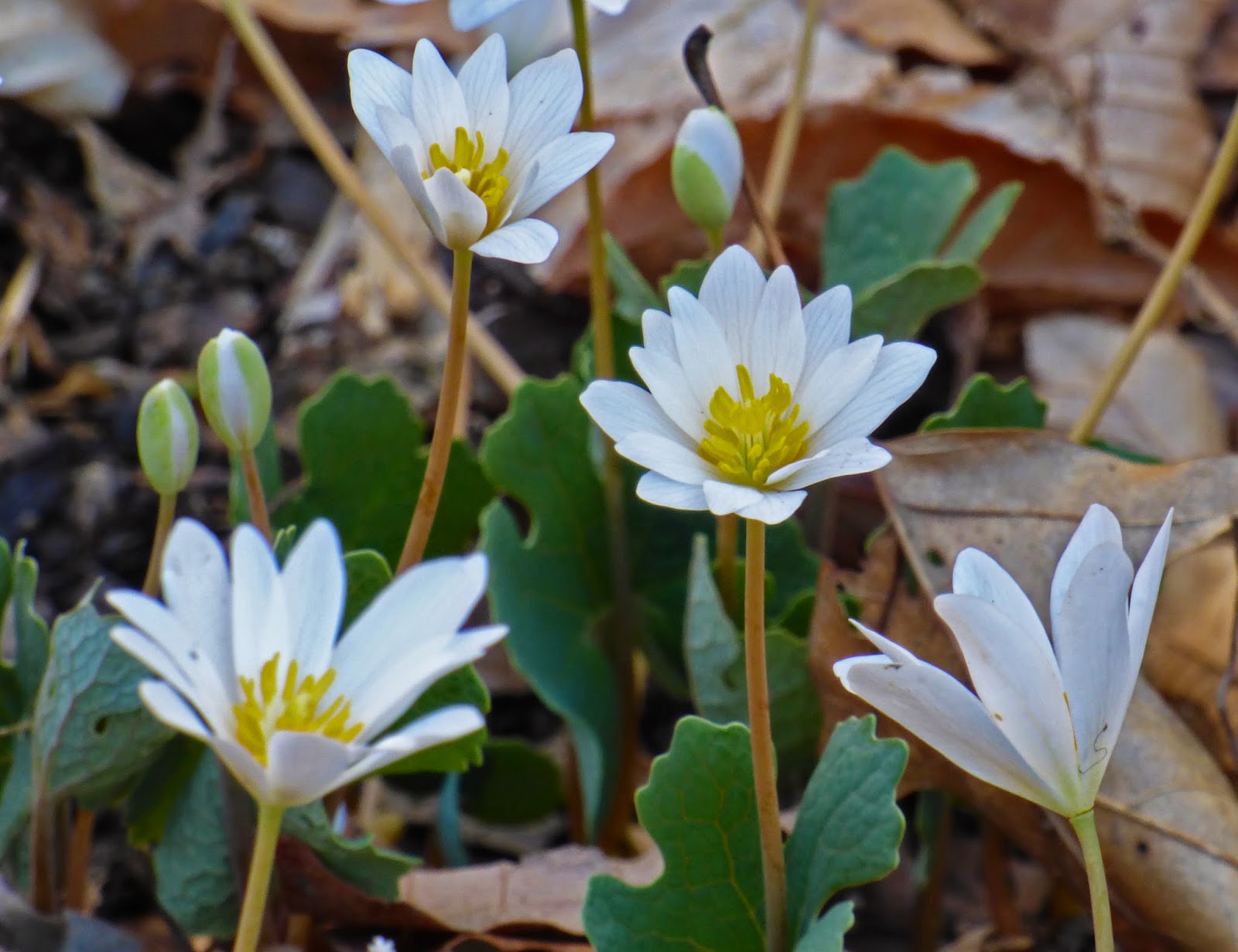
Bloodroot
In a week, the wildflowers can change a lot, so after class I returned to the Rock Run Trail, known as the best wildflower spot in the forest. Last week, the creek was full of water from earlier storms, but Saturday, the upper part was dry, as usual, while the lower part of the trail had water from a spring. I don't remember ever seeing so many large clusters of Bloodroot as I have this year. I think of them as being solitary blooms usually.
Yellow Trout Lily with Green Pollinator
On this sunny afternoon, all the flowers were completely open, and the pollinators were busy, busy, busy.  I always enjoy seeing the variety of pollinators, including different bees, beetles and flies. The tiny Pussy-toes were full of eensy-weensy little flies. 
White Violets
Wren suggested I look around the Sun and Shade Trail, near the headwaters of Lake Nevin for more flowers. In the mowed areas, the ground was purple and white with Common Violets and White Violets. 
Magnolia Blossom
Bernheim is famed for its flowering trees in the spring, and the main road was lined with Bradford Pears and pink Magnolias in full bloom. The Dogwoods are just beginning to come out.
Twinleaf
In the woods by Lake Nevin, I found the first Twinleaf I've seen at Bernheim. Many were in bloom while the leaves were still small and almost closed.
Only 30 minutes away from Louisville, Bernheim Forest is such a wonderful resource, both in their people, programs and natural resources. I am so glad to to be part of it!

Saturday, April 05, 2014

Early Wildflowers

After spending the morning at Bernheim Forest with my grandson and son-in-law, I got home and turned right around to head out again. They have white trout lily in one particular spot there, and if you delay going, you will miss them altogether. 

 Then, of course, are the delicate white bloodroots. They pop up in the embrace of a leaf, and the delicate blossoms only last a day.
Rue anemone, swaying with each small breath of wind...
...and toothwort just starting to blossom.

There will be more of most of these species in the next few weeks, plus many others, but the first I see in the season are always extra special