
What's a birder to do when the sun doesn't shine, and the birds sing only from hidden perches, refusing to come out and be admired? I tend to get distracted by other natural features, and the New River Gorge is chock-full of natural features, as well as an enormous man-made feature, the New River Bridge. The New River Gorge Bridge carries U.S. Highway 19 over the
New River at a height of 876 feet, making it the highest vehicular bridge in the Americas, and the second-highest in the world. That's all straight down folks. For someone with acrophobia (namely me) it's a good thing the side of the bridge is concrete, and I can't see over when when driving.

One of our trips went down into the Gorge though, down a narrow, switch-backed road. We stopped at the base of the bridge supports for some birding. I must admit, mountain birding makes it easier to see warblers, since the trees are at eye-level and your neck doesn't hurt as much. The bridge was completed in 1977, and before that everyone just drove the narrow winding road down, crossed the river on a one lane bridge with a wood floor, and drove up another one lane road going up to the other side. I don't think there would be much to make me take this trip too often. But think back to the pioneers who didn't even have bridges or paved roads. Although finding land, homesteading, and raising crops and family on your own is hard enough, imagine the endless isolation. What if a family member is injured or ill? When it's time to give birth, your husband may not be able to return with a midwife in time. No wonder so many women died in childbirth. But the sheer loneliness must have been overwhelming. I'm glad to be an Interstate Highway girl, thanks.
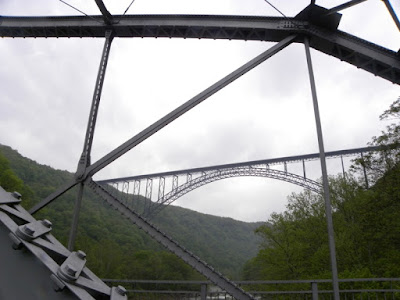 View from old New River Bridge

Do I feel guilty about losing the birding focus? Nah....It's all fascinating. Things with roots always cooperate for the camera. How about a Jack the Referee plant found at Smokey's on the Gorge.
Touchdown!

Every forest has a few Ents, if you look for them. I found this one at the
Opossum Creek Retreat next to one of the cabins. The uplifted arms, long eyes and very long, open mouth remind me of Edvard Munch paintings of The Scream. A Screaming Ent in West Virginia...

Our guides,
Connie Toops and Keith Richards, not only excel at hearing and recognizing bird calls, they know the other inhabitants of the biosphere as well.

Is this a blossom on a cedar tree? No, it's the cedar-apple rust, a fungus. Connie found another fungus that looked like a small orange tipped match growing in a puddle, but I don't remember what she called it.

I'm used to Spanish Moss and other kinds of epiphytic plants in the South. Lichens cover the bark of trees here in the mountains, to the point where you can't see the bark at all. I think this airy thing is some kind of lichen as well.

As the week progressed, we saw spring ebb and flow in the mountains. Along the valleys, the leaves were fully grown. In the higher elevations, most of the trees were still bare. How do you like this one? I call it the Red Velvet Oak for obvious reasons.
Birds are a bright flittering part of the forest, delighting us with their song. All the "small life" is necessary for the forest to provide a habitat for the birds. I love looking at anything with a different shape or color, then trying to find how it fits in the ecology. It would be nice if the chiggers, mosquitos and gnats didn't see me as a potential dinner though. I'm still itching and scratching from their attention.
 They are just ordinary benches, used by Bernheim visitors who are waiting for their friends and family to finish in the restrooms. People who are tired and hot after a hike in the woods plop down on them with a groan of relief to have a seat in the shade. Grandparents listen and smile while grandchildren shout to hear their echoes in the concrete silos housing the vending machines.

 From a distance, the benches look like they are painted a pale green, which has faded and peeled from exposure to the weather. The ecologically minded might guess the benches to be made from recycled milk jugs. It sounds like something Bernheim might do. As you come nearer, however, the green appears to be made of small splotches in at least 50 different shades of green, gray and brown, applied by an Impressionist painter. The lifeless bench has become a living thing now. It's been adopted and absorbed by the many small flat lichens in green and grey.
 Although the lichens are worn away by human seats and hands and cares, they don't give up. Lichens quietly fill in the sides of the seat slats where no human can touch them. Eventually, more complex lichens establish a foothold in a secluded spot near the edge of the bench, curling like layers of pale green lace.
 At times, the lichens sprout what appears to be spiny needles along their edges. What small predator might hunt these lichens causing them to develop such a defense?
 Did Renoir imagine such things when he created are in splotches of paint? If the lichens were removed, would the bench still exist? There is a world of life in the slats of a plain bench, beyond what we can imagine. My soul is enriched by knowing of it.


