Showing posts with label Bernheim Forest. Show all posts

Thursday, April 01, 2021

Bernheim Early Spring

Rue Anemone
It's always a challenge to find the white Trout Lillies in bloom at Bernheim. They bloom early in the spring, and we looked for them earlier in March, without success. On March 31(Wednesday), Dick heard that another volunteer had seen them blooming the Saturday before. The sun was shining, so we said "Let's go!"

Spring Beauty

Bloodroot going to seed
 As we strolled down the walk along Mac's Lake towards the Troutlilly patch, we saw lots of Rue Anemone, and it was the True Rue. False Rue has five petals and True Rue has more than five. (It took me several years to remember that one.) Spring Beauty and Toothwort were popping up too. 

White Troutlilly

As we reached the right spot, we walked between the trees. Plenty of speckled  troutlilly leaves were around, but only one was actually blooming. The ones we saw were beginning to go to seed pods. Well, we said, it's cloudy and windy today and they like bright sunshine to show off. Also, by the end of March, we may simply be too late. Better luck next year!

Virginia Bluebells

As we turned behind the edible gardens, we remarked that early wild flowers are much like migrating birds, except they don't fly away when you try to take their pictures. Both are exceptional at camouflage. The forest floor is covered with brown leaves, and that's basically all your eye sees. The wildflower plants are short and hard to see until you are right next to them. They don't grow well in disturbed areas. In fact, I expect to see more at Bernheim since it has not been farmed for so long. We think we heard a Pine Warbler in the pines, but couldn't spot him among all the pine cones that look like birds from a distance.

Cascading Creek
Rock Run is the best trail to find wild flowers in my opinion. The creek in front of the parking lot was full of water, when normally it is quite dry. We must have had more rain last night then I thought. We carefully walked the trail to avoid mud, leaves and killer roots and rocks.

Rue Anemone
Once again, Rue bloomed more than anything else. One side of the valley is sunnier than the other and things bloom there first.
Sedge and Moss

Star Chickweed
Normally we think of chickweed as a weed, but the native Star Chickweed is quite lovely.
Toothwort
Toothwort also closes its blossoms if the sun isn't shining. 

Wood Betony

Water Leaf

Some plants are starting their leaves while the blossoms will come later in the season. 

Walking Fern
Christmas ferns and Walking ferns don't bloom at all of course.

\

Yellow Troutlily
In another week or so, on a nice sunny day we can try the Rock Run Loop again and find lots of Yellow Troutlillies blooming, but today there was only one brave enough to give it a try. 

Actually, we don't mind a little rain. It's run to listen to the creek chuckle with joy at being filled with life-giving water!

Friday, June 12, 2020

Return to Bernheim?

Morning light in the forest
Dick has volunteered at Bernheim Forest and Arboretum since 2005, working sometimes with the horticulture group, planting and weeding (like he doesn't do enough of that at home?) but mostly interacting with visitors, talking to them about the wonders of nature. Last year this time, he would be at Bernheim 3-4 days a week. But last March, as the coronavirus pandemic grew, Bernheim decided to close altogether during the crisis. The crowds of people coming to see the Forest Giants just couldn't be controlled. It would be safer for all, they decided, to just lock the gates until things changed, a disappointing but understandable decision. Many of the employees have been working from home most of the time as well. Volunteer training has continued via Zoom meetings online. Dick and I helped at one just last week.The volunteers have been recording short videos of why they love nature and Bernheim. They are trying to keep their name out there, but no one can come in.
Daisy with bugs
This morning, however, Dick went out to film a video on site, and they invited me to come along and we could go birding afterwards. Dick said it felt like making a pilgrimage to return there even for just one day. After all, the whole migration season was missed by every birder! No reports to eBird from Bernheim!
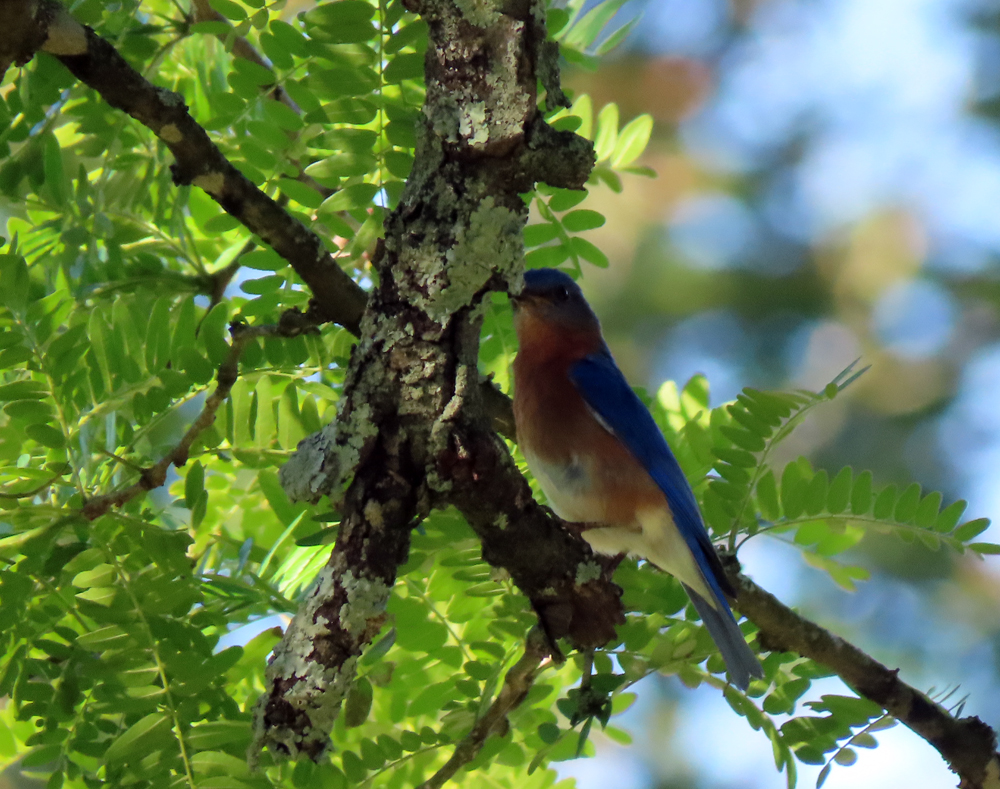
Bluebird
As we parked the car in the shade on a cloudless blue-sky morning, we were greeted by a Bluebird who probably lives out in the big meadow.
Gray Catbird
Instead of hiding in the bushes, this Catbird called and followed us around the area near the silos for over an hour, just to see what we were up to, I think. Maybe he missed having an audience.
"Barn Owls"
I used to see Flicker woodpeckers nesting in the sycamore trees every spring, but none were there today. In fact, I have seen NO Flickers at all this spring, wherever we went birding. We did find this pair of "Barn Owl" nuts on a table.
Red-eared Slider at Kingfisher Pond
 Kingfisher Pond is too small to attract any real Kingfishers, but this 9-10 inch long slider was quite comfortable, despite all the duck weed on his back.
Barn Swallow hatchlings

Barn Swallow chicks
Almost ready to fledge

Barn Swallow adult at nest
Every year, Barn Swallows build their nests of mud under the porch roof of a building near Lake Nevin. The adults were busy flying around catching bugs, but we counted at least 22 nests with chicks of various ages. One of my favorite times and places.
Purple Martin Apartments
 Bernheim has hosted Purple Martins for many years. A volunteer keeps up with keeping them clean and ready when they arrive from the south.
Hanging around the apartment building
Iridescent Purple Martins
 Martins chatter incessantly as they catch air-borne bugs, when when they land, you can see how long their wings are and how they shine in the sunshine.
Tree Swallow
One of those shiny birds, however, was not a Martin but a Tree Swallow, who also nests in cavities. The Martin volunteer said that they were here before the Martins arrived, and wouldn't leave. Unusual, isn't it.
Green Darner
Lambs Ear and bee
Purple Coneflower and pollinators
Widow Skimmer dragonfly
 On of the things I enjoy about Bernheim is the variety of habitats, from dense forests, to streams and lakes, and the Big Meadow grasslands. Each is home to a variety of plants and animals.
Field Sparrow
Although the Field Sparrow normally stays hidden in the grass, this guy came bravely up to the top of a flower to serenade us with his bouncing ping-pong ball song. It's always a challenge to get a photo of one.
Green Heron
 The Edible Garden is a big vegetable garden, operated in a completely sustainable manner. It uses solar power where power is needed, and recycles all water. The garden beds are elevated so they can be reached by everyone, including handicapped visitors. They have bee hives to pollinate all the plants. When Isaacs' Cafe is open, all the fruits and vegetables served there are raised in the garden right across the road.
Green Heron in tree
Although I was trying to photograph nonstop dragonflies, a large bird flying across the pond caught my eye. It was a Green Heron, moving from his place of concealment along the pond's edge to an open space on a big tree!
Red-tailed Hawk
I am always excited to find raptors, no mater where we are birding. This big Red-tail was perched in a pine tree, and we ended up walking all the way around it before getting a good view of her face. She was keeping an eye on the meadow for something yummy for lunch.
Indigo Bunting
We hope that Bernheim will be able to re-open soon. Many other nature preserves have remained open for hikers, although all buildings and playgrounds are closed. Perhaps if they could find a way to close off the Giants...


Saturday, May 07, 2016

Birds and Pollywogs at Bernheim

It's Derby Day in Louisville, and the city celebrates the horse race for two weeks before it actually happens. I used to go to the track when trust department customers from the bank where I worked invited me, but haven't been for years and don't miss it a bit. It's something that's fun to do - once or twice. Does that mean I'm getting old?
Today we went to Pollywogs at Bernheim Forest with my daughter and two grandchildren. The boy is a veteran of this program for pre-schoolers, but it was the first time for our granddaughter. They talked about rainbows and made crafts with all the colors of the rainbow. Miss Whitney does a wonderful job with these very young children.
I've learned to pack a picnic lunch and camera for the day. The cell phone takes good photos of the kids in action, but I need a better lens for any birds or flowers I might find. The silo area just below the education building, is a great place for birding. In fact, you could do a Big Sit and come up with a decent list in a short time. Getting close enough for photos is more of a challenge though. One of the first birds I heard was a Baltimore Oriole, way up in the sycamores where I couldn't find him. Down in the woods, a Wood Peewee called, and out in the meadow several Field Sparrows called from the grass. Flickers nest above the picnic tables too.
The Purple Martin houses attract large numbers of Martins, while a nearby Bluebird box has a closed-circuit camera showing the chicks, who will be ready to fly any time now.
 
 
At the observation room in the education building, the neighboring birds come to chow down at the feeders....


...while the gardens bloom profusely. I'm glad to find little tree seedlings invading their gardens just like we have at home.

Friday, May 22, 2015

How Many Languages Do You Speak?

It can be hard to find one place that fulfills several needs at one time. Bernheim Forest and Arboretum is a place of incredible beauty. The Big Meadow leads your eyes from golden coreopsis flowers to the Earth Measure sculpture and the green hills of the Kentucky Knobs. As the seasons change, so do the flowers in the Meadow, but the thrill I get from finding them never ceases.
Yet Bernheim has always been a place for me to learn, both about nature itself, and how to help people see and appreciate it. Both Dick and I received our training as Certified Interpretive Guides from our mentor, Wren Smith, who works at Bernheim. This week I attended another training session on using social media as an interpretive tool. Paul Caputo, from the National Association of Interpretation, asked the question, "What is interpretation?" Since all of us were CIGs, we all should have known that answer easily, but silence filled the room. I always struggle with that term, yet no one has come up with a better term.
NAI defines interpretation as "a mission-based communication process that forges emotional and intellectual connections between the interests of the audience and the meanings inherent in the resource." Hmm, you can see why we have trouble remembering it. Another description says it involves "what things mean, how they fit together, and why it matters," and helping our visitors understand. 

These Interpreters themselves make the concept come to life!
Although our original CIG training focused on personal interaction with visitors, such as leading tours and classes at a facility such as Bernheim or Creasey Mahan Nature Preserve, Paul reminded us that we need to relate to those visitors wherever they are, which sometimes may be at home in front of their computers or looking at their phones. We can still be interpretive on social media, he assured us, giving people what they want to know about our sites, not just what we think they should know about us. By appealing to the right followers, we can create a real community of our site's friends. When I return to Creasey Mahan, I'll start by explaining concepts like podcasts, hashtags and how Facebook doesn't actually deliver all your posts to all your friends to our director. Whoa. This is going to take some adjustment.
With my head spinning, I thanked Paul and Wren at the end of the second day's session, and headed out into the Arboretum for a walk and some birding, to clear my mind. Each year, the Barn Swallows return to Bernheim's Garden Pavilion, next to Lake Nevin. They build nests of mud, grass and swallow spit in the rafters of the pavilion. Each year the staff tears down the nests, and each spring the birds shrug their wings and rebuild them. How can this be interpreted to non-birders?
Swallows are like all of us. They want a safe place to raise their young, protected from wind and weather. They want a good supply of insects to feed them. And like us, they sometimes have to deal with unwanted traffic to attain these vital goals. To the Swallows, people walking along the Pavilion's porch are like the Interstate traffic many of us deal with every day driving to work. We don't like it particularly, but with care, we can avoid disaster, and get home each day to our families. Since this location provides all their other needs, they put up with the inconvenience and potential danger of the traffic. Of course, sometimes people are startled by a near collision with a fast flying Swallow which doesn't slam on its brakes for anything. Now I just need to interpret people to the Swallows!