Showing posts with label dragonflies. Show all posts

Sunday, July 25, 2010

Good Old Summer Dragonflies

Widow Skimmer
It's a typical summer day in the Ohio Valley. One of those 90-90 days, where the temperature and the humidity levels are both at 90. What sounds like the most fun thing you could do on a day like this? Swimming? Sailing at the lake? Sit in the shade with an icy glass of tea? Or, best yet, just stay inside with the air conditioning?
Common Whitetail Female
We chose option E: None of the Above, and went hunting for dragonflies at Blackacre Nature Preserve instead. A biologist from the Kentucky Nature Preserves Commission led about 10 sweating enthusiasts down to the sunny pond to hunt for dragonflies and damselflies. The Nature Preserves Commission works to preserve areas of biodiversity in the state, and Blackacre is one of their partners. The dragonflies love bright sunshine, so let's hurry before it clouds over, he urged.
Green Darter
Although I listened to his discussion, I was so busy trying to photograph these insect raptors, I didn't always catch his identifications. Or, I couldn't see the insect at all in the first place. So if anyone sees any errors here, let me know. This Green Darter is in the "obelisk" position. By raising its tail into a vertical position, it reduces the amount of heat being absorbed from the sunlight. Pretty smart, isn't it?
Slaty Skimmer
Some dragonflies are perch potatoes, while others zoom around so fast I can hardly see them, let alone identify them. These Slaty Skimmers stayed perched on one branch for many minutes. We saw a Wandering Glider, which can sometimes be found hundreds of miles at sea. They migrate north to breed, then the young migrate back south again.
Halloween Pennant
The Halloween Pennant likes to "tee up" on the tips of grasses or cattails. It has really cool little red spots called "stigma" on its wings.
Green Darner Female
As in birds, the female may bear very little resemblance to the male of the species. In fact, the males are so determined to mate with every female they can as often as possible, we learned that the females sometimes have to go hide in the bushes to get away from them. In some species the male can remove the sperm of the previous male to breed with the female, so he has to guard her carefully while she lays her eggs to be assured of fatherhood.
Ebony Neon Damselfly
Damselflies are quite a bit smaller and less active than the dragonflies we saw. The male Ebony Neon is just that - ebony wings and a blue/green iridescent body. The female has white tips on her black wings, and her body isn't as shiny. I knew the damselfly folds its wings when it lands, but I always thought they only had two wings to begin with. Now I know they have four wings of the same size that overlap when folded.
Ebony Neon Damselfly Female
Blue Dasher
The dragonfly scientists only started giving common names recently, but the descriptions are so accurate most of the time. Dashers, Dancers, Skimmers, Gliders, Cruisers, Darners - lots of names with verbs in them. Or else they wanted to compete with Santa's reindeer!
We found one empty shell called an "exuviae" left behind when the larvae emerges as an adult. Unlike butterflies, these dragonflies will molt and shed their exoskeletons 8 to 17 times before reaching adulthood.
At least the dragonflies were large enough to see easily. This little damselfly was only about an inch long, and just about invisible with its wings folded.
We enjoyed the mid-summer flowers as we hiked back to the pond. Queen Anne's Lace attracted this ant too.
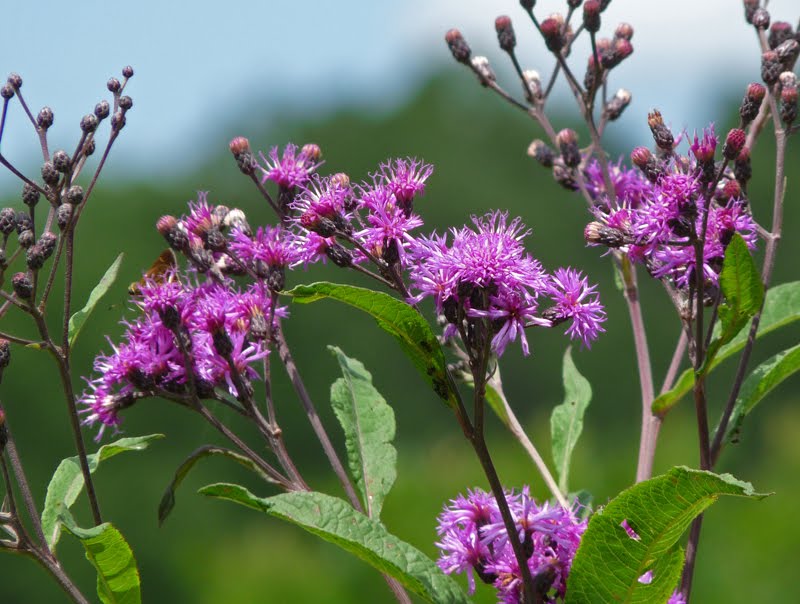
And the iron weed is starting to bloom, while the Bob Whites called from the meadow. When we finished with dragonflies, we started to go for them, but when they didn't respond to my whistles, we decided we were too hot and thirsty to hunt for them this afternoon. Maybe another time....

By the way, have any of you bloggers out there started using the new templates, etc offered by Blogger? I looked at some of it and didn't see an option to upload pictures from my hard drive, only from Picasa or a URL. The template designs looked pretty nice though.

Sunday, November 09, 2008

'Bama Bugs and Butterflies

The Alabama Gulf Coast abounds in bugs and butterflies, particularly with large dragonflies. I've been able to identify the butterflies, which posed cooperatively for the camera. The dragonflies, however, are perpetual motion insects, rarely lading anywhere long enough to focus the camera. Any names you see on them may well just be a descriptive name so I can tell one shot from another. If anyone knows the names of these dragonflies, I'd sure be glad to learn. The large yellow dragonflies never did land, that I could see. Once we saw a large yellow helicopter flying over, and I quickly told Dick to look up at the giant yellow dragonfly going over!
Painted Lady

Gulf Fritillary - topside

Gulf Fritillary - bottom side

Common Buckeye

Why do butterflies go to the beach?

Long-tailed Skipper

Mystery bug - looks vicious

A 2 inch long spider

I'm glad dragonflies aren't 3 feet big as there were in prehistoric times.

Big fat dragonflies are a favorite Kestrel food.

Don't want to find this beetle in my shoes!

Red Saddlebag Dragonfly

Wednesday, August 20, 2008

America's Biggest Home

Anyone going to the Asheville, NC, area should make a stop at Biltmore Estate, America's Biggest Home. We went not so much for the house as for the landscaping and gardens. The Beach Boys concert that night was already sold out, so we had to miss that.
Frederick Law Olmsted was the landscape architect in charge of the landscaping and forest development when the "house" was built in 1889. Think about that title. An architect designs buildings for a purpose. I never thought of landscaping in quite that formal manner. If his name doesn't sound familiar, he also designed Central Park in New York City, and all the city parks here in Louisville, Ky, among many others. Biltmore has a combination of formal gardens and winding paths through more natural forested areas. As we walked down the hill to Bass Pond, pictured above, I wondered how often the turn of the century society ladies actually took this stroll in their long skirts and corsets! I was breathing heavily on the way back up myself! We were accompanied by several Eastern Towhees and Carolina Wrens along the path, and met by soaring dragonflies and butterflies along the pond's edges. In fact, this is the first decent picture I've ever taken of a Towhee.
The walled garden closer to the mansion is an inspiration to gardeners everywhere. They are famous for their roses, but we were impressed by the thousands of annuals planted in the beds, and how much work is involved in replacing them each season. I bet all these gardeners have at least a Master's degree in botany, as well as a green thumb. Bees and butterflies abound. The ripening grapes in the arbor smelled sweeter than the flowers! A hummingbird landed on the trumpeter vines to rest before sticking his whole head in for the next drink of nectar.

The Vanderbilts wanted their property to be self-sustaining, and operated a commercial dairy, timbering, and farming during their tenure. Their descendants follow that tradition, but concentrate on the tourist industry, offering tours of the mansion itself, a gardening center, outdoor recreation and a farm for city kids, an Inn, sales of home design accessories, an equestrian center, and the Biltmore Winery. We learned about the wine making process, and most importantly, got to sample all their products! Yum! To support this endeavor, we purchased a few bottles to take home. Of course, restaurants abound on the property. We had to stop and take photos of the sunflower fields bordering the corn fields.

Now, to me, "home" is where you live all the time. The mansion advertises itself as a home opened to friends, children and dogs. George Vanderbilt was literally master of "all he surveyed" from any window. As high society at the turn of the century, George Vanderbilt was an art collector, and I kept thinking that our Speed Art Museum would kill to have the collections in this "home." Also, as high society, the Vanderbilts had "homes" in New York and Paris, as well, if not Newport and Washington, where they also spent time. Maybe my concepts of home are too limited.

Maybe I would think differently if I were the heir to that much money. They did provide jobs and homes to the people who worked for them all those years, whether the Vanderbilts were actually in residence or not. During those times, I imagine such jobs would have been hard to find in the mountains. They did provide the land for the Mount Pisgah National Forest to be established. I was surprised that family members are still involved with the active management of the property. But I must admit to a prejudice against conspicuous consumption when there is so much need in the world today. On the other hand, much of the world would consider my modest lifestyle to be conspicuous consumption too. I guess it just depends on your perspective.