Showing posts with label Monarch butterflies. Show all posts

Wednesday, September 14, 2016

Beckley Butterflies


Golden Meadow
 It was a beautiful morning, not too hot, so we decided to walk at Beckley Creek Park. What a great decision that was! Everything was golden. All the gold wildflowers were blooming, under the clear blue sky.
Orange Jewelweed
 Along Floyd's Fork we saw both orange and yellow jewelweed blooming in the shade.
Lobelia
 Occasionally, a little spot of blue or purple poked its head up through the gold flowers.
Monarch Butterfly
But the most amazing thing we saw were the scores of Monarch butterflies, landing on golden flowers, or dancing in circles with each other. The Monarch numbers have been so small because of chemicals, then the big snow storm in Mexico at the wintering location. I haven't seen more than a few all summer, despite the milkweed we planted.
Monarch Caterpillar
We found one little Monarch Caterpillar painfully crawling across the gravel, in the hot sunshine. Following the box turtle rule, we gently picked him up and moved him to the grass in the direction he was crawling. 
Monarch in flight
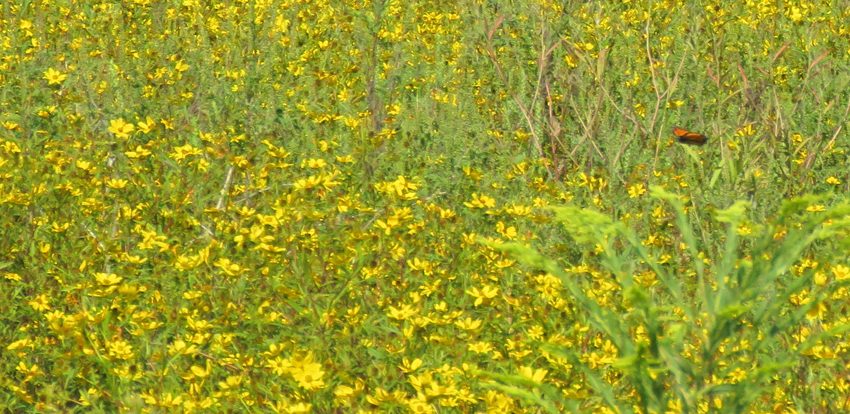
When a Monarch lands on a flower, it instantly folds its wings, while it takes a sip of nectar. No matter how many burst shots I took, I could not get one with it's wings open. I was getting dizzy turning in circles as I tried to find and focus on flying Monarchs. Yep, getting a shot of one in flight would be serendipity. Look carefully. Do you see a Monarch in flight in this shot?

Monarch
Spotted Silver Skipper
Hackberry Emperor
Buckeye Butterfly
Actually, I saw more different kinds of butterflies today, than I have seen in many years. This Buckeye is the first in at least 4 years.


Saturday, October 03, 2009

Monarch Migration and National Parks

It's October, and the flowers are starting to die back. Dick is making plans to re-organize the butterfly garden for next year. The roses love the cooler weather we are having, and are full of blooms. From my window, I notice activity around the butterfly bushes.
It's migration season for the Monarchs and there must be at least 15 of them taking a pit stop on our bushes to sip nectar and rest a bit before the nest step in their journey.
I think it's a long trip to ride 8.5 hours in the car going to Wisconsin. Imagine if we had to flap our arms and fly there, or even farther, for our vacations. The wind buffets these small creatures, requiring extra effort to go small distances. Last weekend they looked like pieces of orange tissue paper, tossed by the wind. Imagine reaching the Gulf of Mexico, knowing you have to fly across it without any place to stop and rest.

We watched the Ken Burns series on the National Parks this week on PBS, loving the wonderful photography and hours of research required for it. I wonder if John Muir would have been involved with wilderness to the same extent if he had been born a century later, in 1938 rather than 1838. Luckily for us he was there to push for the preservation of wild places while there were still wild. It's humbling to think of all the people who made our Parks what they are - explorers, environmentalists, kids in the CCC, motorists willing to drive an open car along unpaved roads with no AAA to save them when they had car trouble. Dick and I enjoyed watching the development of interpretation as a skill among the NPS Rangers. And God love whoever designed those ranger hats! You can spot them a mile away! I was especially moved by the daughter of Alaska superintendent, John Cook, who was the fourth generation of her family to serve with the Park Service. If you missed this marvelous opportunity, you can see clips or even full episodes from it online at http://www.pbs.org/nationalparks/watch-video . Maybe there's still hope for the human race after all. After all, it's always morning somewhere.

Friday, September 18, 2009

Let No Leaf Go Unchewed

Our butterfly garden has been a learning experience this summer. We attracted butterflies all right, not quite the numbers I hoped, but a nice variety of species. Along with the butterfly bushes and cone flowers, we planted three kinds of milkweed, the swamp milkweed, butterfly weed (the orange one), and a tropical milkweed given to us by a fried. Of course, you plant milkweed to attract Monarch butterflies. Three Monarch caterpillars now live on the tropical milkweed, speeding up and down the stems, or pausing to chow down on the leaves. It's hard to tell which end is the front, just as the caterpillars intended. Corinne Mastey, one of the volunteer naturalists at Bernheim Forest, is involved in a program to track Monarch migration patterns. They tag the Monarchs with little identifying dots on the wings, much like bird banding.
We keep looking on the larger swamp milkweed, but haven't found caterpillars or cocoons on it yet. Hopefully, we will find the chrysalis for one of these guys and can put it in a box to watch the butterfly emerge. This plant is shaded by the larger butterfly plant, so I think we'll move it to a spot with more consistent sun for next year.
Milkweed beetles also adore the tropical milkweed plant, especially the seed pods. According to BugGuide.net, there are many species of milkweed beetles. The tropical milkweed is an annual in our climate, but we can save the seeds and start them in the spring. Dick is enlarging the garden to add more native plants next year.