 When we think about birding, we usually mean “birdwatching,” that is, looking at birds to identify them. However, many birds, especially those DLB’s (Darn Little Birds) defy a visual identification. Many of the DLB’s I try to find deliberately taunt me, flying away again just as I get them into view and try to focus my binoculars. I hear them laughing and twittering about having fooled me again in the branches above my head.
Therefore, when I talk to people about birding, I recommend trying to learn birdsong as part of the identification process. My husband bought some CD’s to help. One set has about 25 backyard birds, and the other has about 85 different kinds of birds. I play them in the car while driving to work and it not only makes the drive more pleasant, but helps me learn the songs while sitting in the air conditioning. I’ve listened to that CD so many times by now, that I’m never quite sure if the live bird is one I heard on the disc, or the recorded bird is one I heard live!
Some of the birds I knew already, such as Robins, Cardinals, and Blue Jays. Others just confused me the first time I heard them, such as many of the wrens and woodpeckers. I really enjoy some of the mnemonics associated with particular birds. I had heard “Oh Sweet Canada, Canada, Canada” on the CD. While in Lexington, I actually heard it coming from the trees near my daughter’s parking lot. No one understood what I was so excited about. I had to put the CD back in and listen through the whole thing again until I found the White Throated Sparrow. I now know that Americans usually remember it as “Oh Sam Peabody, Peabody, Peabody” instead. The Field Sparrow sounds like a dropping ping pong ball, which speeds up as it hits the floor each time. I never saw one of these sparrows in New Harmony, IN, but heard them in the fields near the river. I may never see a Red-eyed Vireo, but I now recognize them every time I walk in the woods.
The real frustration about birdsong is the individuality the birds put into it. The CD admits that birds in different regions sing the basic song differently, so I may be hearing a Carolina Wren with a Southern accent. They play a basic Oriole, then four other variations that sound completely different to my ear. I spend a lot of time second guessing myself and getting very frustrated.
I’ve heard of a new book Why Birds Sing, written by a musician. His conclusion is that birds sing for the joy of it! They certainly add enjoyment to my day, so I can go along with this!
When we think about birding, we usually mean “birdwatching,” that is, looking at birds to identify them. However, many birds, especially those DLB’s (Darn Little Birds) defy a visual identification. Many of the DLB’s I try to find deliberately taunt me, flying away again just as I get them into view and try to focus my binoculars. I hear them laughing and twittering about having fooled me again in the branches above my head.
Therefore, when I talk to people about birding, I recommend trying to learn birdsong as part of the identification process. My husband bought some CD’s to help. One set has about 25 backyard birds, and the other has about 85 different kinds of birds. I play them in the car while driving to work and it not only makes the drive more pleasant, but helps me learn the songs while sitting in the air conditioning. I’ve listened to that CD so many times by now, that I’m never quite sure if the live bird is one I heard on the disc, or the recorded bird is one I heard live!
Some of the birds I knew already, such as Robins, Cardinals, and Blue Jays. Others just confused me the first time I heard them, such as many of the wrens and woodpeckers. I really enjoy some of the mnemonics associated with particular birds. I had heard “Oh Sweet Canada, Canada, Canada” on the CD. While in Lexington, I actually heard it coming from the trees near my daughter’s parking lot. No one understood what I was so excited about. I had to put the CD back in and listen through the whole thing again until I found the White Throated Sparrow. I now know that Americans usually remember it as “Oh Sam Peabody, Peabody, Peabody” instead. The Field Sparrow sounds like a dropping ping pong ball, which speeds up as it hits the floor each time. I never saw one of these sparrows in New Harmony, IN, but heard them in the fields near the river. I may never see a Red-eyed Vireo, but I now recognize them every time I walk in the woods.
The real frustration about birdsong is the individuality the birds put into it. The CD admits that birds in different regions sing the basic song differently, so I may be hearing a Carolina Wren with a Southern accent. They play a basic Oriole, then four other variations that sound completely different to my ear. I spend a lot of time second guessing myself and getting very frustrated.
I’ve heard of a new book Why Birds Sing, written by a musician. His conclusion is that birds sing for the joy of it! They certainly add enjoyment to my day, so I can go along with this!
Monday, June 26, 2006
Bird IDs by Ear
When we think about birding, we usually mean “birdwatching,” that is, looking at birds to identify them. However, many birds, especially those DLB’s (Darn Little Birds) defy a visual identification. Many of the DLB’s I try to find deliberately taunt me, flying away again just as I get them into view and try to focus my binoculars. I hear them laughing and twittering about having fooled me again in the branches above my head.
Therefore, when I talk to people about birding, I recommend trying to learn birdsong as part of the identification process. My husband bought some CD’s to help. One set has about 25 backyard birds, and the other has about 85 different kinds of birds. I play them in the car while driving to work and it not only makes the drive more pleasant, but helps me learn the songs while sitting in the air conditioning. I’ve listened to that CD so many times by now, that I’m never quite sure if the live bird is one I heard on the disc, or the recorded bird is one I heard live!
Some of the birds I knew already, such as Robins, Cardinals, and Blue Jays. Others just confused me the first time I heard them, such as many of the wrens and woodpeckers. I really enjoy some of the mnemonics associated with particular birds. I had heard “Oh Sweet Canada, Canada, Canada” on the CD. While in Lexington, I actually heard it coming from the trees near my daughter’s parking lot. No one understood what I was so excited about. I had to put the CD back in and listen through the whole thing again until I found the White Throated Sparrow. I now know that Americans usually remember it as “Oh Sam Peabody, Peabody, Peabody” instead. The Field Sparrow sounds like a dropping ping pong ball, which speeds up as it hits the floor each time. I never saw one of these sparrows in New Harmony, IN, but heard them in the fields near the river. I may never see a Red-eyed Vireo, but I now recognize them every time I walk in the woods.
The real frustration about birdsong is the individuality the birds put into it. The CD admits that birds in different regions sing the basic song differently, so I may be hearing a Carolina Wren with a Southern accent. They play a basic Oriole, then four other variations that sound completely different to my ear. I spend a lot of time second guessing myself and getting very frustrated.
I’ve heard of a new book Why Birds Sing, written by a musician. His conclusion is that birds sing for the joy of it! They certainly add enjoyment to my day, so I can go along with this!


Thursday, June 22, 2006
Great Browntailed UPS Bird
 One of the most easily identified birds we see at the Falls of the Ohio, near Louisville, KY, is the Great Browntailed UPS bird. This large bird has a very loud, distinctive call as it flies overhead. Although these birds have a roosting area across the river near the Louisville Airport, as far as anyone can determine, they spend most of their time migrating. No one has ever been able to determine their breeding territory or mating behavior. Ornithologists believe that the males and females must be the same size and color, although they do not know for sure.
 Breed they must, though, since we often see their young, who are entirely brown in color. The silver coloring of the adult must come at some later stage of life. Again, no one has ever seen them as nestlings, nor learning to fly. These young are completely ground-bound. The young come in several different sizes however, and scientists speculate that as they grow they metamorphose. The young may really be a larval stage of development and the great silver bird the adult, like a butterfly. Therefore, some believe that this is not a bird at all, but some kind of giant insect-like creature.
Tuesday, June 20, 2006
Rockin' Robin
 I haven't posted for a while, because my computer's hard drive died. Fortunately, Photoshop had reminded me to backup all my pictures, and it took three discs to do it, but I was so glad I did!
We tend to overlook the common, such as the American Robin, simply because so many of them are around. At least, I know I do. This summer, an ambitious Robin built her nest in our back porch light when the cover blew off. This spot is ideal as it is under the eaves and protected from bad weather for the most part. Of course, they let us know when we are spending too much time on the patio! We watched her build, then sit on the eggs, and finally hatch four of the ugliest babies you've ever seen. I think their beaks are adult size from the very start. All we saw were beaks in the beginning. Then in a very short time, their eyes opened, and they started holding their heads up better. I know now why young birds learn to fly so soon. As they get bigger eating all those yummy worms, there simply isn't enough room in the nest for four of them at one time! It's either fly or fall out because of the crowding! We also learned that baby Robins produce nice neat little fecal sacs when they are fed. As my mother always said, "In one end, out the other." The parents carry them away and the nest is kept clean.
In two short weeks, the babies had grown enough to fledge and make their way in the world. Well, they still followed Mom and Dad around begging for handouts. I guess they were teenage Robins. I thought it would be a safe time to remove the nest and replace the lamp cover. However, before we could, that Robin was sitting on the nest again. She would fly up to the edge, cock her head and peer down into the nest before sitting down. You could almost hear her counting, "One, two, three" to herself, making sure no eggs had disappeared or appeared mysteriously. Now they have hatched and Mom and babies sit there panting in the afternoon sun. Why does she still sit on the nest with the babies when it is so warm? Closer inspection reveals that she is holding out her wings to protect them from the bright sun when they have few feathers to protect their skin. I have much more appreciation for the common Robin than I ever did before becoming so well acquainted with our pair.
I haven't posted for a while, because my computer's hard drive died. Fortunately, Photoshop had reminded me to backup all my pictures, and it took three discs to do it, but I was so glad I did!
We tend to overlook the common, such as the American Robin, simply because so many of them are around. At least, I know I do. This summer, an ambitious Robin built her nest in our back porch light when the cover blew off. This spot is ideal as it is under the eaves and protected from bad weather for the most part. Of course, they let us know when we are spending too much time on the patio! We watched her build, then sit on the eggs, and finally hatch four of the ugliest babies you've ever seen. I think their beaks are adult size from the very start. All we saw were beaks in the beginning. Then in a very short time, their eyes opened, and they started holding their heads up better. I know now why young birds learn to fly so soon. As they get bigger eating all those yummy worms, there simply isn't enough room in the nest for four of them at one time! It's either fly or fall out because of the crowding! We also learned that baby Robins produce nice neat little fecal sacs when they are fed. As my mother always said, "In one end, out the other." The parents carry them away and the nest is kept clean.
In two short weeks, the babies had grown enough to fledge and make their way in the world. Well, they still followed Mom and Dad around begging for handouts. I guess they were teenage Robins. I thought it would be a safe time to remove the nest and replace the lamp cover. However, before we could, that Robin was sitting on the nest again. She would fly up to the edge, cock her head and peer down into the nest before sitting down. You could almost hear her counting, "One, two, three" to herself, making sure no eggs had disappeared or appeared mysteriously. Now they have hatched and Mom and babies sit there panting in the afternoon sun. Why does she still sit on the nest with the babies when it is so warm? Closer inspection reveals that she is holding out her wings to protect them from the bright sun when they have few feathers to protect their skin. I have much more appreciation for the common Robin than I ever did before becoming so well acquainted with our pair.
Monday, June 12, 2006
Mocking Bird Mystery Moves
 The Army Corps of Engineers opens and closes the gates in the McAlpine Dam for navigation purposes. You never know from day to day how much water will be coming through at the Falls of the Ohio State Park. Saturday morning, the gates were mostly closed, and the water level was down a lot from the previous Saturday. The lower Fossil Beds were partially exposed, but covered with a layer of mud, drying in the sun.
Our mocking birds like to perch on the lamp post and the top of the Interpretive Center, the two tallest places around. From those spots they can see every other bird in any direction. If I hear some unusual song, it's usually the mocking birds giving a concert and trying to fool me. Usually I don't notice small birds on the fossil beds, but this time I saw some mocking birds and starlings running around on the mud. The mocking birds caught my attention because they seemed to be in a Batman mode. One would walk around, cocking its head to peer at the mud. Then, it would hold out its wings, like Batman holding out his cape, for a few seconds. No flying, jumping around, or wing beating. It just held them open for a while and put them down again. After this action, often it would grab for what I assume was an insect on the ground, then take a few more steps and pull the Batman bit again. Strangest thing I've ever seen! If I were a bug, I'd be terrified to see a mocking bird looking at me, whether his wings were open or not!
Friday, June 09, 2006
NWR - A Refuge for People Too

Everyone knows about National Parks. They are wonderful places, but everyone knows about them. The Grand Canyon was great on Christmas Eve, but two days later it was packed with visitors. I shudder to imagine what it's like in July.
Merritt Island National Wildlife Refuge near Cape Kennedy, Florida, introduced us to the National Wildlife Refuge system. 140,000 acres of the Florida coast are home to migrating birds, shore birds, and wading birds which are easily viewed from your car along the 7-mile Black Point Wildlife Drive. What a wonderful introduction to birding for the newcomer! I saw birds I had only read about in books before, such as Wood Storks. We learned to observe beaks and legs closely to differentiate all the different herons, egrets, ducks, etc. Since a friend’s daughter was killed by an alligator, I’m rather paranoid about them. Best viewed from the car.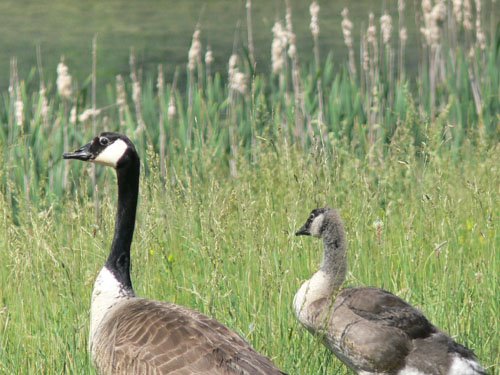 Refuges are found in "exotic" places such as Florida, or places closer to home, such as Muscatatuck NWR near Seymour Indiana, a mere one hour drive away. The birds here were more familiar overall, but it was a thrill to watch a Wood Duck family with 12 little babies swimming in a row, or the Red Headed Woodpecker that landed in a tree right in front of our car. Cars do make good bird blinds. Any people we saw were interested in the birds and wildlife too. Not once did I hear an annoying child whine or argue with a sibling. We used the spotting scope to see a Great Blue Heron release the fish that was too big to swallow after all, and finally decided that the white billed bird must have been an American Coot. These Canadian Geese weren't disturbed at all when our car slowly approached them. My biggest problem was not getting the mirror in the shot!
Sunday, June 04, 2006
The Thrill of Discovery
Saturday was an exciting time at the Falls of the Ohio State Park. I have been watching ospreys there for quite a while. Last summer we saw four of them in the air together in September. This spring people saw them carrying sticks. There must be a nest somewhere, but no one could find it. Of course, the park has several uninhabited islands in the middle of the Ohio River (inaccessible without permission from the Army Corps of Engineers) which would be perfect nesting areas for an osprey family.
Yesterday when I arrived around 8:45, I saw one of the ospreys hunting over the river. Swoop down. Pull up, no fish there. When he flew in front of the rust colored 1870 railroad trestle, his brown feathers blended perfectly, and he became invisible for a while. As he turned for another loop, a flash of white under his wings seemed to say "Here I am. Try to keep up, OK?" Finally, he dove and came up with a beautiful silver fish, and immediately flew off with it. I followed him carefully with binoculars, and saw him head for a dead branch that looked like a great place to land and eat breakfast. However, instead of landing on the branch, he went right past it. Through the scope I saw wings stretching and a white head or breast flashing through the leaves. Hot dog! I think this must be the nest. There was lots of activity for a few minutes and then things settled down again. A little later, one of the ospreys flew down to bathe in a shallow spot in the river.
The staff naturalist at the park now knows where this tree is, as well as several members of the local bird club, so lots of people will be watching for more activity there. Hopefully, someone can get permission to go over in a boat and check this tree for a nest.
First Rule of Birding: You have to be in the right location at the right time. Some of it is luck and lots of it is perseverance.
Friday, June 02, 2006
The Brave New World of Blogging
 Hello World. I have been browsing others' blogs on birds and photography, and for some strange reason, felt the urge to start my own. Is it ego? Well, I'm certainly not an expert birder by any means, but an enthusiastic amateur. I'm not an expert photographer either, but I take my chances and take my shots when I can. Photoshop Elements makes me look like I know what I'm doing, and I toss the rest. Surely, there is someone out there who is in the same situation--just beginning and looking for assistance. I have lots of questions that someone may consider dumb. But if I find an answer to them, I'll be glad to share with other beginners.
We live in Louisville, Kentucky, and I spend a lot of time at the Falls of the Ohio, so my bird photos will be from his area for the most part. However, we have a big trip to the Virginia Eastern Shore on Chesapeake Bay in September and I'm really looking forward to it. Have to figure out how to take terrific pictures before then!
Hello World. I have been browsing others' blogs on birds and photography, and for some strange reason, felt the urge to start my own. Is it ego? Well, I'm certainly not an expert birder by any means, but an enthusiastic amateur. I'm not an expert photographer either, but I take my chances and take my shots when I can. Photoshop Elements makes me look like I know what I'm doing, and I toss the rest. Surely, there is someone out there who is in the same situation--just beginning and looking for assistance. I have lots of questions that someone may consider dumb. But if I find an answer to them, I'll be glad to share with other beginners.
We live in Louisville, Kentucky, and I spend a lot of time at the Falls of the Ohio, so my bird photos will be from his area for the most part. However, we have a big trip to the Virginia Eastern Shore on Chesapeake Bay in September and I'm really looking forward to it. Have to figure out how to take terrific pictures before then!
Subscribe to:
Comments (Atom)