Sunday, June 07, 2009

Hear the Frogs in Yonder Pond

Even the bird club doesn't always find different birds, or many of any sort, on an outing. Not to be discouraged, the resilient birders turn their efforts to other more numerous creatures. Since we walked past the frog pond at Creasey Mahan Nature Preserve just before dusk, we found more frogs than we could count. Green frogs in a pond covered in duck weed are a real photographic challenge!
In fact, they ought to rename this small water plant "frog weed," since the frogs find it the perfect cover. We heard one bullfrog, but it looks like most were green frogs instead. You can tell a green from from a bullfrog by the raised tympanum behind their eyes. I never noticed before how solemn all frogs look.
Listen to the song of the frog in yonder pond, krick, krick, krickety krick, Br-ump! Sounds a bit like a concert of rubber band players! The female Common Whitetail dragonfly does not have a white tail at all, which doesn't surprise us a bit.
You have to count fast to see how many spots this Twelve-spotted Skimmer has before he flits away.
Even the Red-eared Slider is covered with duck weed when he climbs out on a log for a little sunning before dark.
Great Spangled Fritillaries "frit" from flower to flower in the still, humid afternoon.
As we return to the parking lot, we overhear these Bluebird parents discussing who's turn it is to feed the children this time.
We have tried on three different occasions to find nearby Putney Pond, and got more specific directions from other club members. We actually found the correct driveway, but still did not see a path, so we will have to ask again, or better yet, get someone to show us!

Friday, June 05, 2009

It's June, June, June

Omigosh! How did it get to be June already! Today we explored a new trail sponsored by Papa John, the pizza king here in Louisville, and decided we'll have to go back soon. When I tried to identify some of the wildflowers we found, I had to go to the Summer section of the wildflower field guides!
Ebony Jewelwing Damselfly
Remember that old song? "Let me tell you 'bout the birds, and the bees, and the flowers and the trees..." The Anchorage Trail winds among houses of the affluent, behind an orphanage, and along a creek leading into Willow Lake, which has no willow trees, by the way. But the trail leads to many birds, flowers, bees, and other insects.
Hackberry Butterfly
The birds and the bugs paid no attention to the economic status of their neighbors. I, however, was surprised to see soy beans planted in fields along the path.
Cedar Waxwing
Some of my favorite birds came close enough for good photos, and I thank them for starting my summer birding off right!
Baltimore Oriole
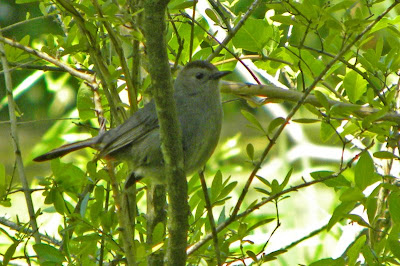
Gray Catbird
At Willow Lake, the fish were not jumping, but swam quietly in the shallow water. Yes, the water really is this clear.
As we approached the edge of the water, a loud splashing drew our attention, and we just glimpsed Mama Wood Duck as she herded her brood behind some bushes, to protect them from these humans. Most of the humans we saw on the path were gossiping with a co-walker, or just talking on cell phones. They would have been just as happy at the YMCA, rather than in the bright sunshine and the cooling breeze. Mama, I don't think you really have much to be concerned about when it comes to humans. They don't care. Geese know they have nothing to fear from people, and just took their time.
Dick likes to sample berries he finds in the wild, a practice I refrain from doing. "Is this a wild strawberry?" he asks? "Maybe so, or maybe it's one of those partridge berries. Squish it and see how soft it is," I advise. So he plucks the berry and puts it in his mouth. Some day he's likely to come home with a stomach ache from something like this. These blackberries will be nice and ripe before too long though. Yum!

Tomorrow I'm going on a field trip to collect and learn about dragonflies and damselflies. I visualize the damsel(fly) wearing a tall hat and flowing scarf, leaning out of a tower calling for some knight to rescue her from the dragon(fly). I know that's just being weird, but it makes me laugh, as I whirl in circles trying to find one of these creatures willing to land and be still for a few seconds while I take its picture! Wish me luck that I come home with lots of good photos and leave all the chiggers and ticks behind.

Sunday, May 31, 2009

Bern Swallows

Several pairs of Barn Swallows nest under the porch roof of the Garden Pavilion at Bernheim Forest. Maybe we should call them "Bern Swallows" instead. Don't you just love these little faces peering over the nest edge? They still have little fuzzies on their heads. Awww... Proud Papa protects his family, and we got dive-bombed until we made a tactful and hasty retreat.

Well, Ma, I chased them away. Don't know why these durn people never learn!

Here's our neighbor, still sitting on her eggs.

Crows just like to chase hawks for the fun of it.

The Goose family enjoy Sunday morning brunch at Bernheim Forest. My, my, don't the children grow up quickly!

Papa Brown Thrasher watches to make sure we don't get to close to his mate and nest in the bushes.

A Bernheim Ent has issues with a No Trespassing sign. Not sure if he's for it or agin' it!

Saturday, May 23, 2009

Identifying the Invasives

When my focus shifts from birds to flowers, I consistently struggle with the same problem. When birding, there are many field guides to choose from, but all the books for Eastern North American contain the same birds. I only have to use one field guide for that area. When trying to identify wildflowers, however, it takes at least two or three, and even then I have trouble finding the plant in my photograph. One field guide proudly limits itself to "true" wildflowers. Another arranges each plant according to family. If you don't know what family it belongs to, good luck trying to find it. A third book wants you to look for the number of petals and their arrangement on the bloom, then look at the leaves and their arrangement. Even while trying to "key" a flower I already know, my analysis and the book's analysis of these features rarely match, leading to great frustration on my part. Just forget finding a plant not in bloom!

Invasives and weeds are seldom included in the field guides, yet they are the most abundant flowers to be found in most places. The number one clue that a plant is invasive is this abundance. Whenever you see a plant that fills a field, displaying its color over a large area, count on it being an invasive. These pictures are of Poison Hemlock, the same that Socrates drank at his death. All along Beargrass Creek this morning, Poison Hemlock grew taller than my head. Yesterday 15-20 volunteers at the Falls of the Ohio worked all day to clear weeds out of the flower beds, including anything that looked like a carrot, stands of red clover, and too many things I couldn't identify at all. My back hurt all night as a result. I guess it's not fair to equate "weeds" and "invasive" plants so lightly. Native plants growing where people don't want them are considered weeds too.

Are these plants part of the Dark Side of the Force? They can be quite pretty. Honeysuckle smells so sweet. Birds like multiflora rose hips and use the thickets for shelter. The tiniest flowers are intricate in design. Often, they look like orchids under a magnifying glass. I'm sure you all know that invasives out grow the native plants. Bush honeysuckle even changes the chemistry of the soil for its own benefit. It's hard for me to even imagine what Kentucky looked like without all these common plants.
Louisville's city parks were designed by the famous Frederick Law Olmsted, and I attended a presentation by the Olmsted Parks Conservancy group, which is trying to restore, enhance and preserve these parks. They cut down bush honeysuckle, then apply industrial strength Roundup to the stumps to kill the roots. We were surprised when he said that within a year or two, the native wildflowers started coming back up. The seeds were in the ground just waiting for a chance to grow. This is the most encouraging thing I have ever heard about the War against Invasives.

Can you identify these common invasive plants?

Last night was Froggy Night for the Bernheim volunteers, and we joined them on a trip into the research forest to a restored wetland area. The early farmers often straightened the creeks on their farms to provide more rich land for crops, eliminating the natural twists and bends in a stream. Look around your own area. If you see creeks that run against one side of the valley, while the rest is open, most likely they have been straightened. I didn't actually go into the creek, but our expert sat there for a while, identifying the different toads and frogs by their voices. Then he reached out, and came up with this guy, a Fowler's Toad. How could he tell? He looked at the number of warts in the dark spots on its back. Apparently that's the field mark to look for in toads.

My goal in life to to know everything (well, as much as I can absorb), but I'm not so sure I need to know how many warts are on a toad's spots!

Oh, yes. Here's a great birding note to end with. I saw a mature Bald Eagle on the wall of the dam at the Falls of the Ohio last Wednesday, and others saw him the next day. We have seen Eagles quite a few times this spring, and there are reports of a pair on an island a few miles upstream. We are all hoping that they may decide to stick around our area.

Saturday, May 16, 2009

Bluebird Bonanza

Although my husband is the primary volunteer at Bernheim Forest and Arboretum in our family, I went to represent the Beckham Bird Club today at Bernheim's big Bloomfest event. The table next to ours hosted the Kentucky Bluebird Society, and Mr. Bluebird led a walk to check on the Bluebird houses. Of course, I jumped at the opportunity, since my backyard has absolutely no chance of ever drawing any Bluebirds. It was fascinating to see the baby birds in their nests.

We must have set some kind of success record, finding 6 of 8 nest boxes with Bluebirds successfully nesting in them. One had eggs only. Another had new hatchlings with their eyes still closed, which we counted by finding the yellow beaks. One little guy was completely buried under his siblings. Another box had one hatchling and a few unhatched eggs. Two other boxes had old nests, but were vacant now.

Bernheim installed a nest cam in a box just outside the education center. Unlike many online cams, this one has a live feed to a monitor in the education center so you can see every movement happening in the box. Mama Bluebird came with a juicy grub, but all the babies were napping, so she ate it herself. Can't let those grubs go to waste!

Another box held babies with their eyes open, and they showed no interest at all, either panic or joy, in the large hand entering their world and moving them around to search for a buried Bluebird sibling. Look at the blue tips on their developing feathers. Mr. Bluebird says that when they are ready to fledge they just burst out of the box and fly away. There is no room inside to stretch and exercise those flight muscles.

We discovered that the ninth box held a nest of Tufted Titmouse babies when the Titmouse mother scolded and cursed at us as loudly as she could directly over our heads. We finally took pity on her (and spared ourselves a dive-bombing) by leaving the box unopened.

As we walked up the hill a way, Mama Titmouse immediately entered the box with a tidbit for the babies, then hurried away to find the next serving.

Thanks, Mr. Bluebird, for a terrific afternoon learning about Bluebirds in wonderful detail. I greatly admire his skill in determining how to open each box, since each was different. His tool of preference? The handy, dandy Swiss Army knife, of course. I was also interested to see the various stages of development in the different nests. My favorite story was when he reached into the nest under a sitting mother, lifted her up to count the eggs, and she didn't move a feather. We didn't find any birds actually on the nest today, but we had a bonus with no House Sparrows in any of the boxes!

Harris Hawk

Our friends from Raptor Rehab of Kentucky attended Bloomfest with some of their favorite birds and mine.

Turkey Vulture

American Kestrels

Green Dragon Blossom

After the great birding opportunities, as the crowds started to trickle off, my flower buddy and expert, Tavia Cathcart, asked if I'd like to go hunting Green Dragons. Dragons? You mean the fire-breathing kind of dragon? No, this is a flower, one I've never seen before, and she was very excited about it.

Most Jack in the Pulpits are finished blooming by this time, but Bernheim's Jacks are in good shape. This one is a Jack in the Pen apparently. Can't imagine was sort of natural law it broke to land in jail!

Flowers and birds weren't the only attendees at Bloomfest. This insect arrived early in the morning, and seemed fascinated with leftover stickiness on the plastic tablecloth I brought from home.

Our favorite blossom is the Wren Flower--a unique forest beauty found only at Bernheim Forest and Arboretum!