Saturday, June 04, 2011

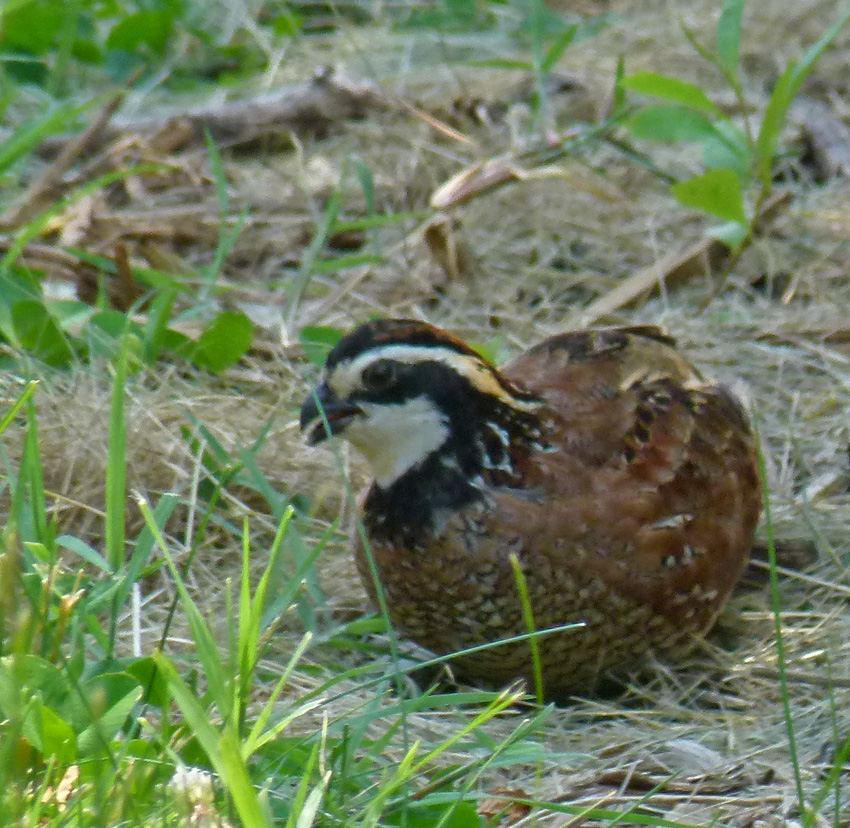
There be QUAIL!

Bobwhite photo by Dick Dennis
When I was a girl, growing up in a small rural community in southwest Ohio, the pert bob-bob-white of this bird could be heard any time you left the town limits. As a birder, however, it is a stellar day when I find Bobwhites now.  If you look for them online, be prepared for ads about rising quail, but there is good information on these sites as well. Apparently there is money to be had in these small birds.

They are the number 1 game bird in many states, but the main cause of their decline must certainly be habitat loss.  A quail range is a delicate balance of cropland, nesting cover, woodlands and fence rows or waterways which serve as travel lanes. Early explorers found quail only in prairie openings or around Indian clearings. Quail closely followed the ax and plow of early settlers, probably reaching their peak abundance about the time of the Civil War. Improvements in farm machinery resulted in larger fields, fewer fence rows and odd areas, and less living space for quail. Oddly, the Bobwhite range in some areas has been hurt because too much land has gone back to timber or has been converted to grasslands which do not support quail.

Bernheim Forest restored a large grassy area several years ago from mowed recreational fields to natives grasses and wildflowers.  Controlled burns keep weeds and trees under control.  In the last year or so, someone had a great idea of raising quail to be reintroduced here. Eggs are in an incubator in the Education Building, then moved to a protected fenced-in "coop" when they hatch.  Several releases have been made, but I haven't heard any guesses about the survival rates.

When we arrived at the Education Building this morning, prepared to teach a Birding Basics class to some of the volunteers, the first sound to greet me was bob-white! bob-white!  What a great way to start the day! While I set up the laptop and projector, Dick got photos of them, which I quickly added to the presentation.  Next week, an Audubon Society group from Owensboro, KY, is coming to Bernheim for an outing, and now I know where to look for these delightful little birds. They've decided that the bottlebrush buckeye trees, which grow branches completely down to the ground, provide wonderful shelter.  No hawk is going to get them here!

Monday, May 23, 2011

Carolina Wrens in Kentucky

Carolina Wrens are the loudest little bird in our backyard.  They sing back and forth to each other at all hours of the day.  When they chatter and scold, you know you are in trouble! I have been noticing much more activity than usual, and here is the reason... they are starting to nest in the hollow gourd hanging outside the back door!
Wrens have nested several times before in our garage.  Once in an upturned bicycle helmet belonging to one of the kids (you can't ask for a more perfect nesting site), and once in a fruit basket hanging on the wall.  As long as we leave the window open a crack they can get in without any trouble.  The one time we actually closed that window, the loud calls alerted us to the problem.
The book says Carolina Wrens eat insects, and I hope they do, because we get plenty of bugs in the yard.  But I notice them chowing down on the suet and peanut feeders more often.  In fact, when I refilled the peanut feeder yesterday, the Wrens and Nuthatches were quite excited!
Some House Wrens built in the gourd the first year it was up, but I'm glad to see my favorite little birds moving in now. And, no, we don't have any snow.  I just pulled this one out of my collection.

Monday, May 16, 2011

Flying Through a Tight Spot

Loving raptors as I do, I was fascinated by this video of a Goshawk flying through various small places.  This is how they can fly through dense brush as well as soaring in clear air. And all without losing air speed. This is too cool!

Tuesday, May 10, 2011

FloraQuest Flora

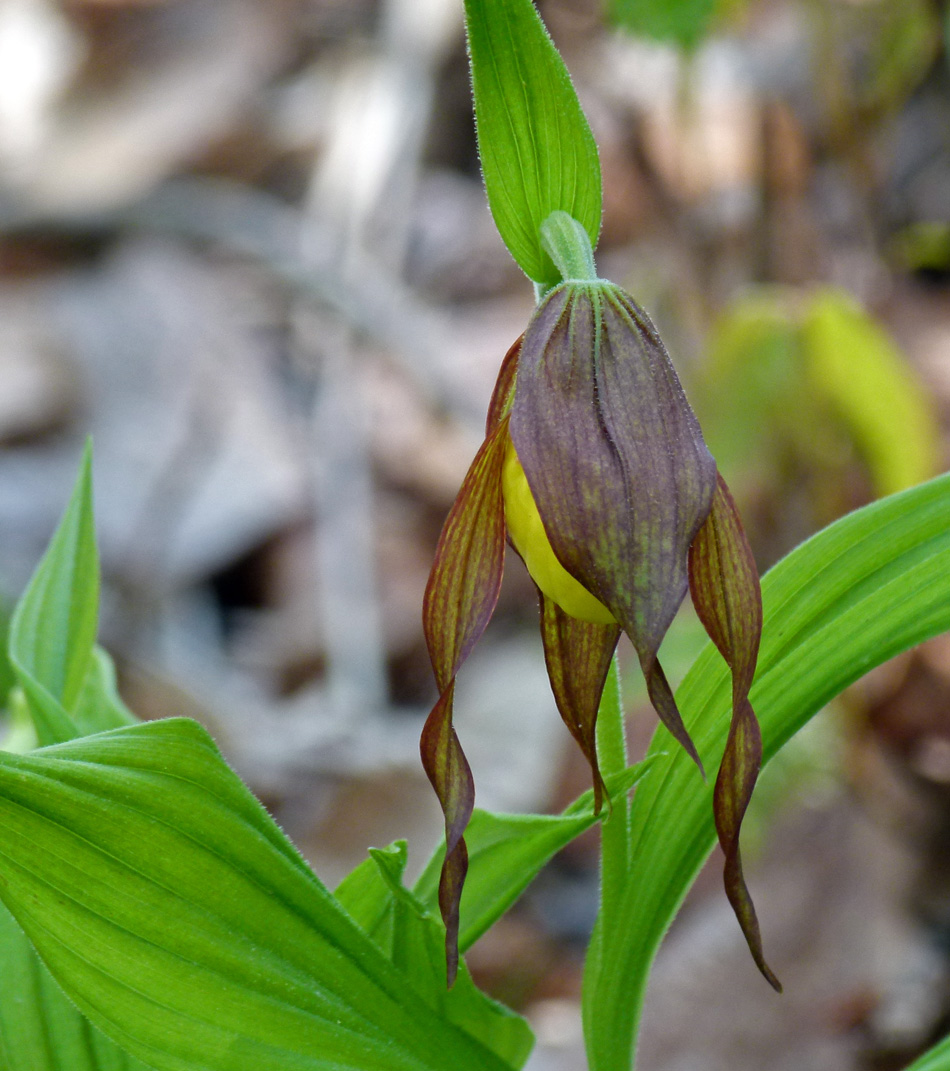
Orchids always amaze me.  I don't find them in my normal wildflower haunts, but only see them when I am with an expert who knows where to find them. In Indiana last year, we saw Yellow Lady's Slippers in some well-mulched forest, about as I expected.
In Ohio at the FloraQuest, we found more of them in poor conditions - on steep hillsides along the roads, for example. But they are beautiful no matter where they grow.

I think Pink Lady's Slippers must grow somewhere in Kentucky, but I haven't found any yet. 

Showy Orchis grew at the Pine Mountain Settlement School in Kentucky, but we didn't get to see it blooming that year. 

I expect orchids to be shaped like the ones you always hoped to have in a corsage in high school, and the reality blows me away.  Take these Whorled Pogonias, for example.  They look like the giant wind mills you see on some wind farms! The ones we found were all clustered around the foot of a tree.
At first, I thought he said we were going to look for begonias....

Tiny Bluets clustered around the base of many trees.  Someone said ants carried their seeds but couldn't get them any farther up the tree.

Dwarf Crested Iris have little, well, crests when you look at them closely.
Fire Pink showed up in only a few spots, in the worst soil conditions we found...


...as did the Pinkster, a wild Azalea we found above the mow mark on the roadside.
Indian Paintbrush has teeny, tiny little flowers.  The large orange parts are really bracts, much like the red bracts on a Poinsettia at Christmas. It almost looks as if the bracts have been dipped in orange paint when you look closely. These grew in a cemetery.
When we first saw the Spotted Mandarin (a member of the lily family), I thought it was Solomon's Seal in full bloom. Shawnee is the northern-most tip of this Appalachian plant. I don't have an official "lifer" list for wildflowers yet, but maybe I should start one with the Lifers found on this weekend!

Friday, May 06, 2011

After the Flood

The Ohio River crested Wednesday night at 31.1 feet, below what was forecast. It is slowly falling, but still well above flood stage, which is 23 feet. Flood levels downstream from Louisville are among the highest in many years.  At Cairo, IL, where the Ohio flows into the Mississippi River, the levels are higher than the great flood of 1937. For most Louisvillians, the flood has been a minor inconvenience, except for those folks who have homes on the river itself.  A few roads have been closed, but most people were unaffected.  They have postponed the annual Steamboat Race which normally would have been run on Wednesday (yes, this is Derby Week).  With the river this high and full of debris, it just wouldn't be safe.

Here are more views taken from the Falls of the Ohio State Park.

The gates on McAlpine Dam are completely open, lifted up and away from the water. I've seen a photo of a towboat and barges going right over this dam once, rather than using the locks on the other side.  The water was high enough to go over the dam, but he took a chance of running into the railroad trestle.

The willows growing just beneath the dam are completely covered.

Here is the same area under normal conditions.  You can see the gates on the dam are in a closed position, letting out only a small amount of water, and willow trees are growing in the sand.

These are the two sycamore trees growing on the Upper Fossil Beds at the Falls.

Debris is the big problem after flooding like this.  You can easily see the high water mark, a combination of logs, plastic bottles and Styrofoam left on the banks after the water started to recede.

We don't usually do anything about the logs after a flood.  If we cut them up and throw them back in the river, people downstream complain about it.  They will float away next year when the river rises.  The real problem is all the plastic, car tires, Styrofoam, coolers, and refrigerators which now clutter the recreational and native habitat areas.  The River Sweep won't be until June 18th, but the call has gone out for volunteers to come now and get a start on this mess.  Just try counting the plastic bottles in this photo of perhaps 4 feet of shoreline, then do the math for 1,000 miles of Ohio River, and double that to include both shores.
Wildlife is affected by the debris as well.  A pair of Canada Geese honked forlornly, looking for a calm place in which to swim.  The current is swift and the shores are full of logs.  They eventually flew up to the railroad trestle to reconnoiter - a place I have have seen geese before.  The debris must attract large numbers of insects though, because the swallows were have a feast.

But this Song Sparrow didn't seem dismayed.  He found a high and dry spot to sing his song, no matter what.  I must admit it cheered me up too.

Sunday, May 01, 2011

FloraQuest

Blue -headed Vireo Building Nest
You would expect a weekend called "Floraquest" to concentrate on flowers, and we did see many beautiful wildflowers at Shawnee State Park in Southeastern Ohio this weekend, but Floraquest is much more. After early morning bird watching, and a filling breakfast at the Lodge, participants set out on ten Quests, looking for butterflies, trees, rocks, Appalachia in Ohio, as well as the flowers. One group of hardy souls even rode off on bicycles, although I don't see how they survived if they used the same roads we did! After a solid week of rain, and basement floods twice in two weeks, we were overjoyed to have a little sunshine on Saturday.  Even showers on Sunday morning didn't stop us.

Blue-headed Vireo
Southeastern Ohio is known as the Little Smokies, sharing many characteristics of the Appalachians with West Virginia and Kentucky. We all know that the Ice Age glaciers flattened most of Ohio several times.  However, the southeastern third of the state manage to escape this fate, retaining a connection with the Appalachian Mountains, which were much much larger at that time.  The two mile high glaciers blocked the ancient Teays River, draining north through the current New and Kanawha Valleys, then north through the center of Ohio, and west towards the Mississippi (they think).  The glaciers put an end to this by burying the river in ice, so all northward flowing water had to look for a new outlet.  At one point, they backed up to from Lake Tight, almost as large as Lake Erie is today, while tips of the mountains, and what is now Adams County and Shawnee Forest, turned into islands.  After about 6,500 years, the blockage burst, and the lake drained. Given all the time I've spent studying geology at the Falls of the Ohio, this fascinated me, although some may have taken an after-dinner nap during the presentation.

Red Bellied Woodpecker
Over the entire weekend, Dick and I saw/heard a total of 79 species of birds, including all the woodpeckers except the Sapsucker!  Since the leaves are coming out, birding by ear was the method used by everyone, and we really got to practice up on our song ID's, especially for warblers - always a challenge for us, since they like to feed so high up in the canopy and are difficult to see at all.  If I didn't know their song, I'd have no idea at all what was up there.  Each year we listen to the cd, trying to add two or three more birds to our repertoire.  This year, I think I've nailed down the Yellow Throated Warbler and the Cerulean Warbler.  (I hope!)

My quest leader was Ohio's own Jim McCormac, author and knowledgeable about everything! His blog on Ohio Birds and Biodiversity is right on the target for his knowledge base. The Quest folks gave us not only a Birds of Ohio checklist, but a plant list for the area, with both common and Latin names for each plant.  Jim just rattled off the Latin like he speaks it at home every day, which he very well may do.  But I really appreciated his dedication to us birders.  Not only can he hear warblers through a closed van window, he made sure we recognized the song as well using a program on his phone. But he was very careful not to overuse the technology and freak out the little guys up in the treetops.  One of the hardest things about birding is finding the bird someone else has discovered.  Where is it?  In that tree... goes that standard answer. Sigh!  Jim carries a small laser pointer to trace the path to the correct three, and he can hold it steady on the appropriate branch.  I was so impressed!  Our birding was a big success because he patiently made sure that everyone saw the bird.  Just follow the green dot in this photo, and look to the right for the Blue-winged Warbler we found.

Prairie Warbler
The forest terrain only goes in two directions, straight UP and straight DOWN.  We took that large Ford van up and down the switchbacks, and across ridges barely wide enough for a one lane gravel road, then squeezed to the side without falling off when traffic came at us from the other direction.  Thank goodness I didn't have to do the driving! Sometimes this topology works to your benefit, because the upper levels of the trees are right at your eye level from the road.  Other times, I would lean backward to find the top of the tree with the bird, and the tree is also at the top of the slope above, making me doubly dizzy. With persistence, however, I got some good shots of several warblers, while finding others in the binoculars (including a LIFER Kentucky Warbler), and honing up on my warbler songs, calls and birding tips.  For example, although I know that eastern tent caterpillars are found in black cherry trees, I never knew that Baltimore Orioles and Cuckoos eat them, while other birds don't, so I can look for those birds where I see the tent caterpillars. Cerulean Warblers and Red Headed Woodpeckers like areas where the trees have been disturbed, and we saw both where the ice storms made clearings in the forest.  And have you ever heard the Kentucky Warbler's song described as sounding like a galloping horse?  Well, that may be a bit of a stretch...
Fence Lizard
Jim knew all the butterflies too, but we really enjoyed this fence lizard that rustled through the leaves and up the side of a tree. "Go look at his side, and try to spot his blue belly," Jim suggested, "that shows it's a male.  But the male Tiger Swallowtails don't have much blue, while the females do." Would you ever think to look at the belly of a lizard on a tree?  I will from now on.
Eastern Bluebird
More on the flora part of the weekend tomorrow....

Sunday, April 17, 2011

Up and Down, and All Around

Shivering in the 40 degree temperature on our final morning at Carter Caves State Park, we joined Evelyn Morgan on a bird hike. Only a few of the roads along the ridge tops are even close to flat, so we hiked down to the stream, then up again to another ridge.  It's strenuous, but beautiful.  All the streams emerge from caves, or another small opening in the sandstone cliffs, then run down the hillside eroding smooth paths from layer to layer in the rocks, growing larger as they are joined by smaller streamlets on the way down. The high muddy levels from yesterday had all gone down, so we enjoyed clear water again. 
After you follow the stream bed for a while, enjoying the splashing sound as it leaps from one rock to another, suddenly the splashing grows louder, as the water swirls around and dives underground! Sometime it seems to sink right down, but in one spot, the water circled around like bathwater in a tub before disappearing! We climbed a steep ridge, then down the other side, and guess what -- the same stream emerged again. The water has an easier time, I suppose, since it only has to go down, and never climb up again!
When you get out of breath from climbing those hills, you can always stop for a little bird watching, and no one will notice the huffing and puffing as everyone scans the trees for that elusive warbler singing just above you!  Today, we focused on the woodpeckers.  Loud drumming on a nearby tree sounded like Pileated, but when we saw one fly across the trail, calling "wacka-wacka," our guess was confirmed.  We saw the pair of Pileated inspect the nest hole in a tree, then climb right in.
The Red Headed Woodpeckers chased each other all through the woods, calling loudly.  I've always wondered why most of the woodpeckers are colored black, red and white in some combination. Think about it...
 
As we entered the steep valley on the Horn Hollow Trail, it reminded me of our trip to the Pacific Northwest. It seemed to be a mature forest, with lots of dead trees laying on the ground, slowly decaying.  Moss and ferns covered the trees, and other plants got a start in the moss, just like the nursery trees in Olympic National Park.

The moss was ready to produce spores, just as the flowering plants are reproducing, but moss grows its own little forest on top of a log!

Then the trail turned up the hill for the longest, steepest climb of the day.  Moisture stayed in the valley, and sandstone sparkled in the sun, but very few flowers bloomed in the dry upland conditions.  Signs at every sinkhole advised visitors that special permits were required to enter these caves.  In fact, many caves in Kentucky will be closing soon because the White-nose Bat disease is now officially found in Kentucky, along with all the other states nearby.  This fungus infects hibernating bats, and some caves have had almost 100 percent fatalities, so everyone is very concerned. On the uplands, the sandstone is worn to this lattice like appearance, but I couldn't guess if it was done solely by wind, or if water used to flow here.  Can you picture little bats peering through these windows in bat condos?

Saturday, April 16, 2011

A Little Rain...

We've all heard the phrase..."Into each life, a little rain must fall."  Well, I must say that we've certainly had our share of rain or more lately.  Last Monday, it rained all day and all night.  An stream runs under our house, and when it rains without stopping, the creek rises and floods our basement. Tuesday we found 4 inches of water in the basement.  Sigh...  So the carpet is gone, and the blowers were still blowing when we headed off for the spring meeting of the Kentucky Society of Natural History on Friday morning.  And...you guessed it, more severe weather in the South, including another inch + of rain. But what's an inch of rain to dedicated Naturalists in a wonderful place like Carter Caves State Park in Kentucky!


John Tierney, park naturalist for many years, leads us to Box Canyon. Water drops from the branches, and hangs from the leaf tips as rainclouds finally blow away and the sun breaks through.  After a short but steep climb, we turn the corner to find Box Canyon with a waterfall leaping over the edge, something which would not have happened without all the rain of the last 24 hours.  There, we found some good from all the rain after all!  Water dripped, dropped, and slid over every rock face, so I was glad to have my rain coat to keep the camera dry.
As we drove up the hill into the park, I had to stop the car and jump out to see all the wonderful white Trillium growing under the cliff faces!  Since we only have Sessile Trillium at home, I was excited to see these.  Although the petals are white, look at the maroon center - characteristic of Erect Trillium, John says - but Tavia's book says they are Sweet White Trillium.  Hmmm, I'll have to double check with her.

As an added treat for having survived all the rain, we also see hillsides full of the Large-Flowered Trillium, Trillium grandiflorum, where the white flowers turn pink as they age and are about to fall off. I asked John why we never see these white trillium at home.  Could elevation have something to do with it?  Olive Hill is about 1060 feet in elevation, and I bet many spots in the park are much higher.  He says they have to have a particular pH level in the soil, and here it is just right.

Oddly enough, we saw some very early bloomers still in bloom, while other flowers which I would expect to see in another month (such as Dwarf Iris, Wood Betony and Hoary Puccoon) were starting to bloom too.

Limestone is the favorite habitat for many flowers, including this small Stonecrop, which seems to grow in solid stone.  Moss and lichen are the first to grow on the limestone cliff faces, or on boulders fallen to the ground.  Then Stonecrop, Bishop's Cap, Ginger and ferns root in the moss.
Quick, there's a Newt dashing between the wet leaves. For a little guy, he runs really fast. The 3 inch long slug we find on a damp log waves his eye stalks, but is in no hurry to go anywhere.

Bird song echoes off the rocks- an Ovenbird down in the creek bed, Cardinals in the trees, a Towhee in the brush.  This Chipping Sparrow perched on a fence at the lodge, singing back and forth to another Chippie at the other end of the building.  Isn't he a beautiful little guy!  Tomorrow, we will brave cold temperatures for a bird hike.  With this group, there is always on expert on hand for anything you find!  I just hope the smell from the basement isn't  too bad when we get home.