Sunday, April 29, 2012

Natural Bridge, Natural Wildflowers

The last two weeks of April are Derby Festival in Louisville, but Dick and I decided to head for the hills instead. Natural Bridge State Park and the Kentucky Native Plant Society hosted their 31st annual Wildflower Weekend, and since we had not been to Natural Bridge and the Red River Gorge for several years, we decided to go. Of course, our friend Tavia Cathcart, Executive Director at Creasey Mahan Nature Preserve, was the keynote speaker for Saturday evening, which encouraged us to come here rather than the Smokies. All the spring wildflowers are blooming about three weeks earlier than in most years, so we weren't sure how many flowers would be seen during the weekend, but boy, were we surprised! I don't keep an official life list of wildflowers (although I should probably start one), but I would have added at least 23 new species this weekend! I was amazed that things like trillium and ginger were still blooming, though not in great abundance.

The orchids were the most exciting to find. Just like some of the best birds are found while standing in the parking lot, some of the nicest orchids were growing right next to the main trail going up to the bridge itself. We saw large orchids, such as this beautiful yellow Lady's Slipper...


 and showy orchis within 3-4 feet of the pathway.


The pink Lady's slipper was much more elusive though, and we risked tripping on roots and rocks in the path to scan both sides of the hill for them.


Typically, I envision orchids as large and elaborate, the big flower you wear at the prom. But many orchids are small and inconspicuous, if not downright invisible! This spring coralroot is an orchid, and the closer I stood to get a photo of the minute blossoms, the harder it was to focus.


The birds sang all day, from Carolina Wrens who sounded like they were using amplifiers, to three little Ruby-throated Hummingbirds dive bombing each other at the feeder. I often thought the same Hooded Warbler was following us around, since we heard one no matter where we hiked, along with many other unseen warblers. If I hadn't studied bird song for many years, I could only have claimed 5 or 6 species actually seen. But then a larger bird flew through the trees and sat where I could find it in the binoculars. The most wonderful Wood Thrush just sat and posed for at least 5 minutes! All his relatives or rivals had serenaded us, but this one came out to take a bow!


He showed each profile, then turned so we could see his warm cinnamon brown back and pink legs. This bird certainly made up for all my disappointment with the other birds that stayed in hiding!


Each of the Kentucky State Parks has a dining room with a view, and they hang bird feeders by the windows for the entertainment of the diners. As always, the gray squirrels show off their acrobatics chasing each other up and down the trees, jumping on the feeders, and hogging all the seed. We met a couple who have attended 30 of these wildflower weekends at Natural Bridge and they gave us a tip. "Come back this evening, when the dining room is closed and darkened," they said. "The flying squirrels come then to get their share of the sunflower seeds." We gingerly shined a flashlight to be sure they were present, and the small noctural squirrels weren't disturbed at all.  I got brave and turned on my camera flash, and that didn't bother them either, so I got some marvelous photos of  their shining eyes and sleek skin folds they use to fly! Every few minutes, you would see a faint glimpse of something in the air - another flying squirrel. I've never seen them in the wild before, so it was truly exciting, and I passed the tip along to a little girl in the lobby the next day. Hope she was able to see some.

If you have never been to/heard of Natural Bridge before, look into it. The Red River shaped the Red River Gorge much as the Colorado River shaped the Grand Canyon. Over millions of years, the river cut and left quite impressive rock formations, also known as arches. In the Red River Gorge there are an estimated one-hundred fifty (150) arches, a number surpassed only by Arches National Park in Utah.To reach them, you hike through deep thickets of rhododendron and hemlocks which may be lost to the wooly adelgid in my lifetime. It's like the glaciers - you should try to see them while you can. The rhodies aren't in bloom yet, but on top of the ridges, the mountain laurel are ready to put on a show. They often grow in a crack of the rock out into nothingness. But look at the delicate landing pads they provide for pollinators. Actually, Tavia's presentation was about the tricky ways flowers attract pollinators, so I now appreciate these more than ever.

Wednesday, April 18, 2012

New Finds at the Nature Preserve


Every spring I get out the field guides for wildflowers, butterflies, dragonflies and fungi, along with the birdsong CD's, to review and relearn things I thought I knew well last year. Many things I can remember, a few more each year (subject to Senior Moments of course). But sometimes I get lucky on a walk at the Nature Preserve, and something I've never seen before pops up. Then I get out all my field books (we could start our own nature bookstore), turning pages looking for a photo that matches the one I took. Sometimes I just have to send my photo to one of my friends who specializes.


The sweet honeysuckle, invading every path, is visited by a black butterfly with white spots which I've never seen before. Fortunately, the first butterfly book I check shows a picture of this to demonstrate the difference between butterflies and moths, since this is actually an Eight Spotted Forester moth, and not listed in the butterfly book at all. It is a showy, day flying, nectaring moth. It has long bright orange hairs on its two forelegs, which look like collected pollen. It has two creamy-white spots on the black forewings, and two on each hindwing, thus its common name Eight Spotted. Yes! I have a match!


The Woodland Fern Garden at Creasey Mahan Nature Preserve is lovingly planted with native species and exotic examples of the same kind of plant in many instances. However, the deep mulch is not only favored by many fern species, but by fungi galore. Here's one poking through the wood chips with a bright red stalk, and yes, it does look like what you are thinking. I think this is the Elegant Stinkhorn, which is supposed to, well, stink. If it did, I failed to notice it today, and continued on my walk.


Here's another odd sighting. I looked in the fungus book, but my nephew suggested it might be a slime mold.   Ewwww!

Eastern Towhees have a very distinctive song. I must have heard at least 15 of them challenging each other through the brush. Some day we should ask an expert to run a census on the Towhees. I think we have more at Creasey Mahan than any other place I go birding.


Despite many grassy areas, we have never had any Meadowlarks at the Nature Preserve. Tuesday as I made the rounds of the Bluebird nestboxes, I heard Meadowlarks in two separate meadows! Not only did I hear them, but heard and photographed one! Woo-Hoo! Life is good.

Thursday, April 05, 2012

Bird Moms

Mallard Duck Neting in Flower Bed
All Moms have to be courageous, and committed. When you carry a baby for nine months, knowing that it will only get harder after the birth, well, we all need any help we can get, right? But avian moms have it even harder than human moms, I think.

Robin Nest
First, she has to decide where to build her nest. Some birds, such as eagles and ospreys, will re-use a nest from year to year, but most birds start over each time. The location has to be close to food and water resources, yet provide will protect against predators. This Robin chose the top of a tombstone in a cemetery, only 3 feet off the ground - not where you would expect to see a Robin's nest. I don't know if she managed to protect her babies till they fledged or not, but I think a cat would find this nest easy pickings.

Tree Swallow Nest
All human moms enjoy re-decorating the nursery, and will drive from store to store to find the right sheets and wallpaper. Bird moms are choosy too. They need just the right building materials, whether moss, grass, pine needles, twigs, mud or large sticks. This Tree Swallow mom will pull the feathers over her eggs and babies when she has to leave the nest, just like we would use a blanket, to keep them warm in her absence. These are too big to be her own feathers though. Don't they look like chicken feathers?

Chickadee on Nest
Little Chickadees make the softest nests! They start with a base of green moss, then add grass and what feels like dog hair!  They sit in it to mold the space to fit just right. This little mama was brave enough to look me in the eye when I opened the door on her nest box. Without any words or chirps, she clearly told me to Go Away!

Barn Swallow
The Barn Swallows at Bernheim Forest like to build under the porch roof at the Garden Pavilion. The location is fine, but what to do about all the humans who walk beneath the nest, especially after the eggs hatch? Sometimes they dive bomb anyone who gets too close, but that can be exhausting. Or they might poop on the human's heads - always an effective tactic!

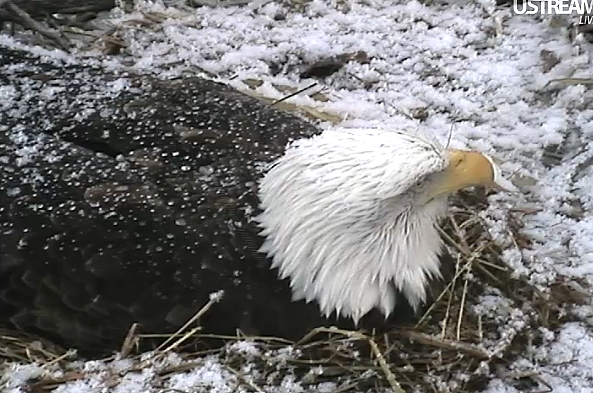
Bald Eagle on Nest in Snow
Then there's the weather to deal with. Some birds, such as Eagles and Great Horned Owls, have eggs or young while there is still the chance of snow. I worried about the Cooper's Hawks in our backyard when a big thunderstorm came. She had to sit there no matter how bad the weather got. How many human moms would do that day after day? And when the sun shines, it can be even worse with it beating down on your head.

Osprey Turning Eggs
Nesting birds lose the feathers on their bellies, creating a brood patch which allows the mom to put her warm skin directly on the eggs. But that only heats the top of the eggs, so periodically she has to turn the eggs over so they are evenly warmed.

Feed Me NOW!
Thank goodness that most of us human moms only have one baby at a time to be fed and cared for. These demanding baby Robins look like they are about to fall out of the nest. Some of our Bluebirds at Creasey Mahan have six eggs in the nest. As the babies grow, they require more and more food. A Barn Owl father may have to catch as many as 36 mice each night to feed 5-6 owlets, his mate and himself. Talk about exhausting! Yet, some birds, such as Barn Owls, Robins and Bluebirds, will have two or three clutches of eggs in a season. No wonder birds don't have long lifespans!


This is a busy time of year for all the birds, and we can help them by providing nesting materials, water, and a safe quiet place to nest. If you have cats, keep them indoors. If you don't find any nests in your yard, that's just the way the birds want it. But you can watch all kinds of birds with online nest cams, Eagles, Hawks, Owls, Great Blue Herons, you name it. One way to keep up to date is with http://www.facebook.com/nestcams.  Cornell Unviversity has several live cams as well at http://watch.birds.cornell.edu/nestcams/camera/index, and there are many more. Be careful though. Watching nest cams is like watching soap operas. You can become addicted to the feathered drama each day, but what a wonderful way for people to become interested in birds!

Wednesday, March 28, 2012

Floracliff


“When the flower blooms, the bees come uninvited.”
Today we joined the director of Floracliff Nature Sanctuary for a wildflower walk along the Elk Lick Creek valley, near Lexington. Dr. Mary Wharton was very passionate about the uniqueness of this area and worked hard to educate others about why it should not be over developed. Her advocacy for the land was exhibited by her battles over the damming of the Red River and the original proposal of the widening of Paris Pike that would have destroyed a quintessential Bluegrass landscape. With her help, both proposals were successfully defeated.

If we could see the miracle of a single flower clearly, our whole life would change.”
In the late 1950s, Mary Wharton began purchasing property along the Kentucky River that she would later name Floracliff. Her dream for the property was to preserve the natural communities and special geological features unique to the area. Dr. Wharton believed that education and appreciation lead to preservation. She recognized the potential for Floracliff to become a center for environmental education and research in the natural history of the Inner Bluegrass and Kentucky River watershed. The Floracliff staff  continue to guide Floracliff by her dreams and beliefs.

"Just living is not enough... One must have sunshine, freedom, and a little flower.”

Flowers and fruits are always fit presents; flowers, because they are a proud assertion that a ray of beauty outvalues all of the utilities of the world. These gay natures contrast with the somewhat stern countenance of ordinary nature: they are like music heard out of a work-house.

Do what you can, with what you have, where you are.
Theodore Roosevelt
When you take a flower in your hand and really look at it,
it’s your world for the moment… Georgia O’Keeffe
People from a planet without flowers would think we must be
mad with joy the whole time to have such things about us.
Iris Murdoch
Flowers are the music of the ground
From earth's lips spoken without sound.
EDWIN CURRAN, "Flowers"

Sunday, March 18, 2012

Metro Wildflowers

Amazed Ent in Cherokee Park
Louisville's Metro Parks system operates five different parks designed by Frederick Law Olmstead - the man who designed Central Park in New York City, among others. My in-law's house had Cherokee Park in the back yard, yet I rarely used it. To me, Cherokee Park was a place my father-in-law confidently drove through to go anywhere else in town. I, on the other hand, became lost any time I tried to drive in it at all. We used to ride horses through the bridle trails in the park, hitch up in the back yard and go in the house for breakfast. That part I enjoyed immensely, but again, my father-in-law was leading the way.

Let's enjoy the sunny hillside
People still love Cherokee Park, and a warm sunny Sunday attracted large crowds of walkers, bikers, children and dogs, but most of them stuck to the roads and sidewalks. Dick and I, on the other hand, discovered some trails through the woods along a small stream leading to Beargrass Creek where we searched for wildflowers, since a friend said he'd seen them in this area last year. I was amazed, since I never knew there were foot paths in Cherokee Park at all. All those people had lots of fun, but they didn't know what they were missing!
Dutchman's Breeches
At first, we saw only mown grass, but down in the stream valley, the flowers popped up, including everything we normally would not expect to see for several weeks yet. When you see the first one, it doesn't take long until you notice that species everywhere you look. Spring beauty and toothwort were the most abundant at first, followed by lovely little Dutchman's breeches.

Yellow Trout lily
Both yellow and beaked trout lily peeped through the leaf litter (but no white ones- we looked)...
Wood Poppy
...with only a few examples of wood poppy...

Fig Buttercup
...while fig buttercup turned entire meadows bright yellow.

Bloodroot
So sad, we said to each other. It looks like we've missed the bloodroot since the weather has been so warm. They must be finished by now. Then we followed the trail up along a limestone bluff, and bloodroot were everywhere! It was absolutely wonderful!
False Rue Anemone
Sessile Trillium
Bluebells
Twinleaf
On another slope, the trilliums grew in profusion, while another sported waving groups of false rue anemone. Last year I missed seeing the twin leaf altogether since they bloom for such a short time, but we found some today. Even the bluebells, which I would not expect to see for another month, were in bloom here and there.
Mutant Trillium?
As we headed back towards the car, however, we spotted the strangest flower I've ever seen. It appeared to be a trillium with at least 12 leaves when there should only be three! Several examples of this grew in the same area. Is it some genetic mutation? Some cultivar designed by a mad botanist and planted in the park? Or could it be some other flower altogether that I've never seen before? Stay tuned as I send this photo so some of my wildflower expert friends.

Monday, March 12, 2012

March Madnesses


Kentucky is known as a state of basketball fanatics. The fact that I don't care much for sports makes me subject to burning at the stake as a heretic if it were known by those who "bleed blue" (or red as the case may be.) This year, the fanaticism is in full spate, since the University of Kentucky, University of Louisville, Western Kentucky University and Murray State University are all in the national playoffs, AND Louisville's new downtown YUM! arena is the site for the first round of playoff games. I am sooo glad I don't work downtown anymore since the traffic will be terrible!


However, this year, more madness is spreading!  The Weather Channel is sponsoring the Weather Song Tournament where, you guessed it, four divisions are filled with songs about the Sun, Elements, Seasons, and Rain. Beginning tomorrow, you can vote for the songs you like best. Click for a printable bracket (PDF file)  You can also hear the songs head to head, as it were, in case you are unfamiliar with any of them. Although I haven't figured out HOW to vote yet, TWC says your votes will crown the tournament champion, with the voting scheduled as follows:
First Round: Tuesday, Wednesday, March 13,14
Second Round: Thursday, Friday, March 15, 16
Sweet Sixteen: Tuesday, Wednesday, March 20, 21
Elite Eight: Thursday, Friday, March 22, 23
Final Four: Tuesday, Wednesday, March 27, 28
Championship Final: Thursday March 29 (Champion revealed Friday March 30)

Birders don't want to be left out of the fun, so the CornellLab of Ornithology will start voting for the March Migration Madness tournament on their Facebook page, in which 16 of North America’s favorite birds take turns going head to head, throughout March. You can vote for your favorite, and the bird with the most Likes will go on to the next round of the tournament. Last year, the beloved Black-capped Chickadee took top honors, besting an all-star set of opponents on the way: American Robin, Downy Woodpecker, Northern Cardinal, and Cedar Waxwing all fell before the chickadee’s appeal. This year’s tournament starts with last year’s top 8 finishers and adds four new wild cards: Bald Eagle, Yellow Warbler, Northern Mockingbird, and Snowy Owl.


I've heard of the Mad Hatter and the March Hare, and yes, the rest of the world is bonkers about soccer, but I doubt that anyone anywhere goes crazy like this every March!

Monday, March 05, 2012

Fickle March


March is the time for fickle weather. We haven't had much winter this year at all, and on Friday, the temperature was in the 70's. The Weather Channel torcon rating for Kentucky and Indiana was 9 of 10, meaning that there was a 90% chance of tornadoes - the highest I have ever seen - and the forecast was certainly correct. Tornadoes almost wiped out the small towns of Henryville, IN, (just north of Louisville) and West Liberty, KY, with a death toll of 34 so far. A one year old child was found in a field. Her parents and siblings died in the storm, and she died of her injuries later. Please include all these people in your prayers that they can pull their lives back together again and go on after losing so much.


I had been watching for early bloomers, such as our liverwort, and harbinger of spring. Our daffodils are in full bloom, and the little purple crocus are about finished. Sunday the temperatures dropped, and this morning we awoke to a beautiful covering of snow. They don't expect it to last long, so I dashed out to take some photos.


The birds in my backyard just fluffed their feathers a bit and sang joyously.


Ounce for ounce, I think the Carolina Wren is the loudest bird in the world, or at least in my yard! I had to search to find this small brown bird perched in the snow covered leaves of our pin oak...


...until he flew in for a quick breakfast of peanuts.


Both male and female Cardinal checked me out before leaving the safety of the trees. When it started to snow in just one spot, I knew a squirrel was running across the branches shaking the snow to the ground.


This Downy Woodpecker is one of our regular visitors as well. When you live outside all the time, you can't let a little snow get in your way.


We are sitting with our granddog and cat this week while the kids and Kittrick visit the Florida family, and Bailey was excited to explore the new scents in the snow. By Wednesday, it's supposed to reach 66 degrees again. Sigh...it sure is March, isn't it?