Thursday, February 21, 2013

Winter Birding Close to Home


Guess I didn't get enough birding in Florida last week, since I went out again here at home. Several people from our bird club have seen a White-winged Scoter on the Ohio River, which is a life bird for me. According to the field guide, this sea duck should be wintering along the coast or the Great Lakes. This lone female must have gotten blown out of her territory by one of the recent winter storms. The Overlook is also home to domestic geese and ducks, and some pretty strange looking hybrids. My favorite is the tuxedo duck - a cross between white domestics and wild Mallards.


Nearby Perrin Park is a nice neighborhood park, which hosts some surprising birds sometimes, and is always worth a quick visit. Canada Geese are the dominant species every day, but this time I found three little Ross's Geese paddling around with the big guys, and one solitary male Hooded Merganser. I've never seen Northern Shovelers paddling around in circles with their heads under water before!


Visitors must be few and far between at the feeding station. I walked there for another look, and got absolutely mobbed by geese and ducks looking for a handout! If a child had been with me, I would have picked it up and run away! I was surprised that all the geese were wearing leg tags.


One goose tugged on my heartstrings though. She obviously had a broken wing and could not fly. She followed me around the platform begging for food. If she can't find it on the ground or in the lake, she must go hungry since she can't fly to another source of food.


Although it still plenty cold to me this afternoon, if Sandhills are starting back north, other winter visitors will be leaving soon as well. So I thought it would be a good time to head out to Shelby County, KY, to check on the Short-eared Owls there. Arriving about 45 minutes before sunset is usually a good time to find them, and 3-4 were flying low over the fields. Some of these photos are a little clearer than the first time, but are still fuzzy due to the distance. The house down the road has SEOs sitting on fence posts in their back yard. I may try this location one more time, and knock on their door to ask if I can use their yard. I bet they don't even know about these beautiful birds!

Friday, February 15, 2013

If You Build It...


Today we "discovered" a wonderful new place to bird in Central Florida - the Orlando Wetlands Park. This is actually a water treatment mitigation area, operated by the City of Orlando to complete treatment of waste water. We always have good birding at water treatment facilities, and this was no exception. The day started cold and dreary - even with a sweatshirt on, I wished I'd brought my gloves. We rushed to the park to take a guided tram ride led by two volunteers, and accompanied by two other birders carrying big scopes. This was our big opportunity to see more unusual birds which we probably wouldn't have found on our own, as they were clear at the back of the property.


"If you build it, they will come..." the birds, I mean. In 1986, this whole area was a cattle farm, which was purchased by the city. Reclaimed water from the sewage system takes 40 days to run through this man-made marsh system, which removes the remaining nitrates and contaminants. The reclaimed water flows first into the cells with the deep marsh habitat, which consists primarily of monocultures with either cattails or giant bulrush. Afterwards, the flow is routed through the mixed marsh and wet prairie cells containing thick growths of pickeralweed, duck potato and other aquatic shrubs. These areas are favored by the wading birds and migratory waterfowl. The final habitat in the wetland system is the hardwood swamp. Cypress, popash, tupelo and water hickories dominate within these cells. However, due to the constant high water levels, the trees have stunted growth and this habitat typically mirrors the deep marsh areas. A 100 acre lake is part of the central and southern flow paths through the wetland system. At least 17 million gallons of clean water is released into the St. John's River every day!


Many of the places we visited this week lacked the larger wading birds we so enjoy when we come to Florida, but the Orlando Wetlands certainly made up the difference today! At Green Cay in Palm Beach County, we saw one Limpkin and felt lucky.  Today, we must have seen ten or more.


Our next target bird was the Vermilion Flycatcher. Our tram driver-volunteer has an unblemished record of finding this bright red bird wearing a Zorro mask each trip he makes to the back areas. As we left this afternoon, he told us they had found more, including females and young, so these small Flycatchers have several breeding families.


In Florida, when they say "hawk," they really mean Red-shouldered Hawk, since Red Tails are few and far between. Palm trees from the old pasture land have died, leaving just clusters of trunks without fronds throughout the lakes. Such natural perches are the favorites of Red-shouldered Hawks. Two of them were in love, and couldn't wait for a secluded place for a little romance!


White-billed American Coots and red-billed Moorhens shared the shallow water without difficulty, clucking all day long. However, we searched for the elusive Purple Gallinule, and found a dozen or more - another first for Dick and me! Look at his long yellow feet as he walks across the tops of the lily pads! The candy corn colors on the beak always stand out, even if the light isn't good for seeing purple feathers. We heard quite a few King Rails, but it would have been asking too much for them to come into view from the bull rushes.


Anhingas are beautiful black and white birds. During breeding season their nares turn bright blue. What a handsome lad this one is! They dive for fish, and then stand with their wings spread to dry since they have no oil on their feathers as other birds do.


Cormorants have a slightly hooked beak, and catch fish between the top and bottom mandibles, toss it up and swallow it head first. The Anhinga, on the other had, has a perfectly straight beak which they use to spear their fish! This is the first time I've ever seen this behavior. Of course, then the problem is getting it off the beak and into the throat. This fish is obviously much bigger than the birds throat and we watched to see how he would handle the situation. We thought the fish must surely be dead, having been out of the water so long, but in a flash it ended up back in the water, and the Anhinga planned another fishing trip.


Normally, you envision an Ibis to be white, with startlingly red beak and legs...


... but the dark Glossy Ibis is also beautiful...


The endangered Wood Stork shared a rookery with Ibis and Egrets of all sorts.


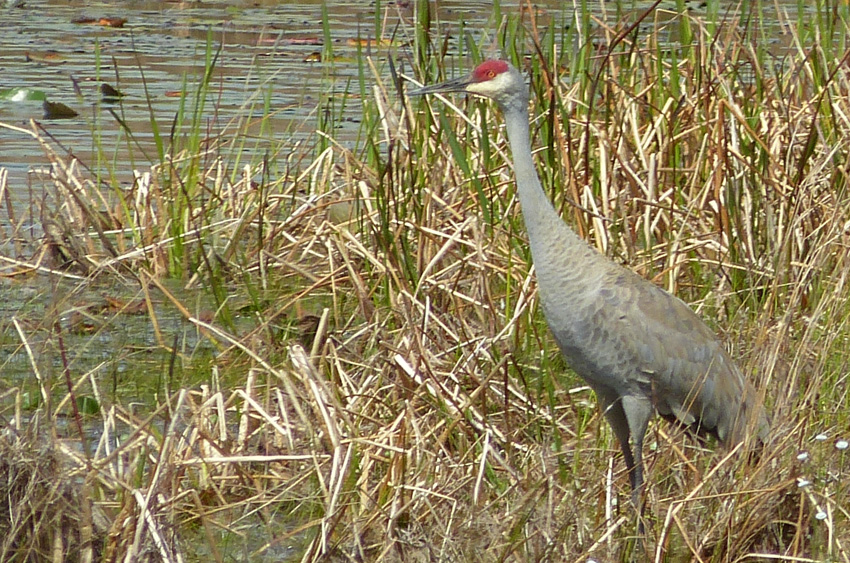
There is actually a separate subspecies of Sandhill Cranes in Florida, where it is protected, and if killed, carries a very high monetary penalty. This subspecies is under protection of state and federal law at this time. Since the loss of habitat is a somewhat controllable cause of a declining population, habitat preservation is a valuable management measure. The current outlook for the Florida sandhill crane, if it can be maintained on the protected habitats, is good.

 
It's not hard to tell these large birds apart when in flight. The Great Blue Heron, Great Egret and Snowy Egret fly with necks tucked in an "S" shape. Wood Storks, Ibis, and Sandhill Cranes fly with necks out-stretched. 
 
 
Well, I could probably go on, after our thrilling day, but it's getting late and Dick wants to use the computer, so I'd better close for now. Only one more day of birding, then it's time to head home in the Big Bird in the Sky!

Wednesday, February 13, 2013

Sometimes You Finds Birds, and Sometimes...


The Nature Conservancy's Disney Wilderness Preserve began as the country’s first large-scale, off-site wetlands mitigation project. In the early 1990s, The Walt Disney Co. purchased and donated 8,500 acres to the Conservancy to offset lands impacted by the development of Walt Disney World. The Disney Co. also provided funds for restoration and wildlife monitoring, and continues to partner a number of on-site projects. As we drove into the property this morning, we both had a feeling of deja vu. I remembered seeing parent Sandhill Cranes and a chick in the first field on the right. Yes, we visited this site in 2006 on our first birding trip to Florida! Florida Cranes are pretty urbanized. We keep seeing them in the drainage ditches along the roads, not concerned at all about the traffic zooming by.


It's amazing that we can remember these things. Clouds covered the sky when we started the day, and I wondered if I should have brought a jacket. But when the sun came out, I realized that I'd forgotten my HAT of all things. As we walked back through the Florida scrub land, a habitat that is rapidly vanishing, small birds flitted from one pine tree to another. You know how it works. They are so small and so fast, that they are next to impossible to see. We finally decided that the trilling call belonged to some Pine Warblers.


While the only bird that sat quietly for us to observe was a little Eastern Phoebe, tail bobbing and all.


A Greater Yellow-legs joined a Glossy Ibis and Reddish Egret shared a small pond behind the visitors center.


But the rest of the day was remarkable for its LACK of birds though. I think we were cursed by this tree demon. As good naturalists, though, we paid attention to the unfeathered creatures, and their signs, as we found them.


A mystery fly with yellow spots landed nearby....


... Aha! Apparently both deer and raccoons think it's easier to walk on the open trails than to push their way through the saw palmettos. Ow! I agree!


At Lake Lizzie, south of St. Cloud, we found the prints of a bobcat in the sand...


...and the burrow of a gopher tortoise, native to Florida.


Last time we were here we saw a Loggerhead Shrike and a duel between a Bald Eagle and Osprey over a fish! Ah well, each trip is a new opportunity, so we keep going.


Monday, February 11, 2013

Return to Merritt Island NWR


In 2006 we visited Merritt Island NWR for the first time, and became hooked on birding. It was like celebrating an anniversary to return there today, since we know so many more birds now. We first saw Northern Shovelers on that trip, and thought they had black heads. The field guide didn't have any black headed ducks. When they turned in the light, we found their heads to be dark green. We didn't know then to look at their enormous bills instead! These three males are NOT sitting on each other's shoulders, although it does look that way.
 
 
Apparently Blogger is having some issues - they are not uploading my photos in a timely fashion, and I'm getting rather frustrated. Grrr!  Anyway, I love all raptors, but Ospreys are about my favorite. See how he's carrying the fish so it faces forward? Very aerodynamic!


I have LOTS more photos, but am too tired to fool around with it. So here's a video of a Tri-color Heron fishing. The good photos are on Picasa at https://picasaweb.google.com/107775610888368954222/MerrittIslandNWRFlorida2013#, so please give it a look! More later...

Sunday, February 10, 2013

Bonnet Creek


As you fly into Orlando, FL, you notice the abundance of small lakes. One of them is in the middle of Bonnet Creek Resort, a Wyndham timeshare nestled next to Disney World. We decided to start our vacation by just walking around the lake, both to see what birds we might find, and to get oriented to the resort facilities.


First we noticed some cormorants. You can't get a good head count of how many cormorants were actually on the lake. As soon as one pops up, you point a camera and it dives immediately when you get a focus!


Yep, that's where it was!


A group of ducks attracted our attention next. It's been a while since I've seen many ducks, so I took photos, thinking we might have some Ring-necks. Get out the field guide - maybe that white around the bills of the brown ones will give us a clue. I decided these are the Lesser Scaup. My birder friends always talk about Scaup, but I've never been clear on them until today. It looks like this group of females, with large patches of white around their bills, are chasing after one male. He must be a real stud! Do ducks have harems?


A flock of large dark birds sped overhead. At first I thought they were Crows, and in fact, we saw some flocks of crows, but these birds just didn't have the right wing action. They don't look like Vultures either, too much flapping. Anyone have a guess?


No doubt about these Grackles as they loudly called back and forth. I think this female is prettier than the male. The poor manager of the lakeside restaurant where we ate supper was almost frantic. He'd chase them away whenever they landed on the table umbrellas. Lately, he said, they've actually attacked people making them bleed, in their search for handouts. I'd call them "bird terrorists!" We are thinking of returning to Merritt Island tomorrow - the place that turned us into birders!

Sunday, February 03, 2013

Eagles Weekend


I'm watching Superbowl 47 (can't handle those Roman numerals) with one eye, while editing photos and videos from Eagles Weekend with the other. (By the way, I'm cheering for the Baltimore Ravens, since they are the only bird team in the game!) The Eagles Weekend was terrific, by the way!


In a 10 mile stretch of shoreline, we saw 41 eagles from the comfort of the CQ Princess, the yacht that takes us on the lake for eagle viewing. When they began holding these weekends in the 1970's and 80s, they were lucky to see one or two eagles. Now we have a combination of resident birds, courting and laying eggs this time of year, and visiting birds who come from Minnesota and Wisconson to spend the winter here where the lake doesn't freeze. By March, only the resident eagles will remain.


Bald Eagles don't get their white head and tail until they turn five years old. Until then, they have various amounts of white mottling, and an expert can tell the age by the amount of white displayed. We had outstanding views of these younger birds practicing their courtship behavior - like teenagers practicing courtship and marriage. KY Fish and Wildlife estimates that we have over 100 breeding pairs in Kentucky now. Any lake large enough for a state park probably has a few.


Raptor Rehab did the Saturday night program. Everyone loved our one-winged Golden Eagle, Aurelia. We have to hold her carrier up to the perch, and she'll step out of it on her own. I love doing this program, since I caught the dream of working with raptors at weekends just like this. I hope we can inspire someone else to work with raptors too.


The last quarter moon was setting when we arose to catch the boat. Can't resist a photo of the moon whenever I can get one!

Thursday, January 24, 2013

SEO - The Search Continues


I am becoming obsessed with the goal of a terrific portrait photo of a Short-eared Owl. They can be found wintering in many different places in Kentucky, but I somehow manage to miss all the great trips my friends take at the last minute. Eileen came back saying, "We saw 35 of them take off at one time!"  Three days later her friend called to say they were all gone.


In Western Kentucky, near Paradise (you remember, "down by the Green River, where Paradise lay," as John Denver sang) the coal companies stripped the minerals out, and have "reclaimed" the area in grasslands, and they often find good raptors there, including Short-eared Owls.


Shelby County is just next door, so when Pat and Jane from the Beckham Bird Club said they saw one right by the road, I asked for directions. We arrived a little early and took the scenic tour of Shelby County farmlands, including some wonderful Kestrel sightings. By 5 o'clock the main show was ready to begin. At least three SEO's soared and circled each other, or flew low to the ground ... on the other side of the field.  We could see them pretty well through binoculars though. I put some mouse offerings on the fence posts near the car, although they weren't interested enough to investigate.


But how often do you get to see owls in synchronized flight? Pretty cool.


By the time the sun set over the silos on the neighboring farm, our fingers were turning to icicles, and we decided to go for coffee and supper. I intend to keep looking for Short-eared Owls whenever I can, since I am determined to find one sitting on a fencepost long enough and near enough for a good photo! Wish me luck!

Sunday, January 20, 2013

Sandhill Crane Festival


As we arrived at Hiwassee Wildlife Refuge, a heavy layer of frost coated everything. Only two or three birds could be seen through the fog, and even they disappeared as the fog thickened. I assumed there was water somewhere, but we sure couldn't see it. The strange rattling kar-r-r-o-o-o drifted up to the birders sipping coffee as they waited for the fog to lift. Sounding and looking like ghosts, one or two of these large birds appeared and faded into the fog calling... By 10:30 we had enough light to see the water, and hoped to see thousands of Sandhill Cranes.


Birders are used to this though. "Oh, yeah," someone says, "We have thousands of _____ (fill in the blank with the name of the birds you want to see)." But it rained all week in Tennessee and most of them must have moved elsewhere. The birds we saw, however, were beautiful as they grazed in the corn stubble along the water's edge. All cranes are omnivorous. Sandhill Cranes are generalists and feed on a wide variety of plant tubers, grains, small vertebrates (e.g. mice and snakes), and invertebrates such as insects or worms. Sandhills find these foods in uplands and in shallow wetlands. Like most cranes, flightless chicks forage primarily on a diet of insects and other protein filled foods during their early stages of rapid growth. The Sandhill's tendency to feed on plant tubers creates conflicts with farming. Sandhill Cranes are adept at probing in the ground and finding planted agricultural seeds such as corn. When large flocks of cranes feed on planted fields, the damage they cause to an unprotected crop can be severe enough to force the farmer to replant the entire field.


A speaker from the International Crane Foundation, in Baraboo, WI, expanded our knowledge of cranes. The different sub-species of Sandhill Crane vary greatly in size and weight. Lesser Sandhills, who breed at more northern latitudes such as the arctic, are the smallest, weighing on average about 6-7 pounds and standing 3-3.5 feet tall. At the other end of the extreme, temperate-nesting Greater Sandhills (the ones we saw) are the largest sub-species and average 4.5-5 feet tall and 10-14 pounds. Body plumage is characterized by varying shades of gray. In many areas, wild Sandhills preen iron-rich mud into their feathers creating a deep rusty brown hue which lasts during spring and summer. As fall advances, these rusty feathers molt and the birds return to their grayish appearance.


We all scanned the air for more birds. You could find a few flying together, but if you looked closely, more and more skeins (I think that's what they are called) could be seen in the distance. The sun was warm and bright, and I think many of the cranes took advantage of the good weather to continue their migration southward. I'm not really sure how much farther these birds might go, since it is the middle of January already. Different populations travel to different wintering grounds. Dick and some of the others saw a few Whooping Cranes, but I missed them.


Throughout the day, we had great luck finding raptors. Several different Bald Eagles, both adults and immatures came to the Refuge, along with a Golden Eagle. As we debated the identity of these brown eagles, one birder came up with a good rule of thumb. "Think chocolate," he advised. "The Golden Eagle is the color of milk chocolate and the Bald Eagle is more like dark chocolate." Sounds good to me! We also spied a Merlin, American Kestrels, lots of Red Tail Hawks, a pair of Northern Harriers and a Cooper's Hawk. In my book, this certainly made up for a rather slow day for the Cranes!


The Tennessee Sandhill Crane Festival is run entirely by volunteers, and they don't charge anything to attend. Kudos to everyone who worked so hard all weekend - the volunteer birders, shuttle bus drivers, TWRA, and all the sponsors and vendors. It's hard to choose between wonderful presentations in a room vs. freezing your toes off in the field for the bird of a lifetime! Brian "Fox" Ellis, the storyteller, attended the dinner Saturday night as Charles Darwin. Since I studied Darwin after our trip to the Galapagos, I especially enjoyed his performance. I understand, however, that the little country school that serves as home base for the festival, will be closing next year, and hope they can make new arrangements. After all, you never know which year will be the one when there actually ARE thousands of cranes to be seen! Birders are always hopeful!