Thursday, March 21, 2013

March Madness

Bufflehead Ducks on Ohio River
Yes, in Kentucky, March Madness means basketball. Well, don't shoot me, but I don't really care about basketball. 

Coots Looking for a Handout at Freeman Lake
But when the KY Bird List sends a notice about some cool bird that has been sighted, that's when I go into action. Get out the bins! Put gas in the tank! Buy a large cup of coffee at Thornton's! It's time for a ROAD TRIP! Yesterday Pat and Jane Bell said the white trout lilies were blooming at Bernheim, and Common Loons in breeding plumage were at Freeman Lake. WooHoo! That's worth a trip, so let's go.

Bloodroot
Now, here's where the madness part comes in. When I left home at 9:30 this morning it was 22 degrees! Hey, it's supposed to be Spring, right? How about some sunshine, and warm breezes? Nope, cold temps, a few snow flurries, and a biting wind coming across the lake. BRRRRR! But when March Madness hits, I have to just suck it up, put on the long johns, and head out anyway.

White Trout Lily
 I looked online but could not find an answer to a pressing question in my mind this morning. When it's this cold, why don't the early blooming wild flowers freeze? Do they have some sort of anti-freeze in their sap? Dick is taking a botany class at U of L this semester, so I asked him to see if his professor knows. Look how small these trout lilies are compared to the brown leaves. They always bloom early and I usually miss them, but not this year! The bloodroot is still wrapped in its protecting leaf, like a child wearing a coat. When the sun comes out for a few days, they will open up for pollination.

Turkey Vulture Sunning at Bernheim Forest
This solitary Turkey Vulture at Bernheim looks pretty cold. Did you know they can reduce their body temperature at night, then sit in the sun to warm back up in the morning?

Common Loon - Freeman Lake
Common Loons were the target bird du jour at Freeman Lake. About 5 individuals swam there - waaayyyy out in the middle, of course. Got some great looks through the scope. I've only seen them in winter colors, and these were in the full black and white.

Pied-billed Grebe - Freeman Lake
The little Pied-billed Grebes swam closer to shore, and their stubby little beaks are unmistakable. I thought I saw some Horned Grebes with horns, but they were so far away I was probably just imagining it.

Red Breasted Mergansers
A small flock of Red Breasted Mergansers napped on the water. Although the wind was blowing fiercely, their head feathers always look like they are having a bad feather day. A little later, they all woke up and the males competed to see who could raise his head the highest as the females watched.

Killdeer at Freeman Lake
Couldn't resist two little killdeer. They are so seldom close and on the ground for a nice photo.

Duck Love
Freeman Lake is known for some of the oddest colored ducks you've ever seen. Now I know why. Duck Love was the popular activity on the lake today. Sometimes 3-4 males tried to mate with the same female at the same time. She was clear under water for quite a while, and I assume she can hold her breath for a long time. Hey, get a room guys!

Wednesday, March 13, 2013

Why Do Birds Matter?

 
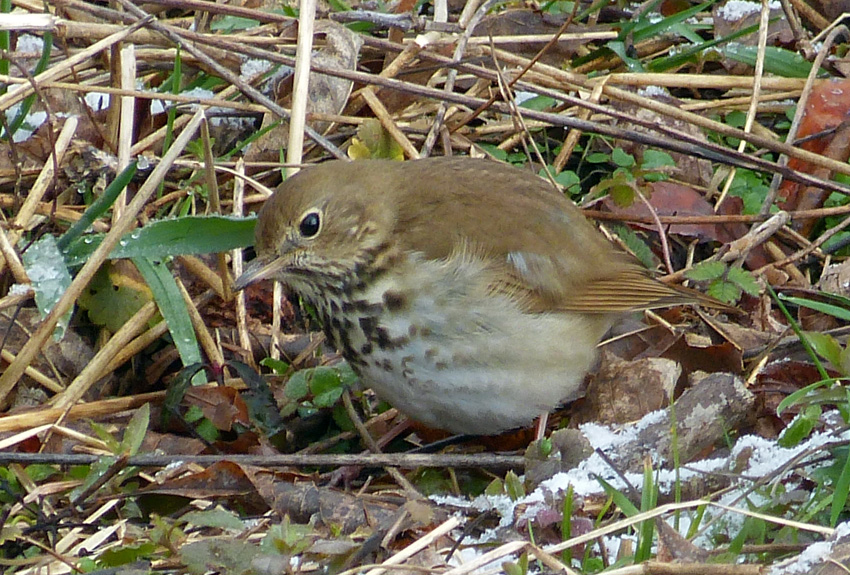
Hermit Thrush
Why am I a birder? Why do birds matter in general, and specifically, why do they matter to me? Wow, such serious thoughts for a birder to have after a blustery morning of birding in March! We received the March/April issue of Audubon Magazine this week, and it is particularly thought provoking. Then Jeff Gordon, President of the American Birding Association, was the speaker at the Beckham Bird Club annual banquet last night, and talked about the image birders present to the world.

Golden-crowned Kinglet
The magazine quotes the opinions of famous and not-so-famous birders, and you will probably agree with them. Birds make any place a chance for discovery. Birds are important because they keep systems in balance. Their fate is our own. Birds remind us that there are angels. Our hearts soar on their wings and their songs. What’s good for the birds is also good for us.

Brown Creeper Camouflaged
The article that caught my interest, however, was entitled "Follow the Money."
Some might not realize the tangible value of birds, but it would be foolish to underestimate how tough life would be without them.
Birds keep farmers in business. They provide critical information about our environment, also known as "ecosystem services." History is packed with stories of birds saving the day from an invasion of insects. Just picture those elusive little warblers, patiently jumping from leaf to leaf looking for insects. Raptors provide natural rodent control without damaging the environment for other animals or plants.

Brown Creeper
Birds stimulate the economy by being beautiful and attracting birders by the thousands. I know how much I spend on birding equipment and travel. U.S. Fish and Wildlife made a study in 2006 estimating that birders spend $12 billion annually on travel, and an additional $24 billion on equipment like binoculars, camping gear and nest boxes. That money ripples through the economy and generates $82 billion in output, employs 671,000 people and enriches state and federal governments by $10 billion. Have you been to any of the big birding festivals recently? Yes, I would believe these figures. What this country needs is more birders! Why can't some politician base a campaign on this?

Great Horned Owlets
Of course, not everyone is interested in birds enough to go out on a cold snowy morning in March, just to look for birds. In fact, many people would say we are all crazy to do so! But lots of people like to stay nice and warm at home looking at their computer or soap operas on TV, and the birding option for those folks is Nest Cams on the Internet. There are many options for about any species you can name. People can get addicted to true reality TV by watching these nest cams. You see the patience and diligence of the mother on the nest, no matter what the weather. You watch as the parents struggle to find enough food for their growing youngsters. If a predator appears, you gasp in horror. In short, that family becomes yours, and that feeling of connection, of relation, makes all the difference. You cheer when the chicks leave the nest, and hope they can survive in the big bad world out there. It makes you think of your own children....Now the birds are important, where before was merely indifference. Why do birds matter? Because they are like us.

Saturday, March 09, 2013

Owling in Paradise


And daddy won't you take me back to Muhlenberg County
Down by the Green River where Paradise lay
Well, I'm sorry, my son, but you're too late in asking
Mister Peabody's coal train has hauled it away


I remember hearing John Denver sing this song when I was in college, and yesterday I went birding at this very place. In the late 1950's, the Bucyrus-Erie Company got the contract to build the world's largest shovel, to be known as the 3850. It took two years to build and each piece was shipped by rail to the new mine at Paradise, to be named the Sinclair Strip Mine. Roads had to be built and a special rail line was made. Special rail cars were made just to haul some of the parts of this big shovel. The assembly of the shovel took eleven months. Once the mine became operational, some of the construction people became miners. In the mean time, TVA was building the world's largest power plant nearby. In the early 1960's, the Sinclair Mine became operational as well as the Paradise Steam Plant. For the next twenty-five years, Sinclair Mines and Paradise Steam Plant were partners in the production of power.


In 1986, the Sinclair Mine had removed most of the coal in the area. The 3850 Shovel was not through. It had been a "star" and the center of attention for almost three decades and it had one more job to perform. With fanfare, the news media, a lot of the miners, the company that built the machine and the company that operated the machine, State and Federal Government and the EPA looking on, the 3850 had one more big dig to make. It would now be used to dig its' own grave. The 3850 faced the new pit and started to dig. It settled into its' final resting place and was soon covered with the Kentucky soil and rocks that it had been digging for a quarter of a century. Peabody had to reclaim the barren pits under the Surface Mining Control and Reclamation Act of 1977, and now Kentucky Fish and Wildlife operates the Peabody WMA there.

 
Preston and Shari Forsythe live nearby and regularly post to the KY Bird List about the birds they see at the Sinclair unit at Peabody WMA, and they invited me to join them for an evening of "Owling in Paradise." Glad I went with someone experienced, since I would quickly have become lost of the gravel roads in the gathering darkness.  Arriving about an hour or so before sunset, we were immediately treated by 5-6 Short-eared Owls chasing each other around on one of the warmest afternoons in months.


As we drove slowly with our windows down, Shari spotted what she thought to be a Mockingbird perched nearby. Closer inspection revealed a Loggerhead Shrike glowing in the sun! We all expected to see them in Florida, but this is the second I've found in Kentucky this winter.  Shrikes hunt the same small mammals as the owls and harriers in this area.


At times, the Harriers and Owls would chase each other. Territorial disputes? There seemed to be so many birds in the same place that the mice didn't stand a chance.
 

The Paradise power plant still operates with TVA, and the smoke billowing from the towers has a distinct yellow tinge to it. I wonder what their scrubber capacity is. I am definitely torn by this issue. I want a clean environment for our wildlife and birds, yet I depend on electricity just like everyone else. I don't like strip mines (and definitely not mountaintop removal), but since the mines closed, the economy of this area has taken a big hit. Not prosperous looking by any means. Some of the lakes and ponds have water, but I didn't see cattails growing along the edges. I assume Fish and Wildlife keeps an eye on the acid levels here, but I do wonder a bit...


We hoped to get a glimpse of the Pan-STARR comet just after sunset, but a layer of haze or clouds blocked our view. While standing on the highpoint of the S2 area, we must have sighted 14-15 owls, given that it's hard to keep an accurate count of rapidly flying birds. Driving out again, we found another 4-5 owls perched in branches, looking all around as we crept up to them so I could take a quick photo through the car window.  Wonderful owling this trip, but I'm still working on a really good closeup. As Scarlett O'Harra said, "Tomorrow is another day."

Thursday, February 21, 2013

Winter Birding Close to Home


Guess I didn't get enough birding in Florida last week, since I went out again here at home. Several people from our bird club have seen a White-winged Scoter on the Ohio River, which is a life bird for me. According to the field guide, this sea duck should be wintering along the coast or the Great Lakes. This lone female must have gotten blown out of her territory by one of the recent winter storms. The Overlook is also home to domestic geese and ducks, and some pretty strange looking hybrids. My favorite is the tuxedo duck - a cross between white domestics and wild Mallards.


Nearby Perrin Park is a nice neighborhood park, which hosts some surprising birds sometimes, and is always worth a quick visit. Canada Geese are the dominant species every day, but this time I found three little Ross's Geese paddling around with the big guys, and one solitary male Hooded Merganser. I've never seen Northern Shovelers paddling around in circles with their heads under water before!


Visitors must be few and far between at the feeding station. I walked there for another look, and got absolutely mobbed by geese and ducks looking for a handout! If a child had been with me, I would have picked it up and run away! I was surprised that all the geese were wearing leg tags.


One goose tugged on my heartstrings though. She obviously had a broken wing and could not fly. She followed me around the platform begging for food. If she can't find it on the ground or in the lake, she must go hungry since she can't fly to another source of food.


Although it still plenty cold to me this afternoon, if Sandhills are starting back north, other winter visitors will be leaving soon as well. So I thought it would be a good time to head out to Shelby County, KY, to check on the Short-eared Owls there. Arriving about 45 minutes before sunset is usually a good time to find them, and 3-4 were flying low over the fields. Some of these photos are a little clearer than the first time, but are still fuzzy due to the distance. The house down the road has SEOs sitting on fence posts in their back yard. I may try this location one more time, and knock on their door to ask if I can use their yard. I bet they don't even know about these beautiful birds!

Friday, February 15, 2013

If You Build It...


Today we "discovered" a wonderful new place to bird in Central Florida - the Orlando Wetlands Park. This is actually a water treatment mitigation area, operated by the City of Orlando to complete treatment of waste water. We always have good birding at water treatment facilities, and this was no exception. The day started cold and dreary - even with a sweatshirt on, I wished I'd brought my gloves. We rushed to the park to take a guided tram ride led by two volunteers, and accompanied by two other birders carrying big scopes. This was our big opportunity to see more unusual birds which we probably wouldn't have found on our own, as they were clear at the back of the property.


"If you build it, they will come..." the birds, I mean. In 1986, this whole area was a cattle farm, which was purchased by the city. Reclaimed water from the sewage system takes 40 days to run through this man-made marsh system, which removes the remaining nitrates and contaminants. The reclaimed water flows first into the cells with the deep marsh habitat, which consists primarily of monocultures with either cattails or giant bulrush. Afterwards, the flow is routed through the mixed marsh and wet prairie cells containing thick growths of pickeralweed, duck potato and other aquatic shrubs. These areas are favored by the wading birds and migratory waterfowl. The final habitat in the wetland system is the hardwood swamp. Cypress, popash, tupelo and water hickories dominate within these cells. However, due to the constant high water levels, the trees have stunted growth and this habitat typically mirrors the deep marsh areas. A 100 acre lake is part of the central and southern flow paths through the wetland system. At least 17 million gallons of clean water is released into the St. John's River every day!


Many of the places we visited this week lacked the larger wading birds we so enjoy when we come to Florida, but the Orlando Wetlands certainly made up the difference today! At Green Cay in Palm Beach County, we saw one Limpkin and felt lucky.  Today, we must have seen ten or more.


Our next target bird was the Vermilion Flycatcher. Our tram driver-volunteer has an unblemished record of finding this bright red bird wearing a Zorro mask each trip he makes to the back areas. As we left this afternoon, he told us they had found more, including females and young, so these small Flycatchers have several breeding families.


In Florida, when they say "hawk," they really mean Red-shouldered Hawk, since Red Tails are few and far between. Palm trees from the old pasture land have died, leaving just clusters of trunks without fronds throughout the lakes. Such natural perches are the favorites of Red-shouldered Hawks. Two of them were in love, and couldn't wait for a secluded place for a little romance!


White-billed American Coots and red-billed Moorhens shared the shallow water without difficulty, clucking all day long. However, we searched for the elusive Purple Gallinule, and found a dozen or more - another first for Dick and me! Look at his long yellow feet as he walks across the tops of the lily pads! The candy corn colors on the beak always stand out, even if the light isn't good for seeing purple feathers. We heard quite a few King Rails, but it would have been asking too much for them to come into view from the bull rushes.


Anhingas are beautiful black and white birds. During breeding season their nares turn bright blue. What a handsome lad this one is! They dive for fish, and then stand with their wings spread to dry since they have no oil on their feathers as other birds do.


Cormorants have a slightly hooked beak, and catch fish between the top and bottom mandibles, toss it up and swallow it head first. The Anhinga, on the other had, has a perfectly straight beak which they use to spear their fish! This is the first time I've ever seen this behavior. Of course, then the problem is getting it off the beak and into the throat. This fish is obviously much bigger than the birds throat and we watched to see how he would handle the situation. We thought the fish must surely be dead, having been out of the water so long, but in a flash it ended up back in the water, and the Anhinga planned another fishing trip.


Normally, you envision an Ibis to be white, with startlingly red beak and legs...


... but the dark Glossy Ibis is also beautiful...


The endangered Wood Stork shared a rookery with Ibis and Egrets of all sorts.


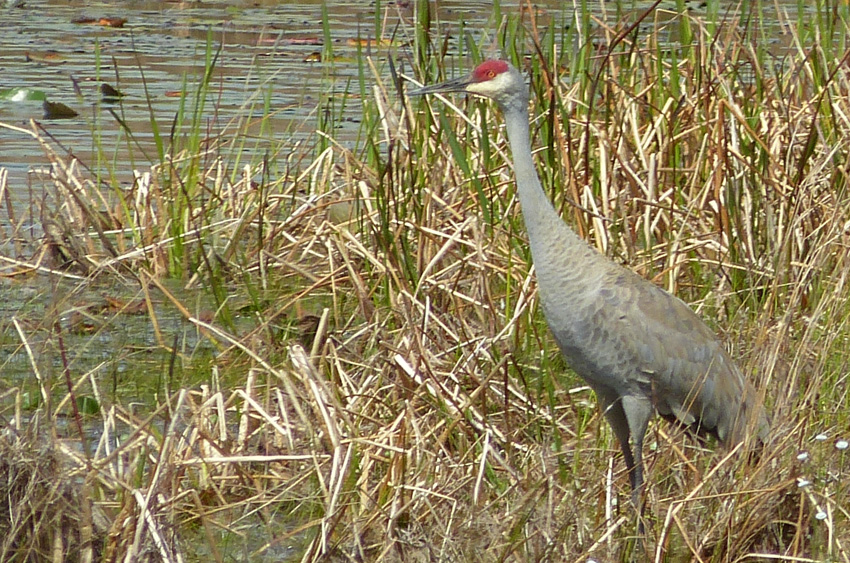
There is actually a separate subspecies of Sandhill Cranes in Florida, where it is protected, and if killed, carries a very high monetary penalty. This subspecies is under protection of state and federal law at this time. Since the loss of habitat is a somewhat controllable cause of a declining population, habitat preservation is a valuable management measure. The current outlook for the Florida sandhill crane, if it can be maintained on the protected habitats, is good.

 
It's not hard to tell these large birds apart when in flight. The Great Blue Heron, Great Egret and Snowy Egret fly with necks tucked in an "S" shape. Wood Storks, Ibis, and Sandhill Cranes fly with necks out-stretched. 
 
 
Well, I could probably go on, after our thrilling day, but it's getting late and Dick wants to use the computer, so I'd better close for now. Only one more day of birding, then it's time to head home in the Big Bird in the Sky!

Wednesday, February 13, 2013

Sometimes You Finds Birds, and Sometimes...


The Nature Conservancy's Disney Wilderness Preserve began as the country’s first large-scale, off-site wetlands mitigation project. In the early 1990s, The Walt Disney Co. purchased and donated 8,500 acres to the Conservancy to offset lands impacted by the development of Walt Disney World. The Disney Co. also provided funds for restoration and wildlife monitoring, and continues to partner a number of on-site projects. As we drove into the property this morning, we both had a feeling of deja vu. I remembered seeing parent Sandhill Cranes and a chick in the first field on the right. Yes, we visited this site in 2006 on our first birding trip to Florida! Florida Cranes are pretty urbanized. We keep seeing them in the drainage ditches along the roads, not concerned at all about the traffic zooming by.


It's amazing that we can remember these things. Clouds covered the sky when we started the day, and I wondered if I should have brought a jacket. But when the sun came out, I realized that I'd forgotten my HAT of all things. As we walked back through the Florida scrub land, a habitat that is rapidly vanishing, small birds flitted from one pine tree to another. You know how it works. They are so small and so fast, that they are next to impossible to see. We finally decided that the trilling call belonged to some Pine Warblers.


While the only bird that sat quietly for us to observe was a little Eastern Phoebe, tail bobbing and all.


A Greater Yellow-legs joined a Glossy Ibis and Reddish Egret shared a small pond behind the visitors center.


But the rest of the day was remarkable for its LACK of birds though. I think we were cursed by this tree demon. As good naturalists, though, we paid attention to the unfeathered creatures, and their signs, as we found them.


A mystery fly with yellow spots landed nearby....


... Aha! Apparently both deer and raccoons think it's easier to walk on the open trails than to push their way through the saw palmettos. Ow! I agree!


At Lake Lizzie, south of St. Cloud, we found the prints of a bobcat in the sand...


...and the burrow of a gopher tortoise, native to Florida.


Last time we were here we saw a Loggerhead Shrike and a duel between a Bald Eagle and Osprey over a fish! Ah well, each trip is a new opportunity, so we keep going.