Friday, August 09, 2013

Thursdate Adventures


Many couples try to have a "date night" when they can just have fun together on a regular basis. Dick and I have started having a Thursday date morning, since neither of us usually have a volunteer job then, a rare thing indeed for us. It's fun to take a hike somewhere we wouldn't go otherwise, such as the Zoo before they are open, or one of the new Century 21 parks. Birding and wild flowers are always great activities for us and we get in some exercise as well.


Yesterday we went to the Salato Wildlife Center, near Frankfort, KY, which is operated by Kentucky Fish and Wildlife Dept. For a change, ours was the only car in the parking lot, so we looked forward to a quiet morning.  Salato has large areas housing native wildlife, such as these bison, elk, deer and turkey, bear, the wildcat of UK fame, and a Bald Eagle. This is the only opportunity many school children may ever have to see such animals.


As Nature Interpreters, we really appreciated the stellar signs and learning exhibits at Salato. Outside the Bald Eagle enclosure, for example, is a huge sample eagle nest, with a large ruler. Another sign explains the size of the largest eagle nest ever (20 feet tall, 10 feet across, and weighing 2 tons!), and invites children to climb into this nest themselves. All the signs are first class quality, and I can only image some rich corporate sponsor paid the bill, since signs like this don't come cheap. Some signs included the QR code (that little black and white grid looking thing). I used my new iPhone to scan the code and listen to the pod cast of our friend Jamie Cook talking about the bison. Too cool!  When it started to rain, we looked up the weather map, and decided to turn back since we had no plastic bags to protect my camera or the binoculars. (I fought getting a smart phone for years, but now I love it!)


The recently added a quail, or Bob White, exhibit. Yesterday all the birds were all quiet, but they had been calling the last time I visited. Again, Bob Whites have become a rarity in Kentucky, and we get excited when we hear them.


The small covey wandered around freely nibbling on seeds from native grasses, or on a supply of chicken feed. The native grasses give them a hiding place if they don't want to be seen, and it's amazing how well they blend in. Upon exiting the enclosure, children are taken on an adventure to "find" a lost chick by learning about the habitat needed by these small birds. The "chick" itself is a six foot tall statue!


At the raptor aviary (empty yesterday) children are invited to compare their own wingspan to that of Kentucky raptors! Sometimes the handlers will bring a live hawk out for a little free flight before he gets fed. I would like to have some signs like this for Raptor Rehab to use.


People who don't care about wildlife, birds or native plants, go to Salato for the fishing. As we walked along the fishing lake, a loud squawk preceded the flight of a Green Heron to a small island in the middle of the lake. If you are looking for a fun date, give Salato Wildlife Center a try!

Monday, August 05, 2013

Missing Zinnia Petals Mystery


A friend has beautiful zinnias in her garden, so we planted some too this summer, and they are just as beautiful as hers. I noticed, however, that some of them were missing petals, usually on the older flowers with large cones.


Then one morning I noticed one of the blossoms swaying when the others were not. Obviously, this cannot be the wind, I thought. Quick, get the binoculars! Sure enough, that bright yellow was not a zinnia, but a male Goldfinch!


As I observed, he hopped from flower to flower, pulling off petals where necessary to real the small seed at the base of the cone. When zinnia first bloom, the yellow "flowers" look like a crown in the center. The cone grows higher as new "flowers" bloom, while seeds develop from the older ones. The colorful petals have nothing to do with reproduction.


He sure works hard for those small seeds. Goldfinches wait until later in the summer to breed and raise young so seeds will be abundant. Goldfinches are among the strictest vegetarians in the bird world, selecting an entirely vegetable diet and only inadvertently swallowing an occasional insect. Many other seed eaters will feed their young insect, but I couldn't find that these finches do so.


Birds don't weigh much in general, but small songsters must be particularly light-weight, since the flowers bend down only a little when the bird lands on them. I used to get lots of Goldfinches at my feeders, but have seen very few in the last couple of years. Even a new feeder and nyger didn't seem to attract them, so I'm delighted to have them back in the yard, attracted to our flowers.


Sunday, July 28, 2013

Bernheim Arboretum


Bernheim Forest is one of our favorite places. Sometimes, it seems as if Dick lives there, since he volunteers so many hours, but then, who am I to talk!  I haven't been there this summer, and joined Dick at a session led by two of the arborists yesterday. We usually spend our time in the forest, enjoying the native plants and trees, but it is also an Arboretum, where non-native plants are cultivated. In fact, the arborist stressed his enjoyment of the wide variety of trees to be found there, a point of view I don't often hear.


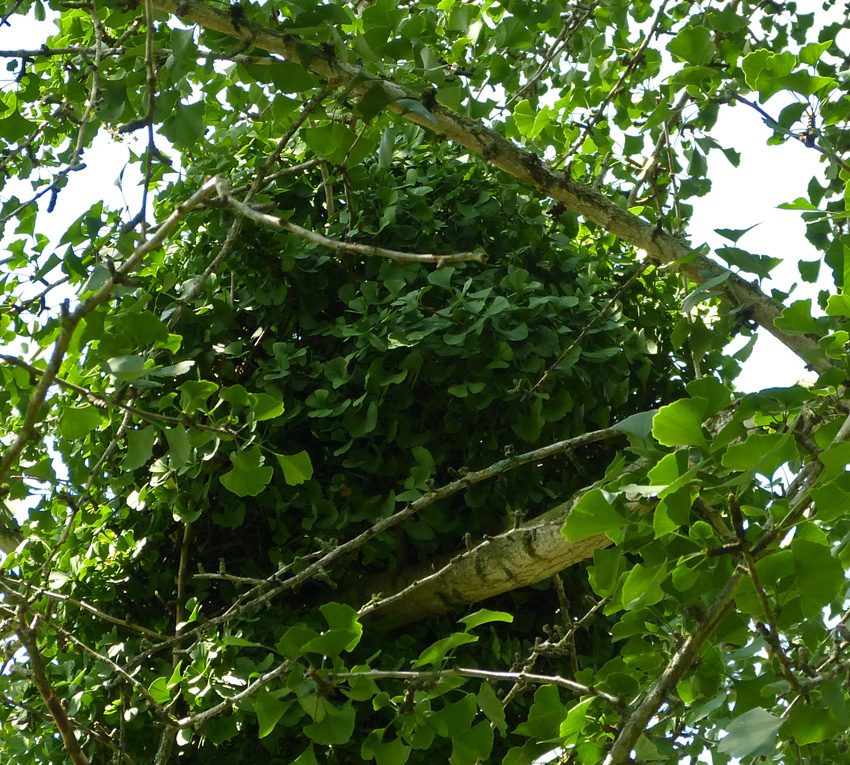
In the winter, we find balls of Mistletoe growing in tree branches, but large thick balls of growth in a tree is called "Witches' Broom," since witches were said to hide their brooms of dense twigs high in a tree during Mideval times. We found them easily visible in both pine and ginko trees. A number of stresses, both biological and environmental, can lead to the formation of brooms. Organisms such as fungi, phytoplasmas (bacterial-like organisms), mites, aphids, and mistletoe plants can cause abnormal growth when they attack a host tree. Environmental stresses that injure the growing points of branches can also trigger the formation of brooms. Some brooms appear to be caused by genetic mutations in the buds of the branches. Unlike brooms caused by living organisms, there is usually just one broom per tree when the cause is a genetic mutation. By either climbing up or shooting samples out of a tree, the broom can be grafted to a normal root, then cultivated, resulting in extremely thick growth that looks like a bush rather than a tree.


Walking over to a particular sweet gum tree, he pulled three leaves from the same branch. One was the normal green, while the other two had developed a variegated coloration. These natural mutations are highly desired by arborists, since they can be cultivated to create new varieties of plants. If the mutation breeds true, Bernheim can then give it a name and sell the new variety. The problem is that after a while, the color variegation can revert to the natural green.


We explored the dwarf evergreen section of the arboretum, finding trees that started as dwarf have outgrown that status now. This little blue spruce has the expected blue needles, but only on the bottom side...

...while bending the branch down for a view of the top reveals the same needles to be green on the top!


Staff shortages can result in surprises sometimes.  When a young plant is waiting to be placed in the ground, they are stashed in pots behind the green houses. Recently, one of the interns discovered a little "Franklinia" tree, which is extinct in the wild and no one knew they had it. Our friend Wren was really excited to learn about it. Franklinia is a monotypic genus in the tea plant family. The sole species in this genus is a flowering tree, Franklinia alatamaha, commonly called the Franklin tree, and native to the Altamaha River valley in Georgia in the southeastern United States. It has been extinct in the wild since the early 19th century, but survives as a cultivated ornamental tree.


As much as I enjoyed seeing a different side of Bernheim, I was determined to track down the Bobwhites we heard while eating lunch. It didn't take much of a walk to find two fast running little birds along the roadside. Restoration of the prairies habitat has made a good home for this reintroduced species. It is such a thrill to hear them whistling "Bob-white!"

Thursday, July 18, 2013

Mississippi Kites in Kentucky


A few years ago, Raptor Rehab of Ky took in a Mississippi Kite, found in far western Kentucky, which had been impressed on humans and couldn't be released. He was the sweetest bird, who was happy to eat meal worms from your hand, and sang every time you walked in his cage. These Kites normally migrate to Argentina every winter, to have a good ongoing supply of insects to catch and eat on the wing. Although we did our best to keep him warm over the winter, he developed respiratory problems and didn't survive. We still miss little Miki.


In the last few days, emails and messages are going around about a pair of Kites actually nesting in a nearby Louisville neighborhood. I normally would expect to find them closer to a nice open field where it's easy to find and catch large flying insects, but the local residents say they have been here for a couple years now.


For someone unfamiliar with this raptor, and I'd never heard of them till Miki came to RROKI, you might think this was a Mourning Dove or maybe a Pigeon. They have long dark wings and a long tail - all the better for catching grasshoppers and cicadas! But look at the eyes, which are surrounded by dark feathers making them look really big. The sharp hooked beak also says this is a raptor.


Kites have many features expected in a falcon - the long wings and tail, and dark around the eyes - an example of form following function. When you are chasing speedy flying insects you have to be fast and maneuverable. Their usual habitat is in the plains area, where they are known to nest in colonies. The young birds come back to the same area after their first migration, and help feed and tend the new nestlings. After their second migration, they will get these beautiful feathers and red eyes, indicating they are sexually mature. I must admit, this was the easiest life bird I've ever found!

Saturday, June 29, 2013

Bring Back the Pollinators


Bee Balm and Bumble Bee
This summer, I've started paying more attention to bees. We've heard about the honey bee Colony Collapse Disorder for a few years now, and I knew that honey bees were imported by European settlers when they arrived. But somehow, I never gave much thought to pollinators  before that time, although logically, the Western Hemisphere had to have its own pollinators.

Bee Balm and Gray-headed Coneflower
 Dick has worked to establish a native plant garden in our yard since his retirement, and this morning, everything is in wonderful, full bloom!

Blanket Flower
 Tavia Cathcart (Executive Director at Creasey Mahan Nature Preserve, and co-author of Wildflowers of Tennessee the Ohio Valley and the Southern Appalachians) and I signed up to attend a native pollinator short course this week, sponsored by the Xerces Society for Invertebrate Conservation.  What wonderful timing this was!  As part of the course materials, we received a copy of Attracting Native Pollinators, which is a fantastic book, with everything you never knew you didn't know about pollinators.
Bumble Bee on Bee Balm
 Did you know there are over 4,000 species of native bees in the United States? In fact, in many instances the native bees are much more efficient pollinators than honey bees. They forage longer during the day, at dawn and dusk, and when weather isn't bright and sunny. Native bees always forage for both pollen and nectar, while honey bees assign some workers to only pollen or only nectar. Certain crops require a "bee buzz" to loosen the pollen, and honey bees can't vibrate at the right speed for this. You can transport a hive of honey bees from field to field, but you have to provide the right habitat to attract the native bees.

Butterfly Weed
 About one in every three mouthfuls of food you eat requires the presence of a pollinator. Without bees, there would be no apples, pumpkins, strawberries and many other fruits and vegetables. Other wildlife, from songbirds to grizzly bears, depend on the work of bees. The economic value of bees and other pollinators is in the billions of dollars, as farmers are finding now that there is a scarcity of bees.

Common Milkweed buds
The problem is that some flowers require a specific pollinator, and some pollinators require a specific flower, either for the adults, or for larvae to survive on. The emergence of adults must be at the same time as that flower blooms for both to thrive. You have noticed the drop in butterfly numbers and variety in the last couple of years, haven't you?

Purple Coneflower with Sweat Bee
 The course also addressed land management for pollinators - aimed at famers essentially, although most of the attendees seemed to be government folks. When I read through the handouts, recommending native plants for our area, I discovered that we were already doing all this in our backyard native flower garden!! 

Native Honeysuckle
 Take a look at Southeast Plants for Native Bees.  Patches of flowers can be grown almost anywhere and will form an important food resource for bees. Even small beds along a field or roadway can help make a difference. It needs to include a variety of plants which bloom at different times throughout the season. Since the native bees reside in the area, they can't just go somewhere else when a particular crop is finished blooming.

Pineapple Sage
Some other recommendations are:
  • Use local native plants, which are as much as four times more attractive to native bees than exotic flowers.
  • Choose several colors of flowers. Native bees are especially attracted to blue, purple, violet, white and yellow blossoms.
  • Plant flowers in clumps. That way the bees don't have to fly so far to pollinate another flower of that species.
  • Include flowers of different shapes. Bees come in different sizes, with different length tongues and  need a variety of flowers to feed on.
  • Have a diversity of plants flowering all season. This supports a range of bee species that fly at different times of the season, and certainly makes your garden more interesting.

Rattlesnake Master

Royal Catchfly

Spiderwort


Sure, I'll brag on my husband, who has done a wonderful job with our garden. And every year it gets better and better!

Friday, June 14, 2013

The Color Purple


I ask myself weird questions sometimes. In spring, I wonder why the early bloomers are mostly white. Now that summer has arrived, more of our flowers in the garden are purple...sort of.


Dick planted all these, so I don't know the names of many of them, but I always think of them as  "purple." Or I did until I started putting this blog post together. As I worked with the photos, suddenly I wasn't so confident about their color. Well, let's see what Google can find.


Purple is a range of hues of color occurring between red and blue. The Oxford English Dictionary describes it as a deep, rich shade between crimson and violet. In the traditional color wheel used by painters, violet and purple are both placed between red and blue. Purple occupies the space closer to red, between crimson and violet. Violet is closer to blue, and is usually less intense and bright than purple. While the two colors look similar, from the point of view of optics there are important differences. Violet is a spectral, or real color – it occupies its own place at the end of the spectrum of light, and it has its own wavelength (approximately 380–420 nm). It was one of the colors of the spectrum first identified by Isaac Newton in 1672, whereas purple is simply a combination of two colors, red and blue. There is no such thing as the "wavelength of purple light"; it only exists as a combination. Pure violet cannot be accurately reproduced by the Red-Green-Blue (RGB) color system, the method used to create colors on a television screen or computer display. It is approximated by mixing blue light at high intensity with less intense red light on a black screen. No wonder these flowers keep looking different on the computer!


Simply put, flowers are colorful for one main purpose, survival. Flowers are the reproductive systems of plants and are therefore responsible for assuring that the plants can survive from one generation to another. Their bright and varied colors help make reproduction and survival possible in several ways. One way is by attracting insects that carry pollen from one flower to another allowing the reproduction process to continue through the creation of fruits and fertile seeds. The color of flowers, such as the red in roses and yellow in marigolds, are found in pigments that are decided upon in the hereditary genome of the plant. Flower colors of red, pink, blue and purple come mainly from the pigments called anthocyanins, which are in the class of chemicals called flavanoids (what gives plants their color). One study says that purple flowers have more nectar.


But flowers may not "actually" change color, rather the "perception" may change. This can vary with people--men tend to see primary colors such as blue or green, women more distinctions such as turquoise or chartreuse. Perceptions among genders is actually related to differences in genetic eye anatomy. Perceptions may also vary with light conditions. Seeing flowers in the warm (reds) light of morning or late evening will give them a different appearance than in midday, or on a cloudy day compared to a sunny day, or under the green light of trees compared to the blue light of open sky. Since the color we see is actually the color of light reflected off the petal or plant surface, anything that can change this reflected light, will change our perception of the color.  
 Flowers which appear to have one color to humans in full spectrum light, may show different colors and patterns in ultraviolet light, which we can't see, but many pollinators can.
Some bee flowers tend to be yellow or blue, often with ultraviolet nectar guides and scent. Nectar, pollen, or both are offered as rewards in varying amounts. The sugar in the nectar tends to be sucrose-dominated. There are diverse types of bees, however. Honeybees, bumblebees, orchid bees, etc. are large groups that are quite distinctive in size, tongue length and behavior (some solitary, some colonial). Thus generalization about bees is difficult. Some plants can only be pollinated by bees because their anthers release pollen internally, and it must be shaken out by buzz pollination (also known as "sonication"). Bees are the only animals that perform this behavior. Bumblebees sonicate, but honeybees do not.


After all this "scientific" investigation, I think I've come up with the real answer. When I was a kid, I only got to have a box of 24 Crayola crayons. I know there are many shades and names for "purple," but they weren't in my crayon box, so I never learned them!

Wednesday, June 05, 2013

Night Jars and Technology

Tree Swallow
My friend, Birder Barbara, is tops at identifying birds at sight, but also from their calls. She hears a soft chip and immediately knows what it is. I don't know how she ever learned all this, but I'm glad to take advantage of it. She mentioned that she had gone to a place in nearby Oldham County, KY, where she found both Whip-Poor-Wills and Chuck-Will's-Widow. Nightjars are not exactly common birds, so when she called with plans to go there last evening, Dick and I were excited to join. Morgan Conservation Park is billed as an "urban forest," but we first noticed the beautiful meadow of native grasses and purple smooth vetch blooming, while the Tree Swallows took turns guarding the nest box and swooping after insects for their babies inside. The park was acquired in 2003 using Kentucky Heritage Land Conservation Funds and contains 4.3 miles of trails.

Henslow's Sparrow
While walking down the road, trying to avoid exposure to ticks as long as possible, we heard an unfamiliar bird calling. Tossing around ideas, we though maybe a Cowbird? Bob O Link??Grasshopper Sparrow? Finally Barbara suggested a Henslow's Sparrow, and just as she said the magic words, this gorgeous little sparrow jumped to the top of the vetch, and posed for pictures in the purple blossoms. I pulled out my brand new iPhone with Audubon's bird app, and we confirmed by picture and voice that is was a Henslow's Sparrow!  A LIFE BIRD for me! Who Hoo! Barbara was excited to see one in this part of the state, since she says she usually drives several hours to Western Kentucky to find them.

Narrow Leaf Verain
The park features an unusual geological outcropping identified in a biological inventory as a glade. The Morgan family referred to the area as a marl bed. Generations ago, farmers valued marl as a fertilizer for lime-deficient soils and as a soil conditioner for sandy soils. The lime in marl cements sand grains together, so the soil can better retain heat and water. When added to clay soils, marl has the opposite effect: soil particles became less cohesive, allowing more air, heat, water and plant roots to penetrate. The feature is noteworthy because glades are known to house rare plant and animal species. The soil is hard, bare and rocky, yet special plants have adapted to the poor conditions. We notice this small narrow leaf verain (no, I didn't know what it was, but found it in the flower field guide this morning). It was no taller than 6 inches anywhere we found it growing. The guide says it is common, but I don't recall seeing it anywhere else.


We saw evidence of animals all along the trail. I have no idea what kind of bug travels around with a hole punch to put round notches in the leaves it samples. Coyote scat was abundant.


I would suspect the deer have been nibbling on the white blades of these daisies, leaving the yellow centers.


Around 9:00, as the sunset blazed in pinks and purples, we heard the first Nightjar - a Chuck-Will's-Widow. It sounds like he's just saying "widow, widow." In a few minutes, Whip-Poor-Will joined the evening chorus. I'm always amazed at the names these birds have. Once again, I pulled out the iPhone and tried the DragonSpeak dictating app to record their songs. Click HERE and listen to the serenade. Blogger isn't good at sound files, so I hope this works, since the song is really neat. On later reflection, it might have been easier to just take a video and post it on YouTube. I had to figure out how to get the sound file off the phone, into iTunes, and then edit it, since I left the recorder on too long and picked up some conversation as well. You learn with experience, and I was just playing with my new toy. So this was a pretty good trip - 2 life birds (the Henslow's Sparrow and Chuck-Will's-Widow) and a chance to use some high tech birding tools! I itched all the way home, just imagining all the ticks climbing under my clothes, but after close examination was tick free, for this trip at least.

Sunday, June 02, 2013

Conk-koo-ree!


The raucous Red Winged Blackbird is an easy bird to identify, and very common any place where there is a bit of water. The black males have a red shoulder with a yellow band below. Most of the photos I have show him with mouth open. When the nest is nearby, he is constantly defending his territory or chasing away intruders.


The Red-winged Blackbird is a highly polygynous species, meaning males have many female mates – up to 15 in some cases. In some populations 90 percent of territorial males have more than one female nesting on their territories. But all is not as it seems: one-quarter to one-half of nestlings turn out to have been sired by someone other than the territorial male. No wonder he's always so defensive!


Occasionally, you may see a black bird with only the yellow band. Is that a different kind of bird? A juvenile perhaps? No, it is the adult may when he's not in an assertive mood. At feeders he'll look like this, sending the message "Hey guys, I'm just looking for a bite to eat and don't want to start a fight right now."


His seldom seen mate is also a very attractive bird. The first time we ever saw one we spent half an hour searching through all the sparrows in the field guide looking for the biggest sparrow we could imagine! Of course, she must blend in with the cattails where she builds her nest.


When you live in the marsh, you have to land on anything available, even if you do the splits!


The female of any species lays only one egg per day. The brown splotches on these are added just before they are laid, and each egg has a different pattern. Looks like they've been pooped on. Predation of eggs and nestlings is quite common. Nest predators include snakes, mink, raccoons, and other birds, even as small as marsh wrens. The Red-winged Blackbird is occasionally a victim of brood parasites, particularly Brown-headed Cowbirds. Since nest predation is common, several adaptations have evolved in this species. Group nesting is one such trait which reduces the risk of individual predation by increasing the number of alert parents. Nesting over water reduces the likelihood of predation, as do alarm calls. Nests, in particular, offer a strategic advantage over predators in that they are often well concealed in thick, waterside reeds and positioned at a height of one to two meters. Males often act as sentinels, employing a variety of calls to denote the kind and severity of danger. Mobbing, especially by males, is also used to scare off unwanted predators, although mobbing often targets large animals and man-made devices by mistake.