Friday, August 30, 2013

The Hiker's Challenge

 
We drove about 2.5 hours yesterday to the Many Glaciers area of Glacier National Park, the northern most section, unless you count Canada, of course. Since it was so far away, we decided to spend the night in a park facility, to get the real feel of visiting a National Park. It rained as we drove, but that didn't stop us from hiking, until it started raining pretty hard, and our ponchos weren't doing a really good job.

 
But as soon as we started back, the sun came out, so we ate lunch by a quiet lake...
 
 
...joined by a pair of curious Gray Jays. "What are you having for lunch? Won't you share with us?" he seemed to say.


The real adventure came when we checked in for our sleeping accommodations in the park. We reserved a cabin at the Swift Current Inn.  Turns out the cabins were built by the CCC crew in 1934, burned down in 1936, and were re-built in 1937.  Since then, very little, if any, remodeling has occurred.  We had cold water in an old kitchen sink for in cabin comforts, electricity for lights, but no heating or insulation of any kind.  The bath house was down the road, shared by ALL the cabins. We did go out after dark to look at the stars though. This is a real National Park adventure!


Dawn was crisp and beautiful as we crossed two lakes in large wooden motor boats. You can't ask for more than this!

 
Our goal was Grinnell Glacier, one of the few active glaciers remaining, and named after George Bird Grinnell - a geologist and ornithologist who spearheaded the creation of this park, so many things are named for him. A park ranger led us up the trail, advertised to require a 1,600' change in elevation, which started immediately.  Puffing, and panting, I rejoined the group as they stopped for breaks several times, but fell farther and farther behind. The rocky "steps" must have been built by a 20 year old who was 7 feet tall - they were certainly bigger than I could climb comfortably. Thank goodness I brought the hiking stick today, when I usually don't.
 
 
We saw wonderful examples of the park geology, learning why the red rocks are red, and the green rocks are green. Why some older rocks are on top of the younger rocks, and how rock can bend and twist (called "folding") in the right conditions. But no fossils, since these rocks were all laid down before there was any life on earth, to speak of.
 
 
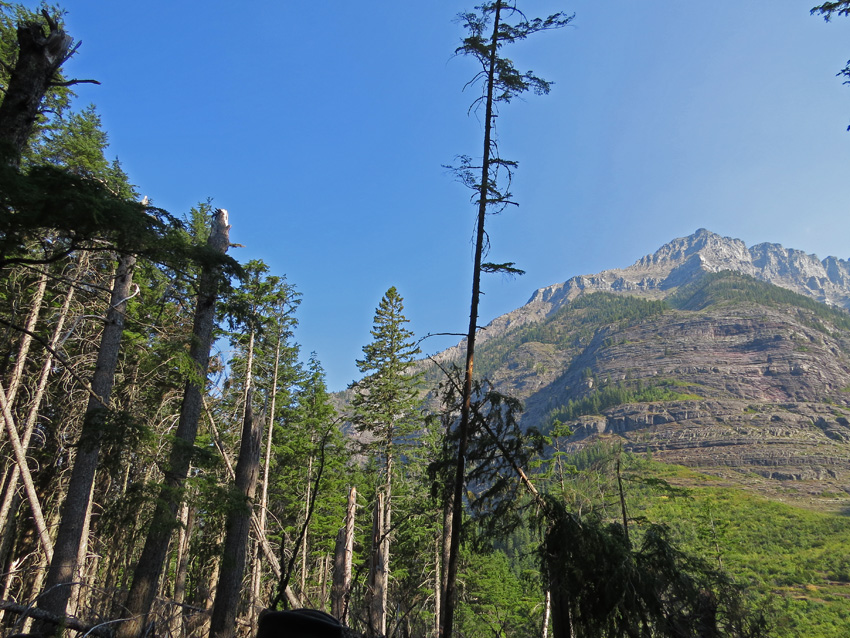
We kept climbing, and climbing, and climbing. Above the tree line, the alpine meadows were delightful. The mountain goats that shared our trail certainly must have thought so, although we didn't see any nearby. The sun shone fiercer as we climbed, but incoming clouds made me worry about rain, after hiking in the rain the day before.


Puff, puff, puff ...are we getting near yet?  No, we weren't even ready to stop for lunch yet.


At Thunderbird Falls, water came directly down a vertical rock face on top of the hikers. The side of the trail next to the wall was wet, while the almost dry side was a sheer drop off. I didn't like either alternative, and just about had a meltdown, since I was on my own.  But I continued, because I didn't was to just turn around without telling Dick that I'd meet him back at the bottom.


No matter how hard I tried, I couldn't catch up with our group. Pairs of hikers, and families with young children all passed me on the trail. My acrophobia started acting up. Look at this section of the trail...do you blame me?  Finally, I loudly blew my wilderness whistle, kept on my vest for emergencies, to get someone's attention.  "Tell my husband I'm going back down," I shouted when the last person turned around. But my wonderful husband said he loved me more than reaching the glacier, and he came back to return to the valley with me.


He thinks we probably made it about 1,000 feet up, but the last 600 after lunch were supposed to be the hardest.  It felt like 2 - 3,000 already to me, so I made the right decision to quit when I did. Going down was faster, but still dangerous.  I was so glad to reach the bottom with no broken bones, and ride the boat back to the hotel where our car waited. Rounding out our adventure in the mountains, guess what - it rained all the way back to the condo again!

Tuesday, August 27, 2013

Up, Up to the Top


The Logan's Pass area at the top of Going to the Sun Road (6,647' elevation), has trailheads to several highly recommended hikes, so we boarded the free park shuttle, and headed back up the mountain as the sun cleared the peaks. This time I sat by the window and got photos of the u-shaped valleys far, far, far below us.


Can you believe it?  Some people (idiots, fools, etc.) choose to ride their bikes up the mountain on this narrow twisting road filled with cars and campers!  Makes me shudder. We actually had to slow way down until traffic cleared enough to pass them. I couldn't even pedal up a small hill, let alone a climb like this.


The moon was setting over the mountains as we started up our first trail. If it falls into this sharp peak, will it pop like a balloon?


Here we go, climbing the Hidden Lake trail off Logan's Pass, a mere 1.5 miles to the overlook, and rising about 400 feet. The subalpine area at the top is too cold and windy for plants to grow tall, and the growing season is pretty short since the snow doesn't melt until June. A boardwalk was constructed to protect the land and plants from people's feet. Everything was pretty dry and a few brave flowers huddled around the boardwalk, which probably gave them some protection from the wind.  A ranger told us about little pikas who collect grass to make hay and store it for the winter. They are having trouble because they can't stand the heat we are getting even at high elevations now.


As we topped a ridge (about 7,000 feet), water started flowing from the remaining snow fields on the mountain, babbling and chuckling on its way down over the bright red and green rocks. Suddenly, all the little alpine plants burst into bloom as far as the eye could see! Reds, yellows, purples, whites - you name it. The water made all the difference. It took a lot longer for us to complete the hike, since I had to stop and photograph each different flower we saw to be identified later. Bees and butterflies did their jobs pollinating all these blossoms before the weather changes. Still not completely satisfied with the focus ability of this new camera. Can't see through the viewfinder properly.


"Wouldn't this greenery be a great place for mountain goats to graze?" I commented to Dick, and in a few short minutes, we found 4 of them doing just that, 2 moms and 2 kids. All the people taking photos only 45-50 feet away didn't bother them at all.


At the overlook, we looked down into another beautiful clear glacial lake, and got out the iPhone for a panorama. This says it all, don't you think?  Very few glaciers remain, but the environment is used to having that water supply to rely on. The ranger yesterday said they are like water bottles, and now the bottle is going dry. All the plants and animals will have to adapt to new conditions, since the annual snowfall isn't as much as it used to be either. Some of them may not be able to make the change. As trees move to higher elevations, the subalpine plants will have to move higher too, since they need the sun. But they can only go up so far.


Dick really wanted to hike the High Line Trail while we were up there. That's the one where you have to creep across a cliff face in the first few minutes. Given my fear of heights, I wasn't enthused about it, but a lady on the shuttle said I could do it, just hold on to the chain. Well, I don't know if it was the altitude, lack of sleep, or just wisdom on my part, but I felt light headed most of the morning, so I made Dick a deal. He could go hike it, and I would wait for him at the Logan's Pass center. When he arrived back, he looked really beat. "I'm glad I went," he started, "And I'm glad you didn't." he concluded.  I agreed completely!

Silt, Tilt, Slide and Glide


Have you ever been to a ranger led program at a state or national park, to be bored to tears by a ranger who speaks in a monotone, or too loud or too quiet, or doesn't respond to questions? You may just shake your head and quietly wander away, with a bad feeling about ranger programs. Dick and I are both Certified Interpretive Guides, which trains us to avoid such situations when we are leading a hike or program. We have been trained to engage the attention of our visitors with questions, memorable sayings, and props they can handle and touch. Strangely enough, this topic has come up twice in the last two days, due to the CIG button on my hat. Our good friend and mentor, Wren Smith at Bernheim Forest, was our trainer for this certification.


This morning we attended a ranger led hike up Avalanche Creek to the lake. This young woman in the full ranger uniform, did everything right. She explained everything we needed to know about bears and why. As we walked along the trail she would yell, "Hey-Ho, coming down the trail!" at the top of her voice, since loud, non-natural noises are a good way to avoid sneaking up on a bear inadvertently. The first stop was at this funny looking rock, when turns out to be a fossilized stomatolite, the cyano bacteria which turned our atmosphere to oxygen about 1.6 billion years ago. She let us try to guess what the rock was and why we were looking at it (engaging us), before she explained the answer.


We hiked for a while, and just as the group got all strung out, she would take a break, so the laggers (usually including me, since I'd stopped for photos so often) could rejoin the group, and everyone could take a short breather, while she explained something else about how the park got to look the way it does.  The most common cause of death in the park is drowning, so please don't lean over too far to get that photo!  She gave us clues to a little poem to remember: silt, tilt, slide and glide. This describes the geologic forces at work to make the park over billions of years.


Many parts of the park have been subject to forest fires, but not this area, and some of the old growth trees are huge. The trees grow so closely together that little light reaches the forest floor, which keeps it cool and comfortable for hikers. But there is little or no understory growth such as we see in Kentucky. Even the spring wildflowers don't have much of a chance, since the conifers don't lose their needles in the winter.


At one point, we walked into an open sunny spot, stretching from shortly uphill of our position, down to the creek below. All the logs on the ground were pointing uphill. "What caused this?" the ranger asked. Would an avalanche make the trees point uphill, she replied to our suggestion.  Well...we scratched our heads. Yes, if the avalanche came down the other side of the valley! In fact, these great masses of speeding snow create a huge wind before themselves, and the wind blew all the trees down in front of the avalanche from the other side. This only happened in 2011, so she pointed out that the park is an every changing system. The light in this clearing allows young plants to grow, and the decaying trees add nutrients back into the soil. Plus, it gives hikers a much better view!


We reached Avalanche Lake, which is fed by runoff from Sperry Glacier. Here the ranger gave a lesson in glacial terminology - cirques, arretes and horns. In 1850, there were 150 glaciers in this area, and now there are...she asked us to guess. Only 25 glaciers remain now, and they are expected to be gone by 2020, or 2030 at the latest. People will still come, and it will still be called Glacier National Park. She closed with the Interpretive Guide's "call to action," -- what can you do to help? Even if you are only one person, you can help.  George Bird Grinnell was one person, who helped the creation of the park in the beginning.


As the group spread out to enjoy the lunches we brought, we approached Becca to praise her good interpretive skills.  It turns out that she has not been through the CIG training at all.  She must have been fortunate to receive her training from Park Services personnel who understood the CIG principles, because she did an outstanding job.  She was glad to hear our praise, since she usually doesn't get much specific feedback, and we certainly know how discouraging that can be.  So, Wren Smith, there are wonderful interpreters out there, but keep up the good work to train more of them!

Monday, August 26, 2013

Crown of the Continent


Here we are in Glacier National Park, among over 2,000,000 visitors who come every year. It's an absolutely huge place, about 1,583 square miles, of which about 1,489 are considered wilderness, so the people mostly come to the same rather small areas to visit. It's about 50 miles across the middle of the park from the West entrance to the East entrance, crossing the Continental Divide at Logan's Pass, the highest elevation (6640ft.) reachable by car in the park. You begin to see the problems, right? So does the Park Service.
 
 
The road was originally built in the 1930's, by men with shovels, pick axes, mules and some dynamite. The slender line across the mountain in this photo is the road working its way up the mountain. It is beautiful, without a doubt, but narrow and twisty. Large campers and other such vehicles can't use it at all, of course. You couldn't pay me enough money to drive across it.  Definitely a white knuckle trip.
 
 
One of its biggest issues is snow, which can vary from 47 inches at the bottom, to almost 14 FEET at the higher elevations. Each year they have to get road crews with plows up there to remove the snow, without losing anyone over the side to avalanches. I don't understand how they can even find the road in all that snow! In 2012, for example, it wasn't opened fully until June 19.  The park posts updates on their progress on their website.
 
 
The Going-to-the-Sun Road is now 75 years old and is in need of comprehensive rehabilitation to ensure that this National Historic Landmark is preserved for generations to come. This work will continue for the next 5 years, depending on funding. As they close down one lane at a time to be completely rebuilt, traffic can really back up, although it didn't seem too bad this morning. In October of this year, they will close the crossing at the top altogether, until next spring.
 
 
Having researched all this online, we were prepared, and signed up for the Red Bus Crown of the Continent tour this morning. Since 1936 a fleet of buses has carried park visitors across the Road to the Sun. Everyone liked the old design so well that Ford Motor Company re-created them using newer technology and safety features, but the old style. Drivers called "jammers," for the tendency to grind the gears in early days, also narrate tours as you drive along.
 
 
The roof rolls back, and you have absolutely spectacular views. When the bus stops, you can stand up and take photos through the rolled back roof! We rode the bus all day, over to the East side and back, stopping for photos and lunch. This was our orientation to the Park. No matter how many maps and brochures you read, you just don't have a good feel for how big this place is, and how to get from one place to another. The Park Service now has a series of free shuttle buses to take people to the most popular locations, and encourage visitors to leave their cars below. I certainly plan to do so!

You know me, I can't walk 6 steps in a place like this without taking a bunch of pictures, so here are some highlights from today....

Mountain Goats at high elevation

Columbian Ground Squirrel at Logan's Pass


Saturday, August 24, 2013

Trains, Planes and Cameras


Vacations are wonderful, yet challenging times. Packing, getting to the airport, wondering if your luggage will make the transfer, you know.  From 36,000 feet I watched a UPS jet speeding across our path, and was amazed at all the air traffic we saw at that altitude. Car rentals - thank goodness for GPS - how did we ever travel without it? Portland is famous for the International Rose Garden and Japanese Garden, both of which we enjoyed. But my faithful Panasonic Lumix had a fatal accident, and I had to rush to Best Buy for a replacement, a Cannon. I'm struggling with the focus on it, but it does have a 50X zoom.


We decided to have a real adventure by riding Amtrak's Empire Builder from Portland to Glacier National Park, with a sleeper compartment for the overnight trip. Well, the sleeper "roomette" was more like an oversized closet. The facing seats turned into one bed, while the upper berth pulled down near the ceiling, leaving no room to sit up in. We were warned that we would have to wait a while during the night, while the rest of our train (including the dining car) joined us in Spokane, so we took off up the Columbia River. All Aboard!


The Columbia Gorge is famous, and I thought about Lewis and Clark, who must have been so relieved to actually approach the end of their trip. The river has many dams on it now, and huge electric towers line both sides. At one point, we saw lots of parasail enthusiasts having fun.


With no dining car, our attendant served a delicious cold supper and champagne in our room, then we went up to the observation car, since our windows did not face the river. Also, it was great fun talking to the other passengers. Cheers!


Portland was cloudy, but as the afternoon progressed, we finally saw Mt. Hood in the distance. This is pretty good with that 50X zoom, and a little more help from Photoshop. Taking photos from a speeding train is a challenge too. As long as you focus on something far enough away, it can be clear, but anything too close to the train is just a blur. The clear spots move away fast, and you still get the trees in the foreground. The new camera struggled to focus on moving targets, and I finally just used my iPhone, which just snaps away without a problem focusing.  After avoiding smartphones for years, I finally got one this summer and just love it. We were able to look up the phone number for the car rental place to tell them we would be late. But the best thing is being able to send those photos directly to Facebook!


After a while, the green Columbia Gorge turned into dry, dry cliffs. I felt like we were at the Nile and I should look for the Temple at Karnak around the next turn.


Electrical generation is a big thing up here, between hydro-power from the river, and acre after acre of windmill farms along the shore. I explained the dangers of these windmills to our seat mates.


As the sun finally set behind us, we climbed into our beds for a good night's sleep. I woke up to find us stopped at 1:30, about as I expected, waiting for the rest of the train from Seattle to join us in Spokane. Woke again at 5:30, still unmoving. Uh-oh. Turns out that the delay wasn't an hour, but three hours!


Actually, this turned out well for us. We were supposed to reach Whitefish, MT at 7:30, with just enough time for breakfast, missing much beautiful scenery in the dark. But now, we enjoyed mountains, greenery and rivers in the morning sun! A much nicer way to spend that time. Apparently, Amtrak has problems with keeping schedules, according to the other experienced riders we met. Since we didn't have specific time requirements, we just relaxed and enjoyed it!  The problem is, we have been off the train for almost 12 hours, and I am still trying to find my land legs! The room keeps swaying just the way it did while were on the train!

Tomorrow, the Road to the Sun on the Red Bus.

Friday, August 09, 2013

Thursdate Adventures


Many couples try to have a "date night" when they can just have fun together on a regular basis. Dick and I have started having a Thursday date morning, since neither of us usually have a volunteer job then, a rare thing indeed for us. It's fun to take a hike somewhere we wouldn't go otherwise, such as the Zoo before they are open, or one of the new Century 21 parks. Birding and wild flowers are always great activities for us and we get in some exercise as well.


Yesterday we went to the Salato Wildlife Center, near Frankfort, KY, which is operated by Kentucky Fish and Wildlife Dept. For a change, ours was the only car in the parking lot, so we looked forward to a quiet morning.  Salato has large areas housing native wildlife, such as these bison, elk, deer and turkey, bear, the wildcat of UK fame, and a Bald Eagle. This is the only opportunity many school children may ever have to see such animals.


As Nature Interpreters, we really appreciated the stellar signs and learning exhibits at Salato. Outside the Bald Eagle enclosure, for example, is a huge sample eagle nest, with a large ruler. Another sign explains the size of the largest eagle nest ever (20 feet tall, 10 feet across, and weighing 2 tons!), and invites children to climb into this nest themselves. All the signs are first class quality, and I can only image some rich corporate sponsor paid the bill, since signs like this don't come cheap. Some signs included the QR code (that little black and white grid looking thing). I used my new iPhone to scan the code and listen to the pod cast of our friend Jamie Cook talking about the bison. Too cool!  When it started to rain, we looked up the weather map, and decided to turn back since we had no plastic bags to protect my camera or the binoculars. (I fought getting a smart phone for years, but now I love it!)


The recently added a quail, or Bob White, exhibit. Yesterday all the birds were all quiet, but they had been calling the last time I visited. Again, Bob Whites have become a rarity in Kentucky, and we get excited when we hear them.


The small covey wandered around freely nibbling on seeds from native grasses, or on a supply of chicken feed. The native grasses give them a hiding place if they don't want to be seen, and it's amazing how well they blend in. Upon exiting the enclosure, children are taken on an adventure to "find" a lost chick by learning about the habitat needed by these small birds. The "chick" itself is a six foot tall statue!


At the raptor aviary (empty yesterday) children are invited to compare their own wingspan to that of Kentucky raptors! Sometimes the handlers will bring a live hawk out for a little free flight before he gets fed. I would like to have some signs like this for Raptor Rehab to use.


People who don't care about wildlife, birds or native plants, go to Salato for the fishing. As we walked along the fishing lake, a loud squawk preceded the flight of a Green Heron to a small island in the middle of the lake. If you are looking for a fun date, give Salato Wildlife Center a try!