For a while, I was getting out to hike, bird and photograph on a regular basis. Lately, it seems to rain every day, or I am volunteering, or being on Nana duty. The weather map has shown a stalled front right over the Ohio River for weeks. But Saturday morning, the sun came out, and the rain predictions were low, so Dick and I headed out to Beckley Creek to enjoy the wildflowers.
Century 21 Parks sowed these field with wildflowers, and the result has been outstanding. We saw kayakers heading into Floyd's Fork. The water was quite high and the kayakers without life jackets - a bad combination. A family lost several members over July 4th when their rented boat crashed into construction barges on the Ohio River, tipping over at night during the fireworks program. They too weren't wearing life jackets. So sad.
As we walked the trails, we tried to identify the flowers, with some success and some failure. The blue Chickory is not native to Kentucky, but doesn't seem to be so invasive as other immigrants.
The biggest confusion arose over the many yellow plants with rays. We could tell by the leaf of this that is it Cup Plant, which we have in our garden.
Gray-headed Cone flower is pretty easy to tell. The heads are gray when it first blooms, but turn brown as they mature.
I think this is some kind of Tickseed. The beetle didn't care. This arrangement of small flowers at the center surrounded by rays is an evolutionary success. I guess the plant gets the maximum chance of reproduction for a minimum of effort.
I used to know many butterflies and dragonflies at first glance, but now I have to take their pictures and look them up when I get home.
But sometimes, even that doesn't work if I can't find them in the book. These two have similar markings on their backs, and I bet they will end up being the same species. I am looking for the email of a bug expert to see if she can help.
Teasel comes in white and purple versions. Watch as their small flowers appear from the bottom and grow towards the top of the thorny structure. All sorts of bugs love them.
Queen Anne's Lace has always been one of my favorites. Look for the drop of "blood" in the center shed by the Queen as she makes these lacy flowers. Then when they finish blooming, they fold up into baskets.
After one solitary day of sunshine, we awoke to thunder and heavy rain on Sunday morning, lasting several hours. Only about 80 people made it to church this morning, and we decided to drive around the block when the street flooded in front of our house. A neighbor said he measured almost 4 inches in his rain gauge from the storm, and more is predicted for tomorrow. It has been an unusually wet summer this year.
When I was a Girl Scout, many, many years ago, we went camping several times every year. As an adult, however, we usually stayed in cabins or the lodge at state parks, until we reached the ultimate luxury of time share condos. Dick used to take Andrew camping when Andrew was younger. Whenever I thought about going camping as an adult, I always cringed thinking of how to plan the food and cook it outside.
But a friend who is an experienced scout leader and camper, and his wife, both of whom are volunteers at Creasey Mahan Nature Preserve with me, organized two family camp outs in the last few years. This is our second, and most successful outing.
It stormed like crazy Friday night, and the clouds couldn't decide whether to stay or go all afternoon on Saturday. But by sunset, the sky cleared, the temps were very pleasant and it was perfect camping weather. We set up the tent with no help (Hooray for us!).
Our friend Karen Dean is a wonderful entertainer, and one of the boys got really involved with her song about the blue Martian! The astronomy club guy brought his telescope and we looked at Venus and Jupiter, which looked extra close to each other, the rings of Saturn and a binary star system. My Sky Guide ap on my phone was a big hit with the other campers.
Of course, any time I can just wander around the Nature Preserve taking photos, I will jump at the chance. While pulling weeds along the paths in the Woodland Garden, I found scads of these small little Birdsnest fungi growing in the decaying woodchips.
Blue Dasher Dragonfly
While Dr. Frog, Karen's husband the biochemist, led the group of eager young boy campers in their search for frogs, I watched for the colorful dragonflys to land somewhere just long enough for me to focus on them.
Then we walked out through the meadow to see what had started blooming in the week or so since I last visited there.
Common Milkweed
Common milkweed is noted for being the host plant for the rapidly disappearing Monarch butterfly, but they also entice many other insects as well.
Passionflower
The Passion Flower grows on a vine, and produces a large apple-like fruit. It is the host plant for the Gulf and Varigated Fritillary butterfly. Tavia says it is called the Passion Flower in reference to the Passion of Christ. In any event, is has a most unusual flower structure.
Purple Coneflower
Purple must the color of summer, since so many summer blooming flowers are purple. Purple Coneflowers attract scores of butterfly species. As they mature, Gold Finches tear the petals off to eat the small seeds produced by the cone at the center of each blossom.
Purple Martin Female with Fecal Sac
Moms are always busy changing diapers for their babies, and mother birds are no different. This female Purple Martin is ready to carry away the fecal sac from one of her chicks in the nest box.
Tree Swallow
I never mess with a nest of Tree Swallows. I didn't even know if this box was occupied or not, and the parent bird dive bombed us until we moved back enough to suit it. Then it dove into the box, leaving only the long dark blue wingtips exposed.
We decided to use sleeping bags instead of sheets and blankets this
time. I was toasty warm and slept better than I often do at home. The
dawn chorus of song birds was joined by a pair of Great Horned Owls
hooting in the woods. Dawn is something that just slips by when you sleep at home. But outside, it calls you to rise and be one with Nature for the new day.
Don't worry about the dewy grass. It will dry in a few minutes. Just appreciate the incredibly long shadows that will cross the fields for just a couple minutes.
Daddy Longlegs
When I finally rolled out of my warm sleeping bag and started to dress, I noticed a Daddy Longlegs on the outside of the screen, but under the roof of the tent. Then I started counting, and found at least 13 of them, sheltering from the dew and, I suppose, spider predators. When we took down the tent after breakfast of burritos cooked on the big grill, I was careful to pick them up and fling them back into the grass. Don't want them living in the car- we've had enough trouble finding mouse nests in infrequently opened boxes and cloth things in the garage lately! In any event, many thanks to Charon, Doug and Dave for the long hours they put in planning this terrific outing!
Aren't you supposed to slow things down when you retire? Somehow, Dick and I have got it reversed, and we seem to be busier than ever since we retired. I couldn't survive without the calendar on my smartphone, and even with it, I fail to write things down and end up promising to be two different places at the same time on more occasions than I care to admit. Sigh.
Mute Swan
So, the last weekend in May was supposed to be spent camping out at Creasey Mahan Nature Preserve, and we were looking forward to it. Setting up the tent, smoke getting in your eyes, singing around the campfire, looking at the stars. All that good stuff. But Thursday evening, the weather forecast for the weekend was just awful, with high chances of storms, so the camp out was postponed. We were suddenly presented with free, unscheduled time over the weekend. Golly! It's been a long time since that happened, what should we do about it?
Crawdad
Let's take a walk on the Anchorage Trail. Listened to some birds and posted on eBird - I'm getting better at that. And we found this giant crawdad in the grass. He must have been 6 - 8 inches long, and was quite aggressive as I neared for a close up photo. These are the guys who build big mud volcanoes in peoples' yards. When I looked it up online, I mostly found links to sites with ways to get rid of them. Look at the orange tips on his pincers!
When he decided we weren't looking any more, he moved quickly through the grass, but the creek was behind him, so I don't know where he was actually headed.
Saunders Springs Nature Preserve
Saturday, we actually ran errands, went to the Farmer's Market and worked in the yard. How ordinary, and how we enjoyed it. I cooked a colorful dinner that we ate on the patio with a cold glass of Turtle Run wine. On Sunday, I joined a small group of Beckham Bird Club members driving to Radcliffe, KY, near Fort Knox, for a birding trip to a new location, for me at least, Saunders Spring Nature Preserve. The local tourism department describes it as "a heavily wooded natural area located on steep terrain with interesting historic features...located on the edge of the Karst
Plateau in the Highland Rim physiographic region of Kentucky. The area
is characterized by many sinkholes, caves and springs which drain a
network of underground caverns."
Louisiana Waterthrush
The streams literally ran out of the steep hillsides, bubbling down the valley. The very first bird we saw, bobbing its tail in the grass, was a Louisiana Waterthrush. We must have seen at least ten of them during the morning hike! Most of the time, we birded by ear, since all the trees were fully leafed out, and combined with the overcast skies, the lighting was just awful. Any birds we did find were usually seen only in silhouette against the gray sky. I've never understood why this bird is called a thrush when it's actually considered to be a warbler.
Kentucky Warbler
We also heard/saw Hooded Warblers, Kentucky Warblers, and Acadian Flycatchers. The Summer and Scarlet Tanagers sang but could not be enticed to come down for a visit. The path along the creek eventually ended in a meadow created by a drained beaver pond. You could see evidence of their work, but the water was gone, and grass covered the stumps.
Goatsbeard
When the birds were hard to find, we appreciated the signs pointing out various wildflowers and trees along the trail. The ferns were "ferntastic!" In fact, next spring, I plan to return to see all the wildflowers blooming, since we saw so many with seeds on them today. Of course, when it rains, the whole valley must disappear under water, so timing will be important. Maybe I can get there early enough to see the Hepatica.
It can be hard to find one place that fulfills several needs at one time. Bernheim Forest and Arboretum is a place of incredible beauty. The Big Meadow leads your eyes from golden coreopsis flowers to the Earth Measure sculpture and the green hills of the Kentucky Knobs. As the seasons change, so do the flowers in the Meadow, but the thrill I get from finding them never ceases.
Yet Bernheim has always been a place for me to learn, both about nature itself, and how to help people see and appreciate it. Both Dick and I received our training as Certified Interpretive Guides from our mentor, Wren Smith, who works at Bernheim. This week I attended another training session on using social media as an interpretive tool. Paul Caputo, from the National Association of Interpretation, asked the question, "What is interpretation?" Since all of us were CIGs, we all should have known that answer easily, but silence filled the room. I always struggle with that term, yet no one has come up with a better term.
NAI defines interpretation as "a mission-based communication process that forges emotional and
intellectual connections between the interests of the audience and the
meanings inherent in the resource." Hmm, you can see why we have trouble remembering it. Another description says it involves "what things mean, how they fit together, and why it matters," and helping our visitors understand.
These Interpreters themselves make the concept come to life!
Although our original CIG training focused on personal interaction with visitors, such as leading tours and classes at a facility such as Bernheim or Creasey Mahan Nature Preserve, Paul reminded us that we need to relate to those visitors wherever they are, which sometimes may be at home in front of their computers or looking at their phones. We can still be interpretive on social media, he assured us, giving people what they want to know about our sites, not just what we think they should know about us. By appealing to the right followers, we can create a real community of our site's friends. When I return to Creasey Mahan, I'll start by explaining concepts like podcasts, hashtags and how Facebook doesn't actually deliver all your posts to all your friends to our director. Whoa. This is going to take some adjustment.
With my head spinning, I thanked Paul and Wren at the end of the second day's session, and headed out into the Arboretum for a walk and some birding, to clear my mind. Each year, the Barn Swallows return to Bernheim's Garden Pavilion, next to Lake Nevin. They build nests of mud, grass and swallow spit in the rafters of the pavilion. Each year the staff tears down the nests, and each spring the birds shrug their wings and rebuild them. How can this be interpreted to non-birders?
Swallows are like all of us. They want a safe place to raise their young, protected from wind and weather. They want a good supply of insects to feed them. And like us, they sometimes have to deal with unwanted traffic to attain these vital goals. To the Swallows, people walking along the Pavilion's porch are like the Interstate traffic many of us deal with every day driving to work. We don't like it particularly, but with care, we can avoid disaster, and get home each day to our families. Since this location provides all their other needs, they put up with the inconvenience and potential danger of the traffic. Of course, sometimes people are startled by a near collision with a fast flying Swallow which doesn't slam on its brakes for anything. Now I just need to interpret people to the Swallows!
A cold front came through last evening with heavy rain, gusty winds and much cooler more pleasant temperatures. When we got up this morning the clear blue sky called, and off we went birding at some nearby St. Matthews city parks. Didn't find anything exotic, although you never can tell, but we enjoyed the birds we did find.
Canada Geese are year round residents in Kentucky these days. None of this tiring migrating stuff for our birds. The weather ususally isn't too bad in winter, and there are plenty of places to stay and things to eat. Why should they leave? The first park runs along Beargrass Creek, and the geese were out in force. We saw at least 25 adults, and about the same number of goslings in various sizes. It looked like three families decided to come to the park for a picnic with their 15 youngsters!
We were very careful to be respectful of the parents, since they can take a chunk out of you real fast. Aren't these babies cute little fuzz balls?
Mama Mallard and her fuzzy ducklings dabbled in the shallow water for goodies. Looks like the ducklings know just how to do it.
I'm getting better with eBird. It's much easier to do on the phone app than to wait and use the laptop when I get home. I can now find existing hotspots, such as Draut Park, with no problem. I set up my own personal spot for another small park and saved it. Is there a way to name some of these?
It's funny that we saw no hawks at all over the weekend in rural Western Kentucky. A Red-shouldered Hawk circled the park, landed briefly, then took off again, chased by both a Mockingbird and Robin. Poor guys. It's tough to be persecuted.
I love the iridescent feathers and bright yellow eye of the Common Grackle.
Mississippi Kite
To finish off our morning of birding in St. Matthews, we headed for the residential area where the Mississippi Kites have returned for their 3rd year (I think)! I'm always amazed that they would choose a neighborhood filled with houses and cars to nest in. There must be enough insects nearby to satisfy them, but I could have thought a more open area would have provided easier hunting. There are two pairs that have been coming back. Even our friend who lives on that street isn't positive where their nest actually is.
On the recommendation of a friend, we headed to Henderson, in Western Kentucky, to spend the night at Ruby Moon Winery, which has a suite for overnight guests! We love going to local wineries, and Kentucky has an amazing number of them, but we've never been able to stay on the grounds before, so this was really a treat. After sampling some of their excellent wine, we did a little birding among the vines, and found the pair of Bobwhites we had heard from the room.
Dickcissel
This morning, we boldly ignored the forecast of the Weather Channel for 90 - 100% chance of thunderstorms in the morning, and headed for the Sloughs WMA. (It never did rain.) Somehow we never get to join the Beckham Bird Club on its trip to this Wildlife Management Area, so we just decided to go on our own, and spent over 3 hours driving on quiet country roads where we could just stop if we saw or heard something interesting.
Several years ago, we drove to Missouri to visit Dick's only surviving aunt (now deceased), and she delighted in showing us all the places where the Dennis children of her generation had grown up. While there, I found a bird that resembled a Meadow Lark to me, but sounded completely different. It turned out to be a Dickcissel, and I hadn't seen one anywhere since then. Until today that is...
They called to each other for at least 8 miles up and down the road. This was just too cool!
So this is one bird song I'll always remember!
Red-winged Blackbird female
Red-winged Blackbird male
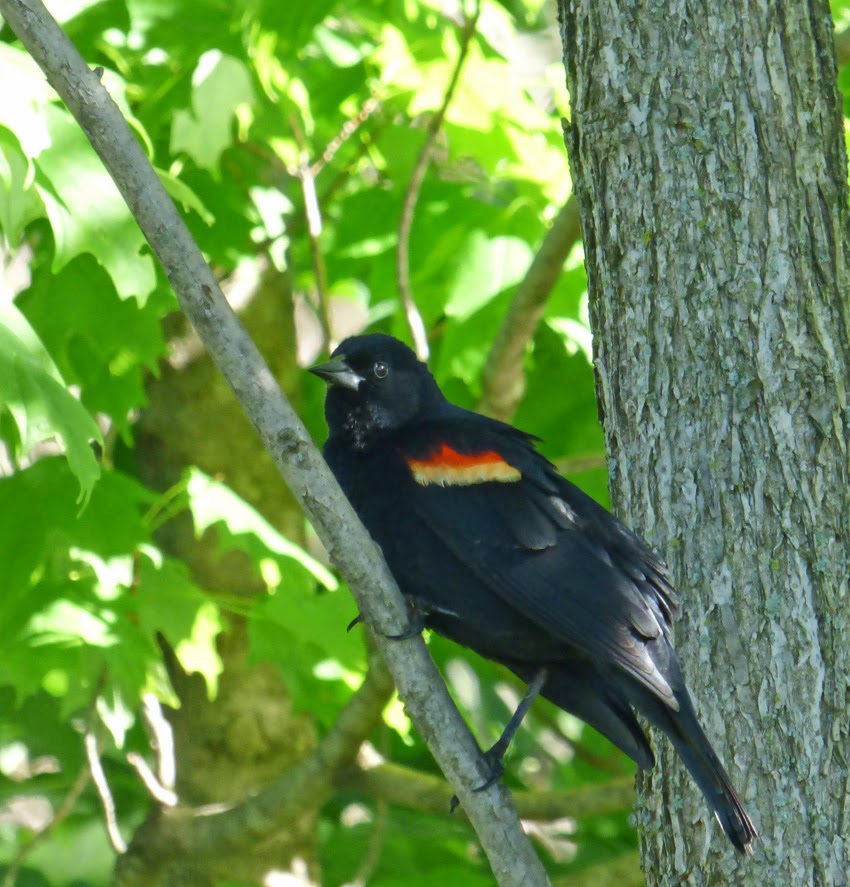
Of course, the Red-winged Blackbird was the most abundant, and certainly the noisiest bird we saw all day. The female is less showy, but just as attractive in her understated way as the male.
Indigo Bunting male
We were not surprised to see no Eastern Bluebirds. The last two winters have just devastated their numbers. I hope they are nesting successfully somewhere. However, the Indigo Buntings were out in force today. They only look this dazzling blue when they are in the sunshine. Their feathers actually are not blue at all.
Indigo Bunting female
Indigo Buntings solve the problem of cold winters by migrating away completely. I think this is the Bunting...or is it a female Blue Grosbeak? Not as likely, I'd say, since we didn't see any Blue Grosbeak males today. Her beak just looks a little large.
Solitary Sandpiper
A "slough" (pronounced sloo, rhyming with too) is a swamp. This one comes and goes with the flooding of the nearby Ohio River. The slough fills the old riverbeds, and is maintained for hunters primarily. We were surprised not to find any hawks today, although a pair of Bald Eagles had a nest atop a dead tree far, far across the slough.
Carpenter Bee
For an insect that can hover in the same spot for hours, it can be hard to get a photo of a carpenter bee that is focused right. Carpenter bees resemble bumblebees in both size and appearance, but are not social insects. They construct their nests in trees or in frame buildings. Most of the top of the abdomen of carpenter bees is without hairs and is shiny black in color. By contrast, the abdomen of bumblebees is fully clothed with hairs. The male bee is unable to sting, and it is the male carpenter bee which is most often noticed. They hover in the vicinity of the nest (i.e., any exposed piece of wood) and will dart after any other flying insect that ventures into their territory. A common behavior of the males is to approach people if they move quickly or wave a hand in the air. The males may even hover a short distance from people causing unnecessary panic. I know they aren't really dangerous, but their size and persistence makes them very intimidating. And boy, can they chase each other around!