Friday, April 22, 2016

Day 2: Deadhorse Ranch State Park

Lagoon at Dead Horse Ranch State Park
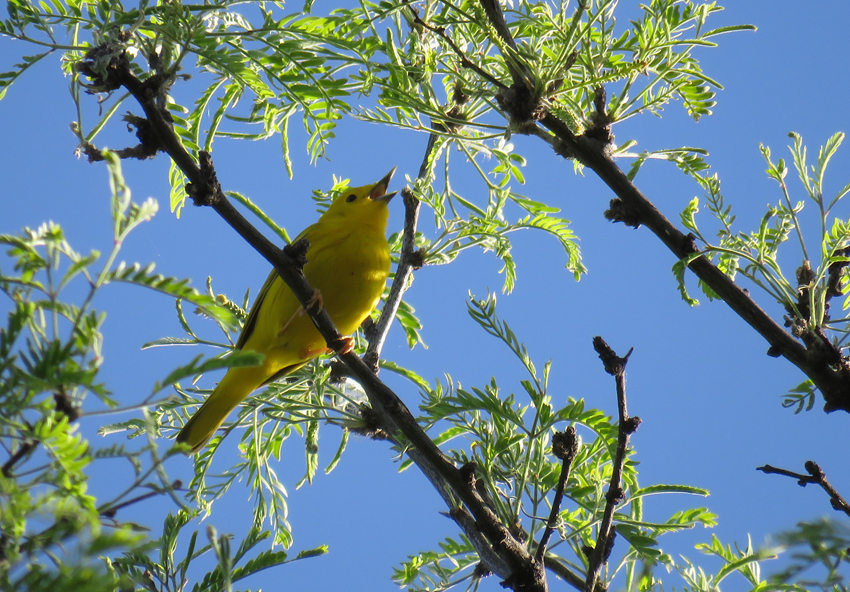
Today we walked along the Greenway at Dead Horse Ranch State Park in Cottonwood, AZ. Our tour leader was expert at birding by ear and knew where many nests were, so we had a good time. The warblers followed us up and down the river looking for tasty little caterpillars.
Bewick's Wren


Gila Woodpecker with Treat
Ladderback Woodpecker
Yellow Warbler
Spotted Sandpiper
We scanned the edges of the cattails in the lagoons for shore birds like the Green Heron. Instead one of our group (who was probably looking at the turtles) saw this little Spotted Sandpiper, a real surprise to our tour leader and a great find.
Vermilion Flycatcher Male
A family of Vermilion Flycatchers was the highlight of the day. Flycatchers are easy to watch. When they leave a perch, they swoop out to catch a bug and usually return to the same perch again. We noticed that this brightly colored male preferred sitting in low branches of the trees rather than high in the branches in most instances. Guess he can see better that way.
Vermilion Flycatcher Female
The female sat waiting rather impatiently for us to leave the vicinity of her nest tree so she could care for her chicks.
Vermilion Flycatcher hovering
Dick and I returned later in the day, for more photos of the male, who kept his back to my camera during the morning walk. We saw him almost hover in the air showing this fantastic display of white under his wings. I've never seen that before!
Lark Sparrow (left)
Diamond Back Rattler
Other than the great birds, we had some excitement when heading back to headquarters. Our tour leader said, "I'll go first. There may be snakes in here." and sure enough she heard a rustling in the grass. I was right behind her a few feet, and I heard a rattle! She looked down and there was a diamond backed rattle snake. It eyed her for a while then slithered through the grass and disappeared. I got a photo of his rattles, and this was obviously a large adult snake. Needless to say, we didn't try any more shortcuts!

Thursday, April 21, 2016

Day 1: Montezuma Well

Montezuma Well
Today was our first trip with the Verde Valley Birding and Nature Festival, fondly known as the Verde Birdy.  For each of the next four days we will go out on well led trips around the area, to see what we can see. The logistics of putting a festival like this are absolutely astounding, and my hat goes off to the organizers and volunteers who do this each year.

Neither "Montezuma" nor "well" are words normally associated with Arizona, and certainly not when used in the same sentence. However, Montezuma Well is a National Monument here in the Verde Valley. In Kentucky we would call it a really, really big sinkhole. In the Yucatan, they would call it a cenote.  Over 1.5 million gallons of water flows into the Well every day, a rate that has not fluctuated measurably despite recent droughts throughout the state of Arizona, with the excess flowing out into Beaver Creek, just downhill from the well. Look in the upper left of this photo for a dwelling from the Sinagua, an ancient people who inhabited this area. Water means life in Arizona, so people have lived here for thousands of years.
Great Horned Owl and Chick
As we entered, a Park Service volunteer preceded us with her spotting scope. There is a Great Horned Owl nesting in the side of the cliff, she said, and you can see them if you know where to look. They mostly stayed back in the shadows to keep the morning sun out of their eyes. Yep, Great Horned Owls can and do live anywhere they want!
Rock Wren in Nest Hole
The limestone sides of the cliffs were chock full of cavities, homes to many kinds of animals and birds. We noticed a pair of Rock Wrens going in and out one hole near the bottom, chasing off a ground squirrel that started coming too close.
Canyon Wren
The Canyon Wren's song echoed across the well, sounding like a child's wind-up toy that was winding down. It's an unmistakable sound, and we finally tracked him down near the water. Flying bugs are abundant, so many kinds of birds that eat them are here.
Barrel Cactus
Yellow Columbine
Flowers are blooming abundantly, both in the dry chaparral areas or the riparian stream sides. I could hardly believe finding this gorgeous yellow columbine and maidenhair ferns growing down in the cool creek areas.
Yellow Warbler
Yellow Warblers and Summer Tanagers taunted us from the leaves of sycamore and cottonwood trees above the flowing the stream.
Black Hawk in Nest
We heard the distinctive call of a Black Hawk, and our tour leader pointed out a Black Hawk nest that had been used in previous years, but seemed to be empty this year. Just as he said that, the hawk flew up and landed in it! Yeah! At the same time, my camera battery died (of course) and when I replaced it with the spare in my fanny pack, you guessed it, that one was dead too. Bummer. You would think I'd have learned better. Fortunately, one of the other birders on our trip has the same camera and she loaned me one of her charged batteries. What a life saver! You know that the best shots will come when your battery is dead.
Black-throated Sparrow
These festivals are terrific ways to add to your life list of birds. Our tour leader today really knew his bird song and found many birds that I'd never seen before. Of course, we still didn't see all of them. The Bell's Vireo and Lucy's Warbler are still on my list to find and photograph.
Cooper's Hawk in Nest
The picnic area is shady and cool and we found two large nests in the trees. One had a Cooper's Hawk sitting in it, keeping an eye on all of us.
Cooper's Hawk with Prey
Her mate came up in a while with her lunch, but cautiously did not fly toward the nest until we were safely out of the way.
Red Tailed Hawk Pair
Yes, love is in the air, along with this courting pair of Red Tailed Hawks. I have been in raptor heaven this week!
Lark Sparrow
By the time we got back to the meeting spot at Dead Horse Ranch State Park, my feet were hurting and I looked forward to driving back to our condo. However, the local Audubon Society representative asked if we had any target birds we hadn't found yet. I replied that I wanted to find Lazuli Buntings and Bridled Titmouse. Well, he replied, just take that path towards a big cottonwood tree. We have shade, seats, and feeders to attract birds of all sorts, and they had the Bunting there this morning.  He was right on all counts, except that the Bunting had been there (as all birders know) but had just left and didn't return while we sat there. But we saw this beautiful Lark Sparrow, another life bird. A group of school children joined us for a while, as their guide introduced them to birding habitats, how to identify them and the use of their binoculars.
Swallowtail and Hummer
The Hummers zoomed in and out to the nectar feeders, but didn't seem to mind sharing the nectar with some big swallowtail butterflies! We'll stop my again tomorrow to look for the Lazuli Bunting, so stay tuned.New life birds so far this trip - 6!

Wednesday, April 20, 2016

Uphill and Down in the Valley

Gambel's Quail 
My body must still be on Louisville time. I have been waking up around 5 am each day so far. We weren't sure when to meet our birding trip leader this morning, and went outside around 7 am. The condos have a few areas of native plant, and we found a covey of cute little Gambel's Quails enjoying the sun and chowing down on grass seeds. What a great way to start the day!
Huckaby Trail
Then we joined Dena Greenwood from Jay's Bird Barn, who leads a bird walk every week as a service for the store (which is a fantastic idea, by the way). After we finished, several people went into the store and spent $$, including yours truly. We started at one of the upland trails where Dena identified several birds by ear, but many of them were too far away to see. She became a grandmother again 2 days ago, and today was her birthday, so she's very dedicated. In addition, she plans all the field trips for the birding festival.
Western Scrub Jay
A Western Scrub Jay followed us around for a while, squawking like all jays...
Bewick's Wren
...while a Bewick's Wren serenaded us on the trail. The Bewick's Wren (pronounced like the Buick car) strongly resembles a House Wren, but has a striking white eyebrow. This little guy protected his territory from any other wrens in the neighborhood.
Cactus Blossom
This trail hosted many desert flowers in bloom. I took photos of many of them, of course, but it will take a while to identify them. This bright pink cactus blossom was the most dramatic.
Say's Phoebe
We next drove down to the Sedona Rancho RV Park, which is on private property right on Oak Creek - a very pleasant place to stay among the cottonwood trees. Carefully skirting the huge RV's, we followed a pair of Say's Phoebes as they gathered bugs and cottonwood fuzz for a nest.
House Wren
Many house wrens were singing in the park, but this little guy was the most determined to chase us away. When he sang, his whole body quivered! Notice the lack of a white eyebrow.
Summer Tanager
The Summer Tanagers have just arrived, and they are brighter red than just about anything, especially when perched in front of a white sycamore tree.
Great Blue Heron
But we went to this location to see the Great Blue Heron rookery. About 5 nests are found in the tall cottonwood trees next to Oak Creek. As you can imagine, the owners and residents at the RV Park are not happy with the situation. They hung shining metal streamers to scare the birds away, but no luck. They built platforms in other trees not in the middle of the park, to encourage them to move, and again no luck. The birds are protected by Federal law, so the people are at a disadvantage. The birds think the park is a great place too.
Great Blue Heron Nest
It was exciting to see these large birds swoop into the trees with sticks for the nest or food for the young. The nests are protected from the sun by the leaves, and the chicks have grown quickly.
Great Blue Heron Chick
My favorite was this chick with the Mohawk feather-do. The nests must be at least 70-80 feet up in the tree, trying to zoom in and focus a shot was a real challenge. Tomorrow the bird festival begins.

Tuesday, April 19, 2016

Bubbling Pond Birding

Cassin's Kingbird
Our walk leader this morning splits his time between Maine and the Sedona area each year, and today we went to the Bubbling Pond fish hatchery. This will be on the trips for the birding festival, but you can only do so much in four days, so we went here early. As usual, some of the best birding was in the parking lot, next to a row of mulberry trees full of berries. The early sun gave good views of Cedar Waxwings and this Cassin's Kingbird.
American Goldfinch
A bright yellow bird flew in to enjoy the bounty, and Kevin decided it was an American Goldfinch rather than the Lesser Goldfinch which is apparently more common here.
Phainopepla
 
My favorite was the Phainopepla, another life bird for us on this trip. It is considered a "silky flycatcher" and is the only one in its family. The plumage is dark and unpatterned except for striking white patches when they fly. It's hard to tell if this bird is black or some other color, it shines in the sun so much. And look at his red eyes! Too cool!
Bald Eagle
We had really good luck with the raptors this morning, starting with a Bald Eagle, and followed by several Cooper's Hawks.
Zone-Tailed Hawk
As the sun warmed the nearby rocks, a kettle of Turkey Vultures rose into the air circling on warm air thermals. Our leader Kevin advised us not to dismiss the group as "just vultures," since both Black Hawks and Zone-Tailed Hawks will fly with the vultures since they resemble them in the air. We found a Zone Tail Hawk and only got a quick view before it dropped beyond some trees. This hawk has grey flight feathers resembling the silver of the TV, and holds its wings in a V, as the vultures do, but it doesn't have a red head. This allows it to sneak up on prey who don't fear Turkey Vultures. The adult has two grey tail bands in flight.
Common Black-Hawk
Kevin was surprised that we hadn't seen a Black-Hawk this morning, until we headed back towards the parking lot, and found one sitting on a branch. We didn't see him fly off, but he posed nicely as we approached his perch. When it flies, it shows one broad tail band, and has very broad wings, with grey underneath, again resembling the Turkey Vulture. I hope we will find more of each in the next few days.
Red Tailed Hawk
We had good views of both a dark morph Red Tail and this beautiful light morph Red Tail.
Bosque Area
Water is an important resource in Arizona, and the Verde Valley area has abundant water. We walked around the fishery ponds towards a bosque. It looked like a nice grassy meadow, but we found benches around the edge, and Kevin said not to walk into the grass because we would sink in up to our ankles. Cottonwood trees grow next to the river, and some of them are absolutely enormous. A few yards away, the mesquite trees grow, since they can't take wet roots.
Gambel's Quail
I always love the little Gambel's Quail with their topknot feathers. This one called from a tree and Dick was the first to find it.
Great Blue Herons
Great Blue Herons waded in the water, perched in the trees, or stalked silently in the grassy fields looking for prey.
Says Phoebe
Both Say's Phoebe and Black Phoebe chased insects along with an Ash-throated Flycatcher. Kevin heard and saw some warblers I couldn't find.
Summer Tanager
As we were ready to leave for our train ride of the Verde Canyon, I heard a bird sing "picky-tucky-tuck," and sure enough we easily saw a bright red Summer Tanager in a sycamore tree. Overall, I think we saw/heard 37 species in a little over 2.5 hours. Pretty good way to start the day!

Monday, April 18, 2016

Photo Frustrations

Oak Creek Canyon
Years ago, when Mary Beth and Andrew were still in school, we took a family Christmas vacation in Flagstaff, AZ, spending Christmas Eve at the Grand Canyon. It was a great trip. One day we decided to drive down to Sedona. Now remember, this was before the days of computers, Google maps or GPS. The paper roadmap just said to take Rt 89A directly to Sedona. What it did not explain was the heart stopping hairpin curves at the top of Oak Creek Canyon. I threatened everyone with death (by car accident) if they didn't stay quiet. After we finally made it to the bottom, everyone enjoyed the day, and we drove the Interstate back up to Flagstaff.
Still pools
Arizona is known as a dry state, so a stream that flows all year is valuable. Oak Creek flows down through a canyon, then winds around the flat lands until it flows into the Verde River. It provides important habitat for plants and animals, and great recreation opportunities for visitors. Today we drove up the canyon to see what we could find in the way of birds. We stopped at a bridge, and walked up Wilson Creek Canyon. A bird on the other hillside sang to us. In the binoculars it looked like a Great Crested Flycatcher, but my bird phone app said they don't live here. Most flycatchers look alike, so I went through their ranges until I found the Ash-throated Flycatcher which can be found in this area. I played its song on my phone, and it immediately flew over to check us out, posing nicely for photos. Some Scrub Jays posed for photos as well. It was a good start to the day.
House Wren
I have noticed that the battery life on this new Canon camera is pretty short. I carry newly charged batteries with me, and changed it when it flashed red. Apparently, however, it had been running low for a while, and none of the photos taken at our first stop (including the life bird) were actually recorded. GRRR!!! At least we still have time to retrace our steps later on the trip to see if we can find that bird again.
Painted Redstart
 
Oak Creek Canyon did provide another life bird for us - a Painted Redstart! Isn't he beautiful! As we drove higher up the canyon, we lost the phone signal, and my birding phone app stopped working. How did we attract birds before cell phones? We pished at them! We found a couple of mystery birds. I heard some calls that I thought I should know, and finally realized I was hearing an Summer Tanager, but we never spotted it. And the bird I thought might be a Hepatic Tanager turned out to be a male House Finch upon closer examination. Maybe later, sigh.
Spotted Towhee
 

Our lunch stop found some much appreciated birds who stayed around for photos. This Spotted Towhee sings, Drink Tea! just like his eastern cousin.
Stellar Jay
 
Stellar Jays are very curious birds. This one squawked like someone being strangled, then settled down to see what in the world we were doing.
Acorn Woodpecker
The clown-like Acorn Woodpecker is one of my western favorites. Sure enough 3-4 of them swooped in at one time, then took off again. In the morning, we are going birding with someone from the Forest Service, so we took time to go to the meeting spot today, so we can find him on time tomorrow morning, followed by wine tasting at one of the local wineries. The waitress said all the wines are dry (not sweet) since they are in Arizona. Hmmm.