|
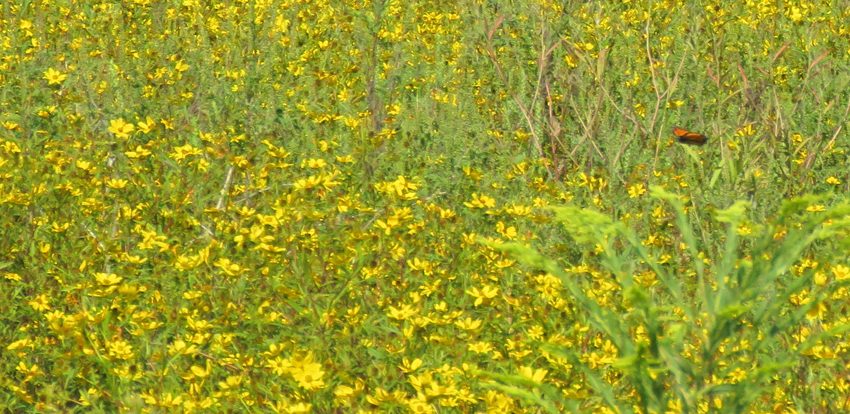
| Sneezeweed |
I can't believe it! I have been blogging, off and on, for over TEN YEARS! Sometimes I get lucky and my photos are really good, and other times, they are a bit fuzzy, but they are a record of some cool bird I saw today. I always say that one of God's greatest gifts is the gift of
forgetfulness. Just imagine what your life would be like if you remembered every single thing you had ever seen or done. You wouldn't have time to see or do anything new! Photographs, and this blog, help me remember the good times, while the rest slips away.
 |
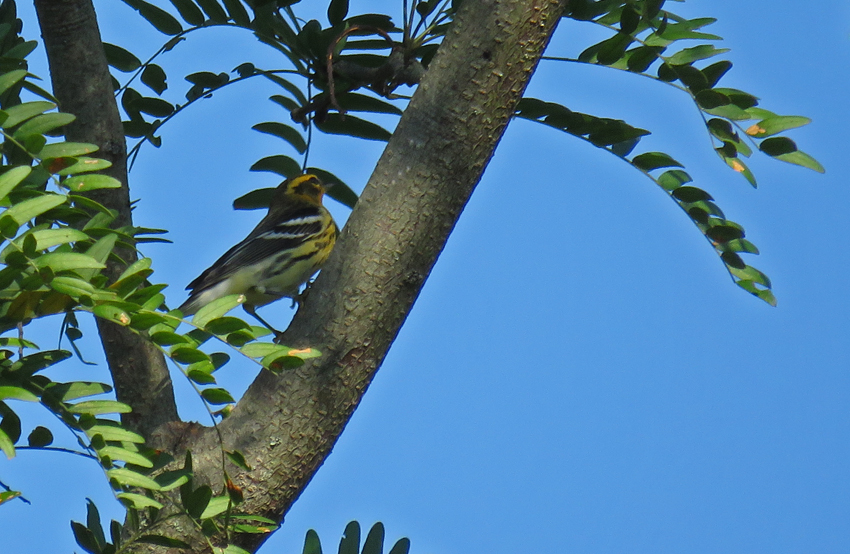
| Blackburnian Warbler |
I started birding about the same time. In fact, I wanted to use the blog to help prove which birds I had actually seen. This morning, I joined the Beckham Bird Club on our annual Breakfast with the Birds outing. We went to
Turkey Run, one of the newly opened areas of the The Parklands. This year we started our Green Breakfast, with everyone bringing their own eating and drinking utensils so we didn't have to throw anything away. Going out with a group of experienced birders is always a benefit to me. On my own, I may hear birds, recognize the song but not be able to find the bird in the trees. Or I see it, do not recognize the song and am left in great frustration. This morning, I kept saying, "How in the world did he
see that bird?"
 |
| Blackburnian Warbler |
Warblers are my great nemesis. Today, Pat, Jane and Rob found Blackburnian, Hooded, Black and White Warblers, and maybe some others I don't remember. Sigh.
 |
| Scarlet Tanager Female |
Then, of course, there are the juvenile and females that don't look like what I expect, since I always picture the male featured in the field guide. Yes, indeedy, you need to learn the females, juveniles, and males in winter plumage, along with the trees they might be perched in.
 |
| Do you see a bird? |
We kept hearing White-eyed Vireos calling to each other as we walked down the trail, but they are skulkers and dart quickly from tree to tree to avoid being seen. Rob is our expert on bird calls. We finally found this one and I actually saw it in binoculars. Birders have to be patient, and my friends are always willing to work with any birder who hasn't seen the current attraction.
 |
| White-eyed Vireo |
I always say that bird photography is an act of faith. You have to find the bird with binocs, then find it in your camera lens, then focus and click, all before it moves to the next branch. Well, 3 out of 4 isn't bad. This guy is a little out of focus, but it's the first photo I've ever taken of a White-eyed Vireo, so I'm content. I like to learn mnemonics to help me remember a call. Found
Spit and see if I care. Spit! and
Quick, give me a rain check! for this one.
 |
| Turkey Vulture |
The Turkey Vulture is one of my favorite birds because it's large enough to be easily seen, and doesn't hide in the tree branches, but flies right out in the open for good photographs!
 |
| Ripe Persimmons |
Of course, if the birds aren't cooperating, I always like to take photos of the plants. They, at least, aren't going to fly away!