Monday, April 17, 2017

Tantalizing Tanagers

Summer Tanager molting
Scarlet Tanager
 In Kentucky, we have two kinds of tanagers, the Summer and the Scarlet, and it's always a thrill to see one. In Costa Rica, however, we sighted 13 tanager species of a total of 20 on our checklist. I never knew they could come in so many brilliant colors!
Blue-gay Tanager
The Blue-gray Tanager was our first, found in the gardens at Hotel Bougainvillea in San Jose. When sitting in the sun, he is a bright blue, but appears to be a drab gray in the shade.
Plain Tanager
The Plain Tanager and the Palm Tanager are similar, and I think I have the right name on this one. It can be hard to remember a week after sighting the bird.
Flame-colored Tanager - male
Flame-colored Tanager - female
The Flame-colored Tanagers were abundant around the Savegre Lodge in the mountains, coming down to eat bananas at the feeders each morning.
Crimson-collaredTanager
We found two different black and red tanagers with white beaks, and it's easy to get them confused. The Crimson-collared has, of course, red around his neck...
Passerini's Tanager
...while the Passerini's Tanager has a red rump. Not many birds in Costa Rica are named after people, but this is one. Both live in the same habitat.
Golden-hooded Tanager
Here's where you get dazzled by bright feathers - the Golden-hooded Tanager...
Silver-throated Tanager
...and the Silver-throated Tanager. There was another, the Spangle-cheeked Tanager which sparkled in the sun, but I didn't get a photo of it. It's hard to decide which birds are my favorite from the trip, but the Tanagers are right up there at the top.

Sunday, April 16, 2017

Bright Hummingbirds

Magnificent and Fiery-throated Hummingbirds
When you go to the tropics, you expect to see lots of colorful hummingbirds, and you won't be disappointed! We saw at least 18 species of hummers, and sometimes it is hard to tell them apart. Different species lived at the higher altitudes around Sagreve Mountain Lodge - from 7,200 to 10,000 feet. In the shade, they all look the same, but when they turn into the sun, the brilliant iridescent colors will amaze you.
Lesser Violetear
 The Lesser Violetear is one of the easier birds to identify, with the patch of violet on an otherwise green head and body. Found in the highlands.
Magnificent Hummingbird
The Magnificent Hummingbird is also found in the highlands. When the sun is just right, the top of his head turns purple while his throat is bright turquoise. He is larger than the other hummers in the area.
Magnificent Hummingbird on Nest
In Kentucky, our little Ruby-throated Hummingbirds build small nests on a branch and are almost invisible. This female Magnificent builds a much larger nest, this time under a roof, so her little ones won't get wet when it rains.
Magnificent Hummer investigating orange nails
All you have to do is put out a few feeders to attract many birds to your yard in Costa Rica. They are fearless and will zoom between people standing in their way to chase another bird from their favorite feeder. I tried holding out my orange finger nails, and several birds came to investigate. This little guy came and tapped on my nail to see if it was a flower.
If the line is too long at the feeder, some will reach down from a nearby twig for a quick drink.
Snowcap Hummingbird
In the Carribean foothills around Rancho Naturalista, about 3,000 feet in elevation, the tiny 2 inch Snowcap is a harder bird to find. Being so small, he tries to keep away from the many larger bullies at the feeders.
White-necked Jacobin
The Jacobin is one of the more aggressive birds at the feeders, but very easy to identify with the white spot on the back of the neck and brilliant white feathers when he spreads his tail. He is more a shiny navy blue than green. The tail spread seems to be a warning for whatever bird he wants to argue with, such as the Rufous-tailed Hummingbird.
Rufous-tailed Hummingbird
The Rufous-tailed also fans his rufous tail as a warning, before taking after the Jacobin to chase him away.
Rufous-tailed Hummingbird
In addition to the rufous tail, this little guy has a rufous beak as well, and is very common in gardens of the middle elevations.
White-throated Mountain Gem
Volcano Hummingbird
 The Mountain Gem is about 5 inches compared to the little Volcano at only 2 inches. 
Green-breasted Mango female
To me, most of the female hummers look very much alike with green backs, and white bellies. This Mango female is quite distinctive though, with a prominent dark stripe down her throat and belly, making her easier to identify than the male.

Saturday, April 15, 2017

Costa Rica Birding

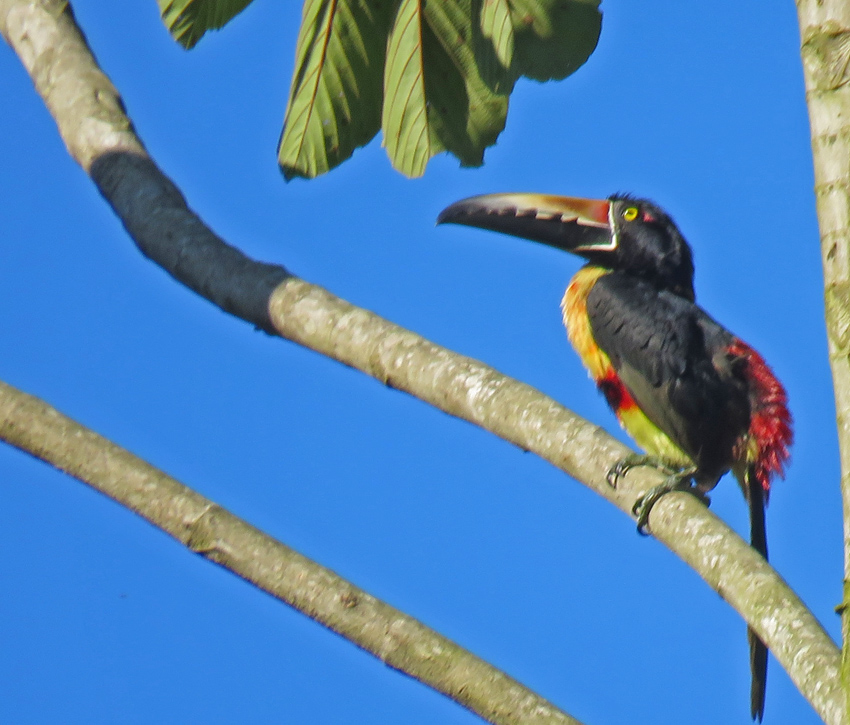
Collared Aracari


We just returned from a wonderful week of birding in Costa Rica - our first time there.  I have worked on my photos all day (except for a much needed nap in the afternoon) and hardly know where to begin on blogging for this trip. We traveled with Wildside Nature Tours, the group that gave us such a great trip to the Galapagos several years ago. Our guide, Glenn Crawford, was absolutely phenomenal! The man has telescopic eyes and an eidetic memory. He knows the calls of about 1,000 birds, which is really useful when you are searching for them in the thick old growth forests of Costa Rica. He can tell the difference between the birds and the frogs. 


 Our driver, Lenny, is the bravest man I've ever met. The roads in Costa Rica are narrow, twisty, windy, and full of turns! But Lenny drove our bus up and down the mountains, taking those sharp switchback turns without blinking an eye, while I was holding my breath all the time. I would never try to make this trip if I had to do the driving! Being passed on such a road by a huge dump truck is quite an experience!
Fiery Throated Hummingbird
Of course, I will talk about the birds and share photos of them, which is the underlying purpose of this blog. I expected to see lots of bright colored tropical birds, which we found, of course. I was surprised, however, that more birds were shades of gray and black, giving them perfect camouflage in the dark reaches of the forest. Those birds were much harder to find.

Rufous-collared Sparrow


Sunrise and sunset in Costa Rica are around 5:30-ish both am and pm. We were in deep valleys, so the full daylight was a little less than this. We usually met at 6:00 am for a short bird walk before breakfast. After breakfast we went out for a 3 hour tour, then back to eat lunch, followed by a siesta. I never got a nap or enough time to work with my photos during siesta. Then out again around 3 until it got too dark to see. It was usually sunny in the morning, with clouds building up by noon. Scattered showers were a possibility any afternoon, but we only got caught once.

Rancho Naturalista Dining Room

And the food! I should have put on about 10 pounds from all the wonderful food I ate three times a day, but fortunately did not. Our Belgian chef at Savegre Mountain Lodge put out a fantastic buffet for each meal and always came by to make sure we had enough. At Rancho Naturalista, the meals were served family style with plenty to go around.
Fiery-throated Hummingbird


On travel days, we stopped for lunch at restaurants with good food for us, and feeding stations for the birds. Glenn had a hard time getting us back on the bus. We wanted to see more birds since we didn't have to hike anywhere for them, or peer between the leaves of trees to see them! It was birding paradise!
Blue-gray Tanager
Wildside printed up a 28 page checklist for us to use on the trip. Every evening after dinner, Glenn reviewed the birds we had seen or heard that day. Many of them I just marked with a G since Glenn heard and saw many more birds than I did. According to my numbers, he/we saw a total of 272 birds. Dick and I had 189 birds, of which 159 were lifers for us! During the first part of the week, I was madly trying to write them down in a little notebook - illegible and spelled wrong. Some of our birders used an app for birds of Costa Rica on their phones. I got it download, and it made things much faster. Then I could actually see what the little brown bird that Glenn found actually looked like, including its call.

Sunday, March 12, 2017

NAI Sunny South Conference

Dick and I belong to the National Association of Interpreters. When I tell people this, the first thing they ask is how many languages I speak. I smile and say I speak the language of Nature, and my job is to help people understand and relate to nature. The Sunny South includes interpreters from the southeastern part of the country, and most of them work for parks of some sort, although this year we had several people from zoos as well. Each state in the region takes turns hosting an annual conference where the interpreters can refresh their goals and skills. In fact, we both were presenters at this year's conference, and it was a challenge to prepare a 45 minute presentation using skills I haven't intentionally used for several years. You know, we all get into habits and just do things the same way. I was afraid no one would come to my presentation on raptors, but 13 people attended. Whew!
Kentucky Glade Cress
 In additional to sitting in a room, we had opportunities for several field trips. We went to look at some Bullitt County glades. A "glade" is an area of very poor soil surrounded by limestone in which little will grow. However, a few glades in Bullitt and Jefferson Counties are the only place in the WORLD where you can find Kentucky Glade Cress. It is a very small plant that only grows in this poor soil that is dry and hot much of the year. This glade belongs to the Kentucky State Nature Preserves, so it is protected. Our reason to visit it was to discuss what to do with it. On one hand, it would be nice to let people come and see this rare plant. On the other hand, you don't want people tramping on it, which they would since it is so small and hard to identify. On the other hand, if protected too well, the cedar trees and other plants will take over the area, making it too "nice" for this tough little plant to grow.
Purple Cress
No trails in the preserve, so we bushwhacked down to the creek to see what might be popping up in the early spring, accompanied by a neighbor's dogs. The creek was lovely, singing it's way down the valley. Purple cress was full of buds and ready to bloom, but on Saturday, the temps dropped back to winter ranges.
The Bullitt County limestone has a lot of magnesium in it, but wears down from the acidic rainfall.
Gypsum Flowers
On Thursday, I took the all day trip to Mammoth Cave since I haven't been there for years. The park ranger led us into the man-made back door of the cave system and down 200 steps into Cleaveland Cave. This is a dry cave without the features most people expect. Sandstone caps over the limestone keep rainwater from percolating through. This cave is the dried out river bed of a stream that now runs lower underground. We were about 260 feet below the surface. However, the ceilings were covered by gypsum growing through small cracks, and curling into beautiful flower formations. The ranger did a great job interpreting both the geological aspects of the cave, and the history. Tours started in 1816, led by Stephen Bishop, a slave. The graffiti on the walls is not from modern visitors, but from people touring before it became a National Park in 1941. The sooty coloring of the gypsum is from torch and lantern smoke.

We walked on a nice smooth path created by the Civilian Conservation Corps  in the 1930's, and I could not imaging walking across all the chunks of stone on the floor of the tunnel. Mammoth Cave is at least 400 miles long, and they are still exploring it. When Bishop explored the cave, he would write his name and the date on the walls, to indicate his path back out again.

Nick was another slave who explored and led tourists into Mammoth Cave. Here is a tribute to him from 1857. My cell phone took better pictures in the poor lighting than my good camera did. Glad I had both. Three days later, my calves are still aching from the climb up and down all those stairs!
After lunch, we went on another ranger led hike to Holton Cemetery, which is not open to the public, to learn about the people who lived in the area. When ever you see daffodils blooming, you know there used to be a homestead. The rangers made these people who were forced from their homes come alive for us. I was struck by the isolation of the home sites. Imagine trying to give birth with no one closer than a mile away. There were no nearby towns.
Ky State Champion White Pine Tree
We were introduced to Edley “Red Buck” Esters (1883-1969), who once owned and eventually sold his acreage to the park in the mid 1930s. His living memorial pine tree (planted about 100 years ago) now measures nearly 12 feet in circumference and stands 13 stories high. Red Buck was known for his "hollerin" either to call in the live stock, or sing really loud. The ranger had an old recording of Red Buck made during a Mammoth Cave homecoming many years ago. As the park staff finds these old cemeteries, or names inside the cave, they do historical research that makes these individuals come alive to park visitors. In fact, there are cemetery databases where they can be traced. These conferences are always great fun. Next year's will be on the Outer Banks of North Carolina, and we plan to attend.

Wednesday, February 01, 2017

Florida Raptors

When we come to Florida for birding, we normally think of gulls and various shore and wading birds, which we saw lots of this trip, of course.
But I really enjoyed all the different raptors we found. Someone said that Florida has the third highest population of Bald Eagles in the country, after Alaska and Minnesota.
This is the beginning of mating season for many birds. Kentucky Eagles are starting to nest as well, but not many of the other birds.
Vultures, both Black and Turkey Vultures can be seen everywhere, rising in kettles.
When I see those large groups, I imagine that there may be a landfill nearby.
Apparently Florida Ospreys don't migrate to South America with the more northern birds. We saw lots of them both over the ocean and in the many estuaries and rivers. We even saw a pair building a nest in the parking lot at Walmart's!
 Red-shouldered Hawk are the predominant hawk in Florida, but their breasts are a paler rust than ours at home.
But I was most excited to find raptors we do not have in Kentucky. This Caraca walked across a field then flew up to a cabbage palm where it was working on a nest.
A Merlin flew into a tree with a grackle in his talons and we watched him eat lunch then fly away.
And Kestrels were everywhere, but no Peregrines on this trip.


Snail Kites are another endangered species in Florida, but we had wonderful looks at them. One mail was eating a big snail, while a female perched quietly in a tree. Just look at the long curved beaks used to dig the snails out of their shells. At Raptor Rehab we would be ready to cope that beak.
Northern Harriers soared by regularly, but never landed where I could get a good look at them.
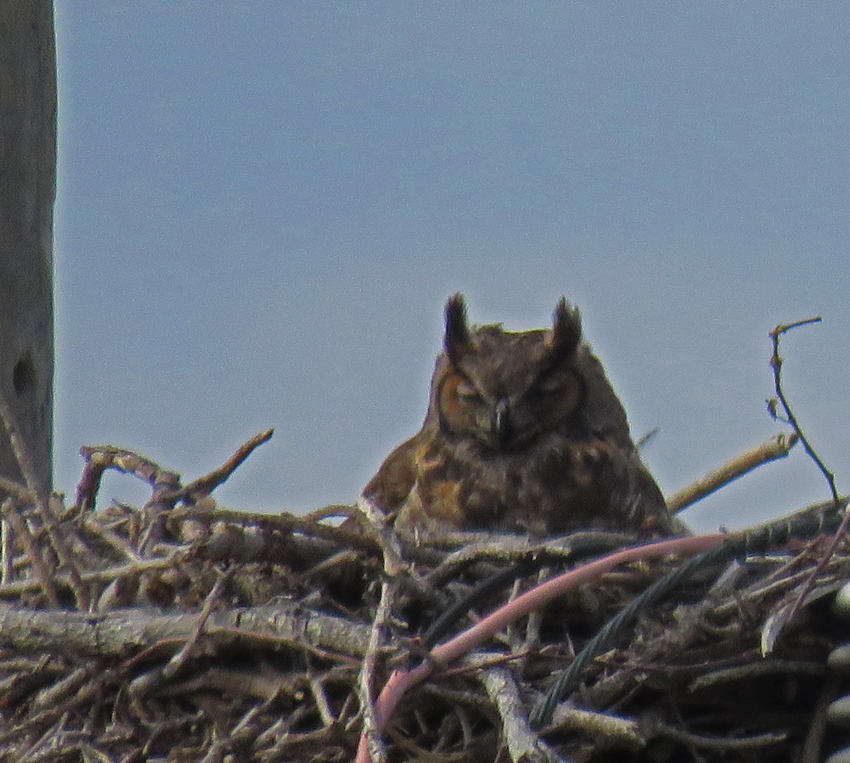
We even saw some owls! This Great Horned Owl had taken over an Osprey nest and was sitting on eggs with her eyes shut in the bright sun. A Barn Owl was nesting in a maintenance building and flew out when someone went to check on the chicks which have already hatched. It's been a wonderful week for a raptor fan like myself!