Sunday, March 21, 2021

Heron Rookery

 
 What is a rookery? These are Great Blue Herons nesting in a colony, yet it always called a "rookry." Once again the Internet comes up with a answer.  The term rookery originated because of the perceived similarities between a city slum and the nesting habits of the rook, a bird in the crow family. Rooks nest in large, noisy colonies consisting of multiple nests, often untidily crammed into a close group of treetops called a rookery.
  
On March 7, we arranged to meet a friend who is an experienced canoeist, and agreed to take us upstream on Harrad's Creek (the backyard creek of his house). We wanted to see the heron rookery, which we had missed last spring. With trepidation I managed to climb into the canoe without tipping either it or myself into the cold water and we set off. I should be OK until it's time to climb out again.We avoided getting smacked in the face by any branches and finally reached the main course of Harrod's Creek, swollen high by the flooding Ohio River.
At first I saw one or two nests made of branches...

...then I glanced to the left and saw many more nests in bare trees over the water. Actually, I didn't really expect the nests to have birds on them this early in the year.  Not  sure if they were sitting on eggs yet, or just getting things ready. David said there were over 80 nests several years ago, but the numbers keep dropping. Perhaps they regret their loss of privacy.


The places where we hiked to bird last spring were all under water, and we didn't see too many species. But we got a fine view of this Red-shouldered Hawk flying off with a mouse for his afternoon snack.

Monday, March 08, 2021

Sandhill Cranes on the Move


"Ka-roooo!" In Central Kentucky, including Louisville, the cry goes out, "I hear Sandhills!" and all the birders rush outside, binoculars in hand.  In November, these large birds migrate south, and in February, they are ready to head back north again. We wonder why they bother to migrate at all sometimes.
Sandhill Cranes

On Feb 11, as the snow started to melt, we decided it was safe to leave home, and went to look for cranes at the Cecilia fire station, situated in the middle of Hardin County farmlands. We found absolutely THOUSANDS of them foraging. These cranes are omnivorous, although in our area they tend to feed in corn stubble, avoiding the soy bean fields. Snow doesn't seem to bother them. 

The range map shows them as mostly a western/central bird, the Greater Sandhill subspecies. But the Lesser Sandhills migrate right across our area in Kentucky. Unfortunately, they have a reputation as the "rib-eye of the sky," and hunting is permitted in Kentucky and Tennessee during a limited time. Every year we hear reports that Whooping Cranes have also been shot.

Adult cranes have grey feathers. They paint them with iron-laden mud and vegetation to turn them rust-color for camouflage during breeding season. They have a bright red skin patch on their forehead. We always look for a large white crane with the flocks, since Whooping Cranes sometimes travel with the Sandhills. Look closely though, because the sun can make them look white when they aren't. The red forehead will give a positive ID.

Sandhill Cranes mate for life, choosing their partners based on dancing displays. Displaying birds stretch their wings, pump their heads, bow, and leap into the air. Although each female usually lays two eggs, only one nestling typically survives to fledge.
During migration and winter the family units group together with other families and nonbreeders, forming loose roosting and feeding flocks—in some places numbering in the tens of thousands.

Marshland Elegyis a chapter in A Sand County Almanac and sketches here and there,where Aldo Leopold tells the story of the noble Crane and of how the crane marsh has been displaced by the short-sighted and wasteful ‘progress’ of human beings.
In the 1930s, Sandhill cranes were generally extirpated east of the Mississippi River but their populations have recovered with there being an estimated 98,000 in the region in 2018, a substantial increase over the previous year. The greater sandhill crane proper initially suffered most; by 1940, probably fewer than 1,000 birds remained. Populations have since increased greatly again. At nearly 100,000, they are still fewer than the lesser sandhill crane, which, at about 400,000 individuals continent-wide, is the most plentiful crane alive today.

Friday, February 26, 2021

Winter Ducks

 
Generally, we don't get big freezes in Kentucky. But when we do, you can always count on seeing a lot of ducks. If the lakes and rivers they normally inhabit farther north are frozen, they can still find open water in Kentucky.
Canada Geese
Although Canada Geese still migrate, many geese have decided to stay in Kentucky year-round. If it gets cold, they can tough it out. And the cold spell doesn't last too long. Just tuck your beak and one foot in your feathers and you can stay warm.
 
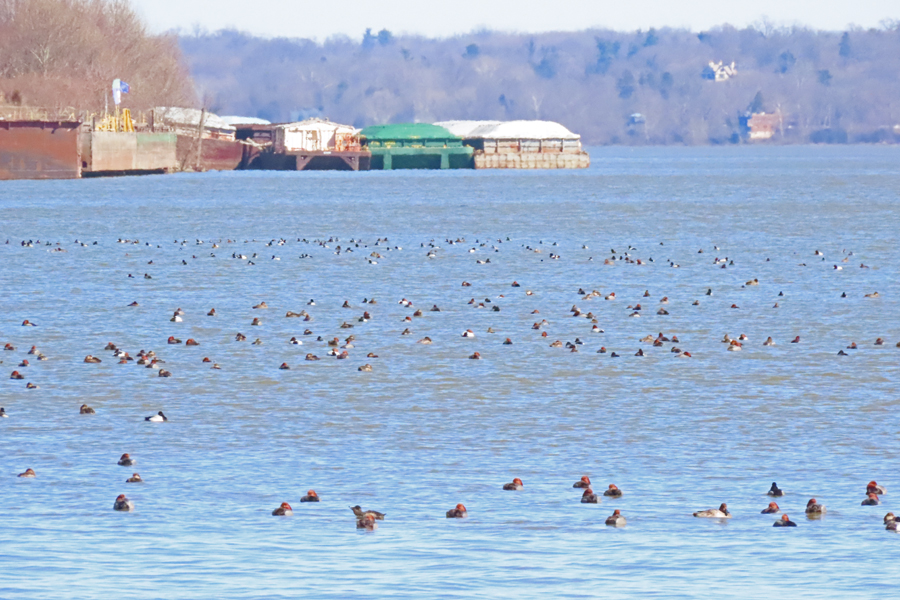
Redhead Ducks
Diving ducks, also called sea ducks, are typically birds of large, deep lakes and rivers, coastal bays and inlets. Their speculums (on the wings) lack the brilliance of those on most dabblers. Most patter along the water in taking wing. They all dive for food, whereas dabblers rarely dive. They also have a more rapid wingbeat than most dabblers. So what are these diving ducks doing on a small open patch of an otherwise frozen lake?

Northern Shovelers
Dabbling ducks, or puddle ducks, frequent shallow waters such as flooded fields and marshes. They feed by tipping up rather than diving. When taking flight, they spring into the air instead of pattering across the water. Most swim with their tail held clear of the water and have colorful, iridescent speculum (a rectangular patch at the hind edge of the wing). Since everyone is cold with heads tucked under their wings, you can't rely on the head color for identification. Check the body colors instead. The rusty stomach on this group indicates Northern Shovelers.

Mute Swans and Mallards
The brown stuff on the ice? Bird poop I think.
Mute Swans in flight
Mute Swans have a a bright orange beak, making them easier to identify than the native swans. Mute swans were imported into America, and many have escaped into the wild.

The Ohio River is always a good place to look for ducks in the winter. Jeffersonville, IN, has a Fisherman's Wharf along the water which is the place to start. No driftwood to try to peer over or around! This huge raft of ducks is on the upstream end, and you would need a spotting scope to tell the birds apart.

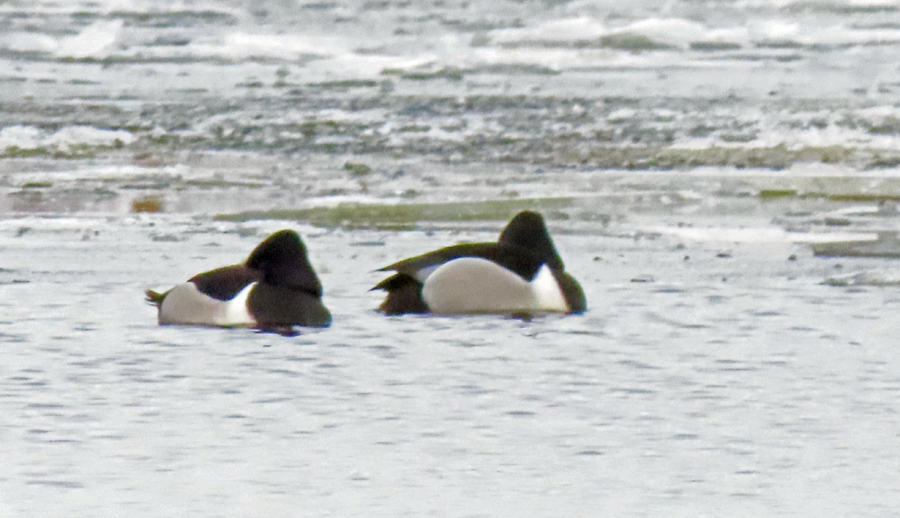
Lesser Scaup
Either bring a field guide along, or take photos of these ducks. Since we don't see them all year,  it's a challenge to differentiate them. You will find white or gray in different locations of the body. Many have red heads, so you can't rely on that alone. Scaup and Ring-necked Ducks are similar at a distance.
Lesser Scaup female
 The Lesser Scaup female is also similar to the female Ring-necked Duck. Of course, you can't see a ring around the neck at all, so I don't know why they are called this!

Ring-billes Gull
Some of my really good birder buddies can tell the difference between species of gulls who come to the Ohio from Northern frozen waters. I usually guess they are Ring-billed Gulls, but you can't see the bill unless they are perched or floating on the water. In flight, you only see the wings.
Ring-necked Ducks
Rings around the necks? No way. But the male Ring-necked Ducks do have a white crescent just below their shoulders and a ring around the bill. I tend to call them Ring-billed Ducks.
Ruddy Duck males winter feathers
And remember, the males of a bird you think you know can change colors in the winter. All these are male Ruddy Ducks, without the stiff tail that stands up straight. 

Eared Grebe in winter feathers
I hard there were some Loons on the river, and thought this was one of them. Closer examination of the photo showed a very short bill, unlike the Loons. Aha, it's not a duck or loon at all, but some kind of Grebe! It has a bright red eye, and a thin white bill. An Eared Grebe, and the first I've seen in winter feathers! 

Thursday, February 25, 2021

Wine and Short-eared Owls

On January 21, it hadn't started to sleet or snow yet. We saw postings from Ky Birders about a Short-eared Owl at Talon Winery on the south side of Lexington. Thinking that the winery should be fairly empty on a Thursday afternoon, we headed down I-64 to Lexington, planning to have a little wine, then watch for the owl. As it turned out, there was a good sized crowd in the tasting room, but everyone kept their distance. The largest group took themselves outside to drink and talk.

Short-eared Owls breed in the far north, but come to Kentucky in the winter, favoring open grasslands. In other years, I have found them at the old Paradise coal mine site, and at a farm somewhere between E-town and Leitchfield. Other notices this year found them near Paris as well as Lexington. The best thing is that they come out to hunt about half-an-hour before sunset, and there us usually enough light for good photos. You can often find Northern Harrier Hawks in the same location.
As sunset approached, we walked around many of the open fields, but the wind made it pretty cold, so we decided to sit in the car instead. We couldn't tell which field to look in, but another car was sitting in the parking lot, and it looked like the lady had a camera. "She's here for the owl too," I thought, and sure enough the owl swooped out of the fence row. There was no place for it to land, so it just flew low over the grass. Look how long its wings are! This one made no noise while we were there, but a recording has them making a barking kind of sound rather than a hoot. It didn't take long for the sun to dip below the horizon and we started home. After cataract surgery and lens implants, I find it difficult to drive at night any more. My pupils open bigger than the lens, so the lens edge captures any available light, making huge halos around car lights, stop lights, etc. I'll have to think about going out at sunset again.

Tuesday, February 23, 2021

Oh the Pandemic!

Oh, the Pandemic! In reviewing this blog, I find that I posted a lot during the spring migration of 2020. There were good birds, and I figured I didn't need to wear a mask outside birding, right? The rest of 2020 was a big flop as far as birding and blogging went. We had a big debate about having the whole family (all ten of them) for Christmas. Mostly I just sat in the chair vegetating for months. It's hard to keep track of time when you go nowhere and do nothing.  

The annual Great Backyard Bird Count was scheduled for Saturday, February 13. Louisville Audubon Society partners with Creasey Mahan Nature Preserve for this event, and we decided (in a Zoom board meeting) that we could still do it, by eliminating the part inside and asking everyone to wear masks on the bird walk. However, as the date approached, the weather forecast was terrible, predicting low temperatures in the single digits or teens, so we decided to cancel it for that date. Instead, we used our Facebook page to encourage everyone to participate on their own, posting photos of common winter birds. I was amazed at the reception - more people than normally view that page on FB. Guess they likd my photos.


However, that Saturday, the 13th, was the beginning of our big winter storms. Kentucky wasn't hit as much as Texas, and we didn't lose power at our house (thank heavens!) I would wake up in the night worrying about what to do if the power went out. You can put lighted candles under terracotta pots to help heat a room, but do we have any pots? Looking back at a calendar, the storms and cold only lasted a little over a week. If you asked me how long it was, I would have said about three weeks! We started with a layer of ice, then about 2 inches of snow. Once the roads were cleared it dropped another 2 inches of snow. Dick was brave and went to the YMCA for yoga when he could, and tried to get me to the Mall to walk whenever he could persuade me (not much that is). By the 21st, temperatures started rising above freezing, and life resumed it's regular patterns. Some friends continued to bird throughout this cold-snap, posting beautiful photos. I don't see how they did it. Oh, we finally got reservations for our COVID vaccines on March 2. That was a source of anxiety too. We'll start making some travel plans for later this year. Sigh!

Rare Bird Sightings

Western Grebe on Ohio River
News of a rare bird is the joy and downfall of any birder. Email lists will advise subscribers of something unusual, and hopefully, where it was last sighted. Then the rush begins, depending how rare the bird is. On January 21, 2021, we saw a notice that a Western Grebe had been spotted on the Ohio, and could be found from the benches at Garvin Brown Preserve. We drove out with the spotting scope to scan the river, a challenging task, since it involved looking at each piece of driftwood floating in the water! Finally, we located the bird waaay upstream from our location, and impossible to photograph. A day or two later, it was spotted downstream a bit, to we tried again, and finally found it about 2/3 across the river, but I got a somewhat fuzzy photo. The Western Grebe is commonly found from Canada through California, and sometimes in Mexico. It usually occurs in the great plains and western states, but only occasionally can be found in the eastern half of the United States. So how did it get this far east? And what birder was looking in the river to notice it?

Peregrine Falcon
On the same trip, we passed a Peregrine Falcon digesting her breakfast. Notice the big lump on her breast? That's her crop. Peregrines are not rare birds, neither are they considered as common birds.

White-faced Ibis
Last spring, the word went out for the sighting of a White-faced Ibis at Hays Kennedy Park, which you must walk through to reach Garvin Brown. This is also a bird of the far West and down into Mexico. Why would it come to the Ohio River in Kentucky, and who in town was there to find it? A friend of mine explained it quite simply.  They have wings and can fly wherever they want!

Western Tanager
I found an article at https://morebirds.com/blogs/news/why-weird-birds-show-up-in-unexpected-places 
which explains this phenomenon pretty well. A vagrant is a wild bird found well outside its expected range. These are usually solitary sightings, with just one bird wowing birders who are lucky enough to find it. Vagrants may arrive at their unusual destinations because of storms, faulty navigation during migration, or simply wandering much further afield than expected. When more spectacular vagrants appear, birders travel significant distances to see them. High-profile vagrant sightings can even make the news. Someone in Kentucky had a Western Tanager in her yard last year.

A bird irruption is a massive movement of birds outside their usual range. This is typically a winter phenomenon, when northern birds such as Evening Grosbeaks, Bohemian Waxwings, or Common Redpolls suddenly appear much further south than typical. These birds have been sighted in Kebtucky this winter, but I haven't found them. This movement is often tied to food supplies or population increases, forcing more birds south to find enough resources for survival. When an irruption happens, birders may not need to travel to see these unexpected birds because the birds come to them.

Bob White
Sometimes a bird that used to be considered as common becomes so rarely sighted, that we have the same excitement at finding it as if it had flown in from Siberia, such as the little Bob White. 

Friday, June 12, 2020

Return to Bernheim?

Morning light in the forest
Dick has volunteered at Bernheim Forest and Arboretum since 2005, working sometimes with the horticulture group, planting and weeding (like he doesn't do enough of that at home?) but mostly interacting with visitors, talking to them about the wonders of nature. Last year this time, he would be at Bernheim 3-4 days a week. But last March, as the coronavirus pandemic grew, Bernheim decided to close altogether during the crisis. The crowds of people coming to see the Forest Giants just couldn't be controlled. It would be safer for all, they decided, to just lock the gates until things changed, a disappointing but understandable decision. Many of the employees have been working from home most of the time as well. Volunteer training has continued via Zoom meetings online. Dick and I helped at one just last week.The volunteers have been recording short videos of why they love nature and Bernheim. They are trying to keep their name out there, but no one can come in.
Daisy with bugs
This morning, however, Dick went out to film a video on site, and they invited me to come along and we could go birding afterwards. Dick said it felt like making a pilgrimage to return there even for just one day. After all, the whole migration season was missed by every birder! No reports to eBird from Bernheim!
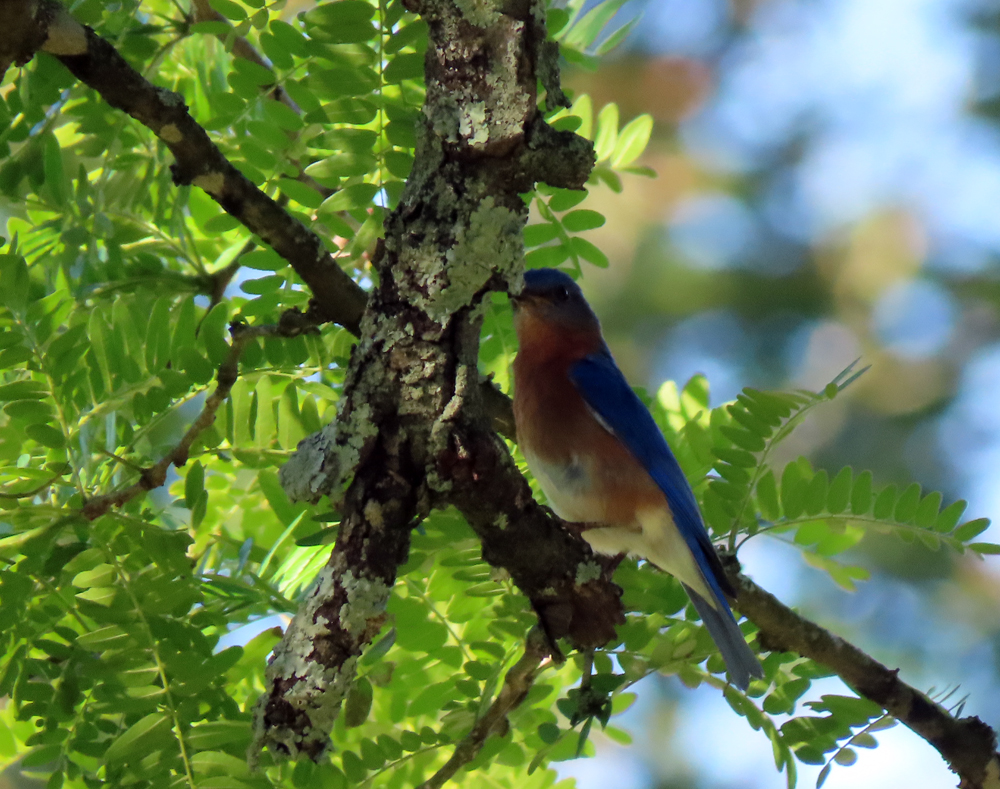
Bluebird
As we parked the car in the shade on a cloudless blue-sky morning, we were greeted by a Bluebird who probably lives out in the big meadow.
Gray Catbird
Instead of hiding in the bushes, this Catbird called and followed us around the area near the silos for over an hour, just to see what we were up to, I think. Maybe he missed having an audience.
"Barn Owls"
I used to see Flicker woodpeckers nesting in the sycamore trees every spring, but none were there today. In fact, I have seen NO Flickers at all this spring, wherever we went birding. We did find this pair of "Barn Owl" nuts on a table.
Red-eared Slider at Kingfisher Pond
 Kingfisher Pond is too small to attract any real Kingfishers, but this 9-10 inch long slider was quite comfortable, despite all the duck weed on his back.
Barn Swallow hatchlings

Barn Swallow chicks
Almost ready to fledge

Barn Swallow adult at nest
Every year, Barn Swallows build their nests of mud under the porch roof of a building near Lake Nevin. The adults were busy flying around catching bugs, but we counted at least 22 nests with chicks of various ages. One of my favorite times and places.
Purple Martin Apartments
 Bernheim has hosted Purple Martins for many years. A volunteer keeps up with keeping them clean and ready when they arrive from the south.
Hanging around the apartment building
Iridescent Purple Martins
 Martins chatter incessantly as they catch air-borne bugs, when when they land, you can see how long their wings are and how they shine in the sunshine.
Tree Swallow
One of those shiny birds, however, was not a Martin but a Tree Swallow, who also nests in cavities. The Martin volunteer said that they were here before the Martins arrived, and wouldn't leave. Unusual, isn't it.
Green Darner
Lambs Ear and bee
Purple Coneflower and pollinators
Widow Skimmer dragonfly
 On of the things I enjoy about Bernheim is the variety of habitats, from dense forests, to streams and lakes, and the Big Meadow grasslands. Each is home to a variety of plants and animals.
Field Sparrow
Although the Field Sparrow normally stays hidden in the grass, this guy came bravely up to the top of a flower to serenade us with his bouncing ping-pong ball song. It's always a challenge to get a photo of one.
Green Heron
 The Edible Garden is a big vegetable garden, operated in a completely sustainable manner. It uses solar power where power is needed, and recycles all water. The garden beds are elevated so they can be reached by everyone, including handicapped visitors. They have bee hives to pollinate all the plants. When Isaacs' Cafe is open, all the fruits and vegetables served there are raised in the garden right across the road.
Green Heron in tree
Although I was trying to photograph nonstop dragonflies, a large bird flying across the pond caught my eye. It was a Green Heron, moving from his place of concealment along the pond's edge to an open space on a big tree!
Red-tailed Hawk
I am always excited to find raptors, no mater where we are birding. This big Red-tail was perched in a pine tree, and we ended up walking all the way around it before getting a good view of her face. She was keeping an eye on the meadow for something yummy for lunch.
Indigo Bunting
We hope that Bernheim will be able to re-open soon. Many other nature preserves have remained open for hikers, although all buildings and playgrounds are closed. Perhaps if they could find a way to close off the Giants...